AGCO Corporation

AGCO Corporation (AGCO) Market Cap

AGCO Corporation has a market capitalization of .

No quote data available.

CEO: Eric Hansotia

Sector: Industrials

Industry: Agricultural - Machinery

IPO Date: 1992-04-16

Website: https://www.agcocorp.com

AGCO Corporation (AGCO) - Company Information

Market Cap: -|Sector: Industrials

Company Profile

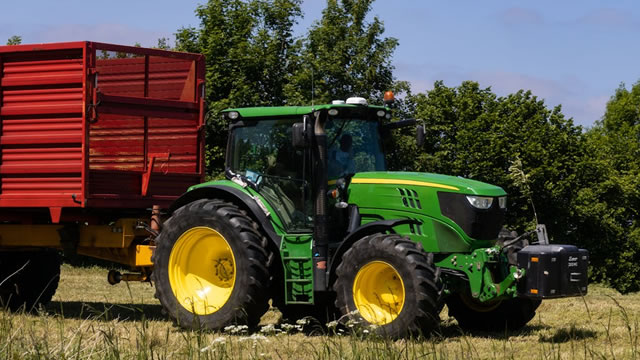
AGCO Corporation manufactures and distributes agricultural equipment and related replacement parts worldwide. It offers horsepower tractors for row crop production, soil cultivation, planting, land leveling, seeding, and commercial hay operations; utility tractors for small- and medium-sized farms, as well as for dairy, livestock, orchards, and vineyards; and compact tractors for small farms, specialty agricultural industries, landscaping, equestrian, and residential uses. The company also provides grain storage bins and related drying and handling equipment systems; seed-processing systems; swine and poultry feed storage and delivery; ventilation and watering systems; and egg production systems and broiler production equipment. In addition, it offers round and rectangular balers, loader wagons, self-propelled windrowers, forage harvesters, disc mowers, spreaders, rakes, tedders, and mower conditioners for harvesting and packaging vegetative feeds used in the beef cattle, dairy, horse, and renewable fuel industries. Further, the company provides implements, including disc harrows leveling seed beds and mixing chemicals with the soils; heavy tillage to break up soil and mix crop residue into topsoil; field cultivators that prepare smooth seed bed and destroy weeds; drills for small grain seeding; planters and other planting equipment; and loaders. Additionally, it offers combines for harvesting grain crops, such as corn, wheat, soybeans, and rice; and application equipment, such as self-propelled, three- and four-wheeled vehicles, and related equipment for liquid and dry fertilizers and crop protection chemicals, and for after crops emerge from the ground, as well as produces diesel engines, gears, and generating sets. The company markets its products under the Challenger, Fendt, GSI, Massey Ferguson, and Valtra brands through a network of independent dealers and distributors. AGCO Corporation was founded in 1990 and is headquartered in Duluth, Georgia.

Analyst Sentiment

58%
Buy

From 15 Active Polls

1Y Forecast: $124.63

▲ +0.0% Potential Upside

Consensus Target Metrics

Low Bound

$105

Median

$126

High Bound

$152

Average

$125

Price & Moving Averages

Loading chart...

🎯 Wall Street Analyst Intelligence Report

1-Year structural target targets, chart projections, and sentiment maps.

Average 1Y Target
$124.63
▲ +7.06% Upside
Low Target
$105.00
-10% Risk
Median Target
$125.50
8% Mid
High Target
$152.00
31% Max

Consensus Trend Projection

Trailing closures vs. 12-month metrics map.

Analyst Vote Distribution

Aggregate institutional coverage sentiment weights.

Sentiment volume allocation data unavailable.

Historical valuation matrix unavailable.

📘 Full Research Report

ℹ️

AI-Generated Research: This report is for informational purposes only.

📘 AGCO CORP (AGCO) — Investment Overview

🧩 Business Model Overview

AGCO designs and manufactures agricultural equipment, including tractors, combines, hay tools, and associated implements, then distributes products through a global network of independent dealers. The dealer channel is central to the business model: dealers provide sales coverage, financing introductions, and—critically—ongoing service and parts support.

The long-term value creation mechanism is the installed base dynamic. After tractors and machinery enter farmers’ fleets, customer economics tend to favor OEM-aligned service, scheduled maintenance, and replacement parts. That creates a recurring service-and-parts layer that partially offsets the cyclicality of new equipment demand driven by planting seasons and farm income.

💰 Revenue Streams & Monetisation Model

AGCO monetises through two primary streams:

  • Equipment sales (tractors, combines, and implements): more cyclical, linked to replacement cycles and seasonal demand conditions.
  • Parts and service: structurally more resilient due to the large installed base, higher frequency of spend over the asset life, and service requirements tied to uptime.

Margin drivers typically include (1) the mix shift toward parts and service, (2) operational execution in manufacturing and supply chain sourcing, (3) dealer-funded promotional discipline, and (4) pricing/discounting discipline in the face of demand swings.

🧠 Competitive Advantages & Market Positioning

AGCO’s core moat is best understood as installed-base stickiness plus channel depth rather than pure product brand alone. Once a fleet is in operation, farmers and dealers have strong incentives to source compatible parts and maintain uptime using OEM-aligned systems and service practices. This creates practical switching costs (parts compatibility, service know-how, and downtime risk) and encourages recurring demand through the dealer network.

Competitive benchmarking:

  • Deere & Company: broad premium positioning and strong integrated digital ecosystem emphasis. Deere’s competitive edge also includes scale and dealer support, but the company’s model is more tightly coupled to its own platform.
  • CNH Industrial (Case IH / New Holland): extensive product line and global dealer coverage. CNH competes aggressively on breadth and local market fit.
  • Kubota: strength in compact and specialty equipment segments with strong distribution relationships in key geographies.

AGCO positioning versus rivals: AGCO competes as a global multi-brand OEM with a focus on tailored equipment solutions across crop needs and farm sizes, supported by extensive dealer service infrastructure. The competitive differentiator is the ability to convert the installed base into durable parts/service revenue while maintaining product competitiveness across geographies and farm segments.

🚀 Multi-Year Growth Drivers

  • Mechanisation and productivity demand: agricultural output growth depends on labor efficiency, stronger crop yields, and better farm economics—benefiting equipment penetration and replacement needs.
  • Replacement-cycle support: machinery is capital-intensive; aging fleets and rising productivity expectations drive periodic equipment refreshes.
  • Precision agriculture adoption: as farmers seek input optimization (seed, fertilizer, chemicals) and yield stability, adoption of telematics, guidance, and connected workflows increases the value of integrated equipment and service.
  • Higher life-cycle spend: even when equipment units fluctuate, the installed base supports service and parts volumes, helping stabilise cash generation over a cycle.
  • Dealer network monetisation: dealer coverage expansion and service capability upgrades increase attachment rates for parts and service, reinforcing recurring revenue.

⚠ Risk Factors to Monitor

  • Agricultural cycle sensitivity: equipment demand tends to track farm profitability and credit availability; downturns can compress unit volumes and pricing.
  • Credit and financing conditions: while dealers often absorb a portion of financing distribution, tighter credit standards can slow customer purchases.
  • Input cost and supply chain volatility: component sourcing, logistics, and manufacturing cost inflation can pressure margins if pricing power is insufficient.
  • Competitive intensity: major OEMs compete on pricing, product incentives, and dealer programs, which can affect gross margins.
  • Regulatory and emissions compliance: technology requirements and compliance costs influence product roadmaps and capex intensity.

📊 Valuation & Market View

The market typically values agricultural equipment OEMs using EV/EBITDA and earnings power metrics, with a premium often assigned when service-and-parts mix improves and when management demonstrates cycle-resilient cash generation. Key valuation swing factors include:

  • Parts/service attachment and demonstrated durability of installed-base revenue.
  • Margin structure: pricing discipline, cost absorption, and operating leverage through the cycle.
  • Net working capital and cash conversion: inventory management and dealer channel health.
  • Balance sheet risk: leverage and funding costs that affect downside protection in downturns.

In this sector, valuation is often less about near-term forecasting precision and more about the credibility of mid-cycle earnings resilience and the durability of service revenue.

🔍 Investment Takeaway

AGCO’s investment case rests on an installed-base-led model where equipment sales feed a growing stream of recurring parts and service. The moat is reinforced by practical switching frictions tied to fleet compatibility, OEM-aligned maintenance practices, and a deep dealer network. Over a full cycle, the key differentiator is the ability to sustain service monetisation and margin discipline while managing the inherent cyclicality of new equipment demand.


⚠ AI-generated — informational only. Validate using filings before investing.
📊 AI Financial Analysis

Powered by StockMarketInfo
Earnings Data: Q Ending 2026-03-31

"AGCO (Q1’26, ended 2026-03-31) reported Revenue of $2.34B and Net Income of $55M, with EPS of $0.76. On a YoY basis, revenue fell from $2.05B (Q1’25) to $2.34B, a +14.3% increase; net income rose sharply from $0.01B to $0.055B (reported as a large positive step-up, though the prior-year base was very small). On a QoQ basis, revenue declined from $2.92B in Q4’25 to $2.34B (−19.7%), while net income decreased from $95.5M to $55M (−42.4%). Profitability softened: operating income margin fell to 3.4% from 9.5% in Q4’25 and net margin narrowed to 2.3% (vs. 3.3% in Q4’25). The 4-quarter pattern shows meaningful volatility—strong profitability in Q2–Q3’25 contrasted with weaker margins in Q1’26. Cash flow quality weakened materially in the quarter: operating cash flow was −$410M and free cash flow was −$455M, alongside a decline in cash to $515M. Despite negative FCF this quarter, AGCO remains balance-sheet resilient with total assets of $12.0B and positive equity of ~$4.6B. Shareholder returns look supportive from price momentum: the stock is up +47.7% over 1 year (total return tailwind), and the dividend yield is modest (~0.25%)."

Revenue Growth

Positive

YoY revenue growth of +14.3% (Q1’26 vs Q1’25), but QoQ revenue declined −19.7% (vs Q4’25), indicating a downshift after Q4 strength.

Profitability

Fair

Net margin was 2.3% in Q1’26, down from 3.3% in Q4’25 and well below Q3’25/Q2’25 levels; margins contracted over the last 2 quarters.

Cash Flow Quality

Neutral

Operating cash flow was −$410M and free cash flow −$455M in Q1’26, a sharp deterioration vs strongly positive cash generation in Q4’25.

Leverage & Balance Sheet

Positive

Balance sheet remains solid: total assets ~$12.0B and positive equity ~$4.6B. Net debt is negative (net cash) at about −$0.40B in Q1’26, though leverage has risen versus earlier periods with cash falling.

Shareholder Returns

Good

Strong momentum with 1Y price change of +47.7% materially boosts total-return attractiveness; dividend yield is low (~0.25%) and buybacks/repurchases were not indicated in Q1’26 data.

Analyst Sentiment & Valuation

Fair

Using the provided price target consensus of $127.29 vs current price $118.60 implies modest upside (~7%). Valuation metrics appear elevated (P/E ~38 based on provided ratios), tempering the score.

Disclaimer:This analysis is AI-generated for informational purposes only. Accuracy is not guaranteed and this does not constitute financial advice.

Fundamentals Overview

Loading fundamentals overview...

AGCO’s Q1 2026 performance showed clear operating leverage but the forward picture remains constrained by tariffs and macro-driven uneven end markets. Reported operating margin rose +100 bps to 3.4% and adjusted operating margin gained +50 bps to 4.6% on higher sales (~$2.3B, +14% YoY) and improved execution. Adjusted EPS of $0.94 more than doubled, helped by lower adjusted tax and volume leverage. Management framed the business as operating near the cycle trough with inventories normalizing and dealer inventory months improving toward targets. However, 2026 guidance embeds tariff costs of ~$135M (about +$25M vs prior estimate) and incremental freight headwinds, resulting in full-year adjusted operating margin targeted at 7.5%–8% (vs much stronger mid-teens mid-cycle goal). Q&A emphasized North America earnings staying in a mid-teens margin-loss cadence and Latin America trending toward breakeven only as incentives and industry recovery materialize. Capital returns increased via $350M additional buybacks and a dividend raise, supported by a Rabobank JV monetization (~$190M).

AI IconGrowth Catalysts

  • High-horsepower tractor strength driving regional net sales outperformance in Europe/Middle East and North America
  • Precision agriculture/technology upgrades demand (Symphony Vision, AI-enabled innovations) supporting higher-value equipment purchasing
  • Dealer inventories improved, enabling more balanced customer support while maintaining operational stability through 2026

Business Development

  • Rabobank: executed agreements on April 30 to sell AGCO’s 49% equity interest in U.S. and Canadian AGCO Finance joint ventures for ~$190 million, while establishing new financing framework agreements
  • AGCO Finance remains predominant financing partner for AGCO and its customers post-transaction

AI IconFinancial Highlights

  • Net sales ~$2.3B, up 14% YoY; underlying improvement driven by stronger performance in [indiscernible] vs a challenging prior-year period
  • Reported operating margin expanded +100 bps YoY to 3.4% (operating income +60% YoY to $80.7M)
  • Adjusted operating margin improved +50 bps YoY to 4.6%, driven by volume leverage and business optimization benefits, partially offset by higher cost inputs including tariffs
  • Adjusted EPS more than doubled YoY to $0.94, attributed to operating leverage from lower-cycle levels and a lower adjusted tax rate
  • Cash: used $455M in Q1 2026 (seasonal inventory build); free cash flow conversion targeted at 75%–100% of adjusted net income for full-year 2026
  • Replacement parts sales ~$447M: +3% YoY reported, down ~6% excluding currency translation; wet weather in Europe limited parts consumption; North America dealers focused on inventory optimization

AI IconCapital Funding

  • Share repurchases: $300M initiated in Oct 2025; additional $350M repurchases planned during Q2 2026 (under existing $1B authorization)
  • Dividend: increased regular quarterly dividend to $0.30/share from $0.29 (annualized ~$1.20/share at this run rate)
  • AGCO Finance JV monetization: ~$190M proceeds from Rabobank JV equity sale on April 30
  • Capex planned at ~$350M for full-year 2026
  • Free cash flow conversion guidance: 75%–100% of adjusted net income (supported by working capital/inventory efficiency)

AI IconStrategy & Ops

  • Production hours: Q1 2026 up 15% YoY (driven by Europe rebound from a reduced Q1 2025 base), but aligned with operating plan; full-year 2026 production hours planned broadly flat to modestly lower than 2025 with a measured step-down through the year
  • Dealer channel: Europe dealer inventory months improved to just under 4 months vs target; Latin America improved to ~4 months from 5 months at year-end, progressing toward 3-month target; North America ended Q1 at ~7 months vs 6-month target
  • AI-driven farm and enterprise initiatives: Symphony Vision Dual and AROTube introduced at PTX Winter Conference; AI in customer support/service; internal AI use cases for forecasting and used-equipment analytics
  • Cost program momentum: project reimagine run-rate cost savings run-rate cited as just above $200M after Q1 (from ~$190M on prior guidance framing)

AI IconMarket Outlook

  • Full-year 2026 net sales: $10.5B–$10.7B (modestly tightened)
  • Full-year 2026 adjusted EPS: targeted ~ $6
  • Second quarter 2026 net sales: $2.7B–$2.8B
  • Second quarter 2026 adjusted EPS: $1.35–$1.40 (excludes impact from potential EPA tariff refunds and excludes impact from sale of AGCO Finance U.S./Canada JV equity)
  • Global industry demand in 2026: in line with prior year, operating at ~86% of mid-cycle demand
  • Pricing: pricing range reaffirmed at 2%–3% for 2026; foreign currency benefit ~3%
  • Tariffs: expects ~$135M tariff costs in 2026 (≈$90M higher than 2025; $25M higher than prior estimate); outlook does not assume EPA tariff refunds

AI IconRisks & Headwinds

  • North America and Latin America profitability pressure: Q&A referenced North America cadence staying at mid-teens margin loss for balance of year, despite solid pricing; Latin America expected to improve toward breakeven only as industry recovers
  • Tariff cost escalation: additional $25M incremental tariff headwind expected, concentrated in North America; 2026 tariff cost estimate increased to ~$135M
  • Macro-driven uneven purchasing: higher interest rates, tighter credit conditions, currency volatility, and input cost increases affecting larger equipment orders
  • Parts demand headwind: wet weather in Europe early in Q1 reduced parts consumption; North America dealer caution slowed replacement part volumes vs prior expectations
  • Freight and cost inflation: incremental freight costs (diesel fuel, ocean freight charges, Middle East conflict impacts) cited as ~$0.20 headwind flowing into COGS in the guidance bridge

Q&A: Analyst Interest

  • Topic: FY earnings cadence through the year by region (losses in North America and Latin America); Management’s detailed response: Damon said tariff-related incremental headwinds concentrate in North America, keeping earnings cadence near mid-teens margin loss for the rest of the year, fluctuating by quarter volume. He projected North America roughly negative 10% to negative 12% for the full year, with Latin America near breakeven by year-end as recovery and incentives (e.g., FINAME mid-year) offset early weakness.
  • Topic: Guidance bridge—what improved vs worsened and how costs/pricing connect; Management’s detailed response: Damon outlined a bridge from prior guidance midpoint ~$5.50–$6 to $6: $0.25 tariff headwind from ~$25M incremental costs; ~$0.20 Latin America and Eastern Europe/Turkey volume softness headwind; ~$0.20 freight cost headwind. Offsets included ~$0.15 benefit from share repurchases and restructuring savings raised to $60M–$70M (vs $40M–$60M) plus other cost-of-goods savings to net back to ~$6.
  • Topic: Europe demand durability and margin progression—confidence Europe stays strong; Management’s detailed response: Eric began explaining Europe crop timing, noting winter wheat is planted in fall and grows through winter into spring, implying demand and purchasing behavior are tied to crop cycle visibility. He indicated next that he would address farmer health and whether Europe’s historically steady mid-teens margin progression across the year changes, but the transcript cut off before the full answer.

Sentiment: MIXED

Note: This summary was synthesized by AI from the AGCO Q1 2026 earnings transcript. Financial data is complex; please verify all metrics against official SEC filings before making investment decisions.

Loading financial data and tables...
© 2026 Stock Market Info — AGCO Corporation (AGCO) Financial Profile