
📘 KRATOS DEFENSE AND SECURITY SOLUTI (KTOS) — Investment Overview
🧩 Business Model Overview
Kratos Defense and Security Solutions operates as a specialized defense supplier across mission-critical platforms and components—most prominently in unmanned systems, space/space-derived capabilities, air and missile defense-related technologies, and secure communications/cyber-adjacent solutions. The business typically follows a defense contracting value chain: (1) compete for program awards or follow-on tasks, (2) engineer and integrate systems to customer specifications, (3) produce and deliver hardware and software-enabled mission capabilities, and (4) support deployments over long operational lifecycles through upgrades, sustainment, and incremental modernization work.
Customer stickiness is driven by the clearance and qualification process, systems integration complexity, and the time/expense required to re-qualify alternative suppliers once an architecture is fielded. Kratos tends to participate where customers require rapid fielding, modular integration, and cost-controlled production approaches—creating ongoing opportunities for follow-on contracts rather than purely one-time deliveries.
💰 Revenue Streams & Monetisation Model
Revenue is primarily generated through a mix of:
- Program and production contracts (transactional, project-based): system deliveries and component manufacture tied to specific government and prime contractor requirements.
- Operations, support, and sustainment (more recurring in character): maintenance, upgrades, and mission system modifications that extend beyond initial delivery.
- Software-enabled capabilities and service-like add-ons: where mission software, secure communications, and data-centric components drive incremental modernization and recurring engineering/support work.
Margin drivers generally include (1) contract type (fixed-price vs. cost-plus dynamics), (2) program execution discipline, (3) proportion of sustainment/upgrade work versus pure production, and (4) working-capital efficiency around production ramps and government payment schedules. Because defense programs span multi-year lifecycles, sustaining a higher mix of follow-on modernization and support can improve earnings durability relative to a purely hardware-centric profile.
🧠 Competitive Advantages & Market Positioning
Kratos’ competitive positioning is best characterized by a combination of switching costs and program qualification moats—less about brand perception and more about systems integration, cleared engineering capacity, and demonstrated delivery under customer-specific architectures.
- Switching costs / qualification friction: Replacing a qualified defense supplier requires re-engineering interfaces, re-qualifying hardware/software, and navigating test and certification cycles—especially where platforms are embedded within larger prime contractor ecosystems.
- Scale in specialized engineering execution: Kratos’ focus on specific mission areas enables it to concentrate capabilities (autonomy, unmanned/space-related subsystems, secure mission solutions) rather than competing head-to-head as a broad-based prime across every domain.
- Lifecycle leverage: Modern defense procurement favors continuous upgrades and sustainment. Once integrated, the installed base supports follow-on engineering and recurring sustainment-like revenue.
Competitive benchmarking (industry context):
- Northrop Grumman and Lockheed Martin: Both are large, full-spectrum primes with extensive program portfolios across air, space, and missile defense. Their broad scope can raise cost structures and slow specialization cycles for certain niche mission needs.
- General Atomics Aeronautical Systems and AeroVironment: These companies compete more directly in select unmanned and ISR-adjacent areas. Kratos’ advantage typically lies in mission-system specialization and integration speed within targeted subsegments rather than dominating every major airframe category.
Compared with these rivals, Kratos’ industry focus emphasizes specialized platform/components plus modernization pathways, which can support recurring work streams when systems become embedded in customer architectures.
🚀 Multi-Year Growth Drivers
Over a 5–10 year horizon, the growth opportunity is supported by structural demand for:
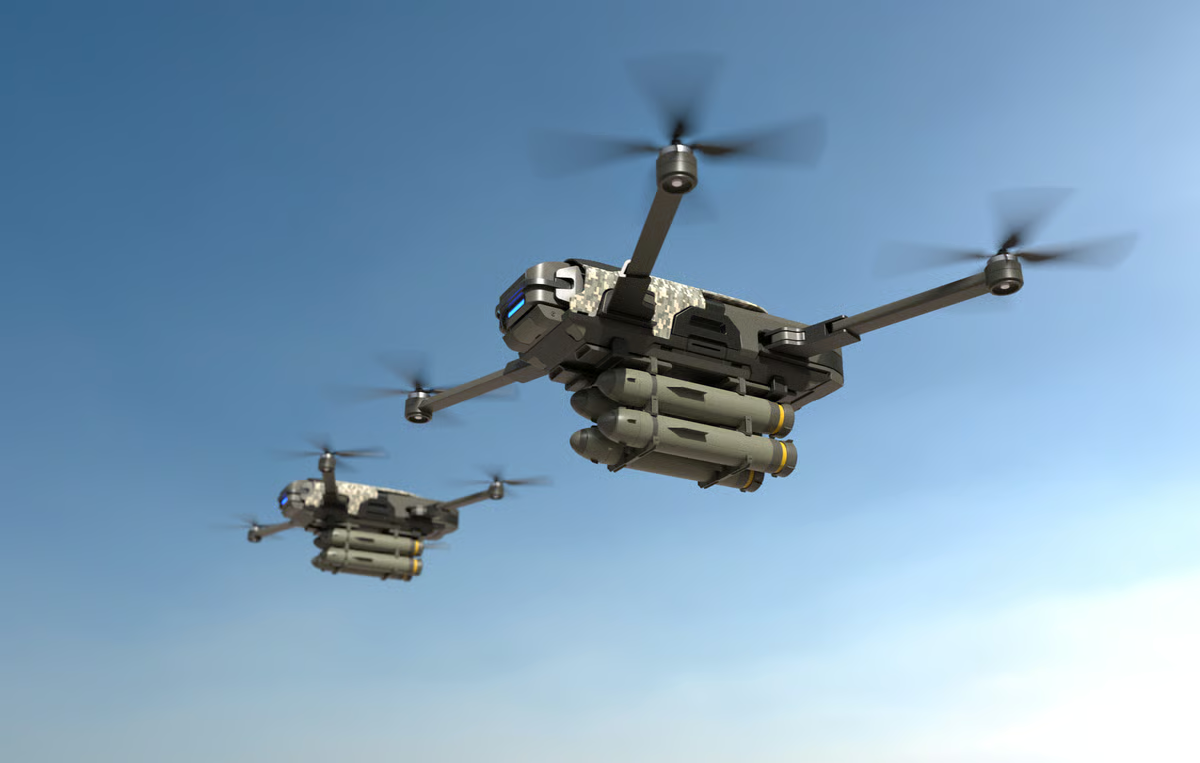
- Unmanned, attritable, and autonomous mission systems: Persistent ISR and operational flexibility drive expansion of unmanned fleets and autonomy-enabled payloads.
- Integrated air and missile defense countermeasures: Defense modernization and survivability requirements expand demand for mission sensors, intercept-adjacent technologies, and target/defensive training ecosystems.
- Space-enabled capabilities and defense resilience: Increased utilization of space assets elevates demand for space-related mission systems, communications support, and resilient architectures.
- Cyber/secure communications and mission assurance: Secure data exchange and hardened mission operations remain enduring procurement priorities.
- Lifecycle sustainment and upgrade cycles: Platform modernization is often more repeatable and less procurement-fragmentary than entirely new platform introductions.
TAM expansion is therefore less dependent on a single weapon system and more linked to sustained funding for ISR, contested-domain resilience, and modernization of the “system-of-systems” defense stack—where Kratos’ integration and execution capabilities can translate into follow-on share.
⚠ Risk Factors to Monitor
- Program concentration and budgeting cycles: Defense spending and procurement prioritization can shift, impacting contract awards and timing.
- Fixed-price and execution risk: Contract structures can create margin volatility if cost estimates, supply availability, or production learning curves underperform.
- Competitive rebids within prime ecosystems: Large primes may re-source subsystems and integrations, requiring Kratos to win competitive follow-ons.
- Technological disruption and integration complexity: Rapid advances in autonomy, sensing, and secure communications can force design refreshes and additional engineering cost.
- Supply chain and labor constraints: Access to specialized components and cleared engineering talent can constrain production and delay deliveries.
- Regulatory/export constraints: Export rules and compliance requirements can affect international market opportunities and product configuration.
📊 Valuation & Market View
The market typically values defense contractors through a blend of EV/EBITDA and P/S, with sentiment heavily influenced by:
- Backlog quality and visibility: Contract mix, nature of follow-on work, and expected conversion into revenue.
- Margin trajectory and execution discipline: Ability to sustain margins through production ramps and sustainment.
- Free cash flow conversion: Working-capital management and payment timing relative to production cycles.
- Program stability and competitive standing: Evidence of re-awards, modernization wins, and customer retention.
Because results can be lumpy around program deliveries, valuation tends to reward contractors that demonstrate a stabilizing sustainment/upgrade cadence and prudent contract selection—reducing earnings variability over the cycle.
🔍 Investment Takeaway
Kratos is positioned as a specialized defense systems integrator with defensible switching costs rooted in qualification, integration complexity, and lifecycle sustainment. The investment case rests on participation in enduring modernization themes—unmanned/autonomy, defense resilience, space-enabled capabilities, and secure mission operations—while managing typical defense risks tied to execution and contract structure. Long-term upside is most credible when Kratos sustains a higher share of follow-on modernization and support work that reinforces earnings durability beyond discrete production events.
⚠ AI-generated — informational only. Validate using filings before investing.












 Growth Catalysts