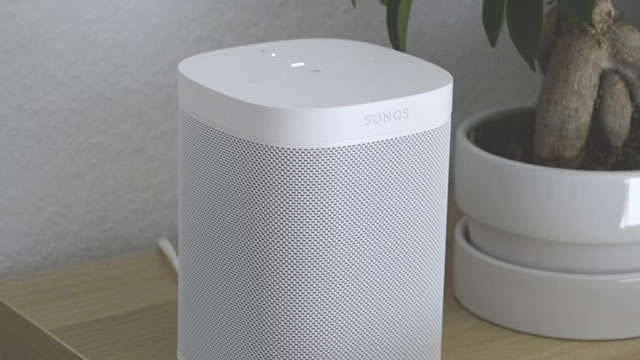
Sonos, Inc.

Sonos, Inc. (SONO) Market Cap

Sonos, Inc. has a market capitalization of $1.80B.

Price: $15.08

β–Ό -1.17 (-7.20%)

Market Cap: 1.80B

NASDAQ Β· time unavailable

CEO: Thomas Conrad

Sector: Technology

Industry: Consumer Electronics

IPO Date: 2018-08-02

Website: https://www.sonos.com

Sonos, Inc. (SONO) - Company Information

Market Cap: 1.80B|Sector: Technology

Company Profile

Sonos, Inc., together with its subsidiaries, designs, develops, manufactures, and sells multi-room audio products in the Americas, Europe, the Middle East, Africa, and the Asia Pacific. The company provides wireless speakers, home theater speakers, components, and accessories. It offers its products through approximately 10,000 third-party retail stores, including custom installers of home audio systems; and e-commerce retailers, as well as through its Website sonos.com. The company was formerly known as Rincon Audio, Inc. and changed its name to Sonos, Inc. in May 2004. Sonos, Inc. was incorporated in 2002 and is headquartered in Santa Barbara, California.

Analyst Sentiment

85%
Strong Buy

From 4 Active Polls

1Y Forecast: $19.50

β–² +29.3% Potential Upside

Consensus Target Metrics

Low Bound

$18

Median

$20

High Bound

$21

Average

$20

Price & Moving Averages

Loading chart...

🎯 Wall Street Analyst Intelligence Report

1-Year structural target targets, chart projections, and sentiment maps.

Average 1Y Target
$19.50
β–² +29.31% Upside
Low Target
$18.00
19% Risk
Median Target
$19.50
29% Mid
High Target
$21.00
39% Max
Consensus
Buy
4 / 9 Buys

Consensus Trend Projection

Trailing closures vs. 12-month metrics map.

Analyst Vote Distribution

Aggregate institutional coverage sentiment weights.

πŸ“Š Historical Valuation Multiples

Real-time Trailing Twelve Month (TTM) momentum side-by-side with discrete quarterly metrics.

Fiscal QuarterTTMQ1 2026Q4 2025Q3 2025Q2 2025Q1 2025Q4 2024Q3 2024Q2 2024
Period EndingTrailing 12MMar 28, 2026Dec 27, 2025Sep 27, 2025Jun 28, 2025Mar 29, 2025Dec 28, 2024Sep 28, 2024Jun 29, 2024
Market Cap ($M)1,7961,5302,1781,8451,2921,2931,8341,4971,809
Enterprise Value ($M)1,6551,3891,9251,7301,1531,1831,6181,3921,643
Price to Earnings Ratio (P/E)76.75-13.245.81-12.18-95.60-4.619.12-7.05121.93
Price/Earnings-to-Growth Ratio (PEG)β€”β€”0.06β€”-2.92β€”0.08β€”2.13
Price to Sales Ratio (P/S)1.235.443.996.413.754.983.335.864.55
Price to Book Ratio (P/B)4.733.984.915.193.243.383.913.493.90
Price to Free Cash Flow Ratio (P/FCF)15.28-21.8113.84-789.5439.53-19.8212.82-27.9844.92
Enterprise Value to Sales (EV/Sales)β€”4.933.536.013.344.552.945.454.14
Enterprise Value to EBITDA (EV/EBITDA)16.50-105.6316.57-96.4475.94-26.9426.29-30.9566.27
Debt to Equity Ratio-1.410.150.130.170.160.160.140.150.13

⚑ SONO Growth Runway Model

Standard long term linear growth fade

Multi-Stage Discounted Cash Flow Sandbox

Market Price$15.08
Intrinsic Value$4.64
Market Alignment
Overvalued by 69.2%relative to calculated intrinsic value
9.00%
Exp: -4%-4%
i

Growth runway slowdown

This value provides a time window for the growth rate to decline beyond Stage 1 toward the terminal rate. Longer windows are most useful for companies with high growth starting conditions or strong competitive advantages. This option stretches out the growth rate slowdown across 5, 10, or 15-year steps. A high-growth starting condition (exceeding a 25% initial growth rate) automatically applies a curve decay to simulate realistic, rapid market saturation.
i

Terminal growth rate

With long-term inflation between 3-5%, revenue must grow by that baseline to maintain flat real-world market share. This value sets the permanent terminal growth rate to factor into the valuation beyond the growth slowdown runway toward maturity.

3-Stage Financial Runway Horizon

🧠 Perpetuity Horizon Engine (Stage 3: Post-2035)

Terminal FCF Base$0.01B
Perpetuity TV Value$0.20B
Discounted TV (PV)$0.08B
TV Weighting %57.6%
⚠️
Financial Model Disclaimer & Risk Disclosure: This interactive scenario simulator is an educational sandbox provided strictly for informational and analytical research purposes. Core historical financial statements and consensus estimates are sourced directly via Financial Modeling Prep (FMP). All downstream outputs are entirely deterministic, hypothetical projections generated by combining automated mathematical formulas (including linear interpolation and Gaussian bell-curve decay models) with user-selected variables and third-party financial data inputs. Users assume all liability for trading decisions executed based on these sandbox calculations.

πŸ“˜ Full Research Report

ℹ️

AI-Generated Research: This report is for informational purposes only.

πŸ“˜ SONOS INC (SONO) β€” Investment Overview

🧩 Business Model Overview

Sonos designs a wireless multi-room audio system that ties hardware (speakers, soundbars, and related accessories) to a proprietary software platform (controller app, device management, and orchestration for synchronized playback). The economic engine is an installed base: once customers adopt Sonos for room-to-room coverage and consistent sound, additional purchases (new speakers, soundbars, and upgrades) tend to follow through the same ecosystem to preserve user experience and system-wide integration.

Distribution is primarily direct and through retail partners, with software acting as an β€œoperating layer” that improves the value of the installed hardware over time and supports higher engagement with connected audio services.

πŸ’° Revenue Streams & Monetisation Model

Revenue is predominantly driven by hardware sales (speakers, soundbars, and accessories). Monetisation has an important secondary component from content and service-related economics, such as licensing/partner economics tied to streaming experiences and Sonos software-driven discovery and engagement. While services are smaller than hardware, they typically offer better incremental margins than pure device sales.

Key margin drivers include:

  • Hardware mix: higher-value categories (e.g., multi-room speakers and soundbars) can support better blended margins than entry-level devices.
  • Scale and component costs: networked speaker platforms benefit from design reuse and procurement scale.
  • Software/service contribution: incremental gross margin leverage from app-driven engagement and partner economics.

🧠 Competitive Advantages & Market Positioning

Sonos’ moat is strongest in switching costs and intangible ecosystem value, supported by an installed-base flywheel.

  • Switching costs (ecosystem lock-in): multi-room synchronization, app-based device management, and room-by-room configuration create practical friction for customers considering a wholesale move to another platform.
  • Intangible assets (software integration and user experience): the controller ecosystem and system reliability are difficult to replicate at the same level across multiple device categories without years of iteration.
  • Network effects (limited but present): while Sonos is not a social network, ecosystem β€œcoverage value” increases with the number of rooms/devices a household connects and with the breadth of supported services and integrations.

Competitive benchmarking:

  • Amazon (Echo / Alexa ecosystem): broader smart-home reach and aggressive pricing; Sonos targets premium multi-room audio performance and a more focused audio-first experience.
  • Bose: strong audio heritage; Bose competes heavily in hardware but lacks the same breadth of Sonos-style multi-room software-driven system orchestration.
  • Apple (HomePod / AirPlay ecosystem): deep integration with Apple devices; Apple emphasizes platform integration, while Sonos historically differentiates through cross-room, multi-speaker orchestration across a wider device mix.

Sonos’ industry focus centers on multi-room, audio-first architecture rather than a general-purpose smart-home platform, which supports differentiation where customers prioritize synchronized listening across rooms.

πŸš€ Multi-Year Growth Drivers

Over a 5–10 year horizon, growth is driven less by single-product novelty and more by structural adoption of networked home audio:

  • Premium multi-room adoption: wireless speakers and synchronized playback continue to shift away from single-room listening and legacy wired systems.
  • Installed-base expansion: households with a first Sonos product typically add speakers/soundbars over time to extend coverage, improve acoustics, or upgrade capabilities.
  • Content and engagement economics: an app-centric platform can deepen user engagement with streaming services and discovery features, supporting service-related margin contribution.
  • Integration with smart home ecosystems: voice control and connected-home interoperability broaden addressability while preserving Sonos as the audio layer.

⚠ Risk Factors to Monitor

  • Consumer demand cyclicality: wireless audio is sensitive to discretionary spending and pricing pressure during weaker consumer periods.
  • Competitive pricing and feature parity: large platform players can compress margins through bundling and aggressive promotion; audio-only rivals can pressure share through incremental hardware releases.
  • Platform and software execution risk: user experience and system reliability are central to switching costs; missteps in app/OS changes can weaken perceived ecosystem value.
  • Supply chain and component volatility: audio devices require continuous sourcing of semiconductors, audio components, and power systems; cost inflation can pressure gross margin.
  • Regulatory and privacy constraints: voice and connected-home features implicate privacy/security expectations and can increase compliance and engineering costs.

πŸ“Š Valuation & Market View

The market typically values SONO through a consumer hardware + platform optionality framework. Device-centric businesses often trade on P/S or EV/EBITDA adjusted for product-cycle volatility, while platform characteristics (software-led engagement, service contribution, and installed-base durability) can support a higher multiple when investors see evidence of margin resilience and recurring-like economics.

The valuation β€œneedle movers” are generally:

  • Gross margin trajectory driven by hardware mix and component cost control.
  • Stability and growth of installed base, reflected in accessory expansion and repeat ecosystem purchases.
  • Service/content contribution that lifts blended margins and reduces earnings dependence on purely new unit volume.

πŸ” Investment Takeaway

Sonos presents a defensible premium position anchored by ecosystem switching costs and software-driven multi-room orchestration. The investment case rests on the durability of the installed base, the ongoing expansion of multi-room audio penetration, and the ability to translate software-led engagement into improving blended margins. Competitive intensity from large smart-home platforms remains a material overhang, but the audio-first ecosystem and user experience are structural differentiators that can sustain customer retention and incremental upgrades over a full cycle.


⚠ AI-generated β€” informational only. Validate using filings before investing.

πŸ“° Market News & Coverage

15 Stories Available

Real-time institutional reporting and market updates for SONO.

zacks.comβ€’2026-06-03

Sonos (SONO) Up 17.6% Since Last Earnings Report: Can It Continue?

Sonos (SONO) reported earnings 30 days ago. What's next for the stock?

businesswire.comβ€’2026-06-01

Sonos Announces Participation in Rosenblatt's 6th Annual Technology Virtual Summit

SANTA BARBARA, Calif.--(BUSINESS WIRE)--Sonos, Inc. (Nasdaq: SONO) today announced that Saori Casey, Chief Financial Officer, will participate in a fireside chat with Rosenblatt analyst Steve Frankel at Rosenblatt's 6th Annual Technology Virtual Summit on Tuesday, June 9th. The fireside chat will begin at 2:00 pm Pacific. A live webcast and replay of the fireside chat will be accessible in the News & Events section of the Sonos investor relations website: https://investors.sonos.com/news-an.

businesswire.comβ€’2026-05-18

Sonos Announces Participation in 2026 Jefferies Software, Internet, and AI Conference

SANTA BARBARA, Calif.--(BUSINESS WIRE)---- $SONO--Sonos, Inc. (Nasdaq: SONO) today announced that Saori Casey, Chief Financial Officer, will participate in a fireside chat with Jefferies analyst Brent Thill at the 2026 Jefferies Software, Internet, and AI Conference on Wednesday, May 27th. The fireside chat will begin at 3:30 pm Pacific. A live webcast and replay of the fireside chat will be accessible in the News & Events section of the Sonos investor relations website: https://investors.sonos.com/n.

youtube.comβ€’2026-05-09

The Sonos Comeback Starts Here?

After a rough year, Sonos might finally have its comeback moment. We tested the new Sonos Play and Era 100 SL to see if the company can win back trust with better sound, smarter features, and serious value.

seekingalpha.comβ€’2026-05-07

Sonos: Despite Memory Spike, Sonos Excels At What It Can Control

Sonos faces gross margin pressure from surging memory prices, but I reiterate my 'Buy' rating, viewing recent downside as short-term noise. SONO is actively mitigating memory cost headwinds via tariff refunds, engineering redesigns, and disciplined opex management, without resorting to price hikes. Strong Q2 results: revenue grew 8% y/y to $281.5 million, beating expectations and supporting management's confidence in accelerating growth for 2H FY26.

zacks.comβ€’2026-05-05

Sonos' Reports Q2 Loss, Revenues Beat Estimates, Stock Jumps

SONO posts Q2 revenue growth and narrower loss, as improving trends and strong execution mark a key turnaround for SONO.

seekingalpha.comβ€’2026-05-04

Sonos, Inc. (SONO) Q2 2026 Earnings Call Transcript

Sonos, Inc. (SONO) Q2 2026 Earnings Call Transcript

zacks.comβ€’2026-05-04

Sonos (SONO) Reports Q2 Loss, Beats Revenue Estimates

Sonos (SONO) came out with a quarterly loss of $0.02 per share versus the Zacks Consensus Estimate of a loss of $0.04. This compares to a loss of $0.18 per share a year ago.

businesswire.comβ€’2026-05-04

Sonos Reports Second Quarter Fiscal 2026 Results

SANTA BARBARA, Calif.--(BUSINESS WIRE)---- $SONO--Sonos, Inc. (Nasdaq: SONO) today reported Second Quarter Fiscal 2026 results. β€œThe first half of Fiscal 2026 marks an important turning point for Sonos as we return to growth and change the trajectory of the business,” said Tom Conrad, Chief Executive Officer of Sonos. β€œThe progress we're seeing comes from coordinated execution across the areas that matter most: better products, a stronger software experience, more effective marketing, and continued expan.

zacks.comβ€’2026-05-01

Sonos to Release Q2 Earnings: Here's What Investors Should Expect

SONO heads into Q2 with a modest growth outlook, but tariff pressures, rising costs and lack of new product contributions may weigh on performance.

businesswire.comβ€’2026-04-15

Sonos Announces Date for Second Quarter Fiscal 2026 Financial Results and Conference Call

SANTA BARBARA, Calif.--(BUSINESS WIRE)--Sonos, Inc. (Nasdaq: SONO) today announced that after market close on Monday, May 4, 2026 the company will report financial results for the second quarter ended March 28, 2026. The company will issue a press release and accompanying slide presentation at that time which will be accessible at https://investors.sonos.com/reports-and-filings/default.aspx#section=earningsreports. The company will host a conference call and Q&A to discuss the results on th.

businesswire.comβ€’2026-03-23

Faraday Highlights 40nm SONOS eNVM as NOR Flash Alternative for MCU Designs

HSINCHU, Taiwan--(BUSINESS WIRE)-- #ASIC--Faraday Technology Corporation (TWSE: 3035), a leading ASIC design service and IP provider, today highlighted its 40uLP SONOS embedded non-volatile memory (eNVM) solution, offering MCU vendors a cost-efficient alternative to NOR Flash while ensuring stable memory supply for long-lifecycle applications. As AI adoption accelerates, demand from AI servers and networking systems is tightening supply for consumer DRAM, NAND, and NOR Flash while increasing memory con.

zacks.comβ€’2026-03-20

New Strong Buy Stocks for March 20th

ASTE, SONO, BWXT, BCBP and CAPL have been added to the Zacks Rank #1 (Strong Buy) List on March 20th, 2026.

zacks.comβ€’2026-03-20

Best Value Stocks to Buy for March 20th

GCT, BCBP and SONO made it to the Zacks Rank #1 (Strong Buy) value stocks list on March 20th, 2026.

zacks.comβ€’2026-03-18

3 Audio Video Stocks to Buy as Industry Tailwinds Gain Momentum

Investments in cutting-edge and innovative solutions are likely to aid Zacks Audio Video Production industry participants like DLB, SONO and LVO amid cautious discretionary spending.

πŸ“Š AI Financial Analysis

Powered by StockMarketInfo
Earnings Data: Q Ending 2026-03-28

"SONO reported Q2’26 revenue of $281.5M and net income of -$93.8M (EPS -$0.78, diluted -$0.75). QoQ, revenue fell sharply from $545.7M in Q1’26 (-48.4%) and net income swung from +$94.0M to -$93.8M. YoY, revenue rose from $259.8M in Q2’25 (+8.3%), but profitability deteriorated: net income moved from -$70.1M in Q2’25 to -$94.0M in Q2’26 (decline of -33.8%). Gross margin improved slightly QoQ and YoY (44.3% in Q2’26 vs 46.5% in Q1’26; vs 43.7% in Q2’25), but operating leverage was unfavorableβ€”operating margin fell to -12.1% from +18.9% in Q1’26. Cash flow quality is a key concern: operating cash flow was -$163.3M and free cash flow was -$157.3M in the quarter, versus +$163.3M operating cash flow in Q1’26. Balance-sheet resilience is mixed: reported total assets were $839.5M, with no reported debt and sizable cash + short-term investments of $249.1M, but equity is shown as $0 in this dataset. Total shareholder returns appear strong on momentum: the stock is up +86.6% over 1 year, with no dividends. Analyst consensus targets ($19.5) are above the $14.37 price (~+36% upside), supporting sentiment despite ongoing losses."

Revenue Growth

Neutral

YoY revenue growth of +8.3% (Q2’25 $259.8M to Q2’26 $281.5M), but QoQ revenue declined -48.4% (Q1’26 $545.7M to Q2’26 $281.5M), suggesting volatility rather than a steady run-rate.

Profitability

Neutral

Net income deteriorated to -$93.8M vs -$70.1M YoY (-33.8%) and swung from +$94.0M QoQ. Operating margin contracted to -12.1% (from +18.9% QoQ) despite gross margin near mid-40%s.

Cash Flow Quality

Neutral

Operating cash flow was -$163.3M and free cash flow -$157.3M in Q2’26, down from +$163.3M operating cash flow and +$157.3M FCF in Q1’26β€”clear deterioration in quarter-to-quarter cash burn.

Leverage & Balance Sheet

Fair

No total debt reported and net debt is negative (cash/short-term investments exceed debt). Total assets were $839.5M, but equity is shown as $0 in the dataset, limiting confidence in resilience metrics beyond liquidity.

Shareholder Returns

Good

Strong 1-year price momentum: +86.6% (dividends none; buybacks occurred but are not sufficient to quantify total return precisely). Capital appreciation is supportive despite fundamentals.

Analyst Sentiment & Valuation

Fair

Consensus target $19.5 vs current price $14.37 implies ~+36% upside. However, persistent losses and negative cash flow reduce fundamental valuation support.

Disclaimer:This analysis is AI-generated for informational purposes only. Accuracy is not guaranteed and this does not constitute financial advice.

Fundamentals Overview

Loading fundamentals overview...

Sonos’ Q2 shows a credible turn toward growth and profitability: revenue rose 8% YoY to $282M near the top of guidance, while adjusted EBITDA increased 48% and expanded margin by 510 bps, aided by GAAP and non-GAAP OpEx reductions. However, the company’s near-term story is constrained by memory cost inflation (about a 200 bps headwind in Q2; embedded ~400 bps YoY headwind for Q3). Management partially offsets tariffs via mitigation but explicitly excludes tariff refunds in Q3, adding ~200 bps of headwind versus Q2, while flagging a potential IEEPA refund of up to $40M (timing uncertain). Growth catalysts are product-led: Play (de minimis in Q2) and Aero 100 SL ($189) are positioned as new entry points to expand the multi-room system, supported by restored customer advocacy. Outlook is constructive but conditional: Q3 revenue $355M–$375M and adjusted EBITDA $20M–$48M, with supply confidence based on multi-channel procurement begun in early 2025.

AI IconGrowth Catalysts

  • Sonos Play launched at/near quarter end; early international press reviews described as β€œcomeback/back on track,” positioning Play as an entry point into the multi-room system
  • Aero 100 SL launched alongside Play with simplified design and $189 price point to lower the barrier to join the system; management expects it to build on Era 100 pricing-driven installed-base growth momentum
  • AMP Multi slated to launch in fall; expected to be a meaningful professional installer-channel product (no Q3 revenue contribution)
  • System reliability improvement and restored customer advocacy supporting expansion from new households and within the installed base
  • Geo expansion: APAC/EMEA growth markets delivering double-digit growth and consecutive quarters of strong performance

Business Development

  • New leadership: Frank Barbieri joining as Chief Operating Officer; will take responsibility for partnerships and direct consumer relationships across DTC, CRM, customer experience, as well as revenue systems and IT
  • No named customers/retail partners or distribution agreements disclosed in the provided transcript

AI IconFinancial Highlights

  • Revenue: $282M in Q2, +8% YoY, near the top end of guidance
  • Adjusted EBITDA: +48% YoY; margin improvement of 510 bps; adjusted EBITDA positive $2M (above midpoint of guidance range), first positive Q2 adjusted EBITDA in past four years
  • Gross profit: GAAP gross profit +10% YoY; non-GAAP gross profit +6% YoY; gross margins: GAAP 44.3%, non-GAAP 46%
  • Memory costs: ~200 bps gross margin headwind in Q2
  • Tariffs: referenced as offsetting last quarter; Q2 tariff impact described as offset by mitigation actions
  • Operating expenses: GAAP OpEx down 16% YoY; non-GAAP OpEx down 10% YoY; restructuring costs drove GAAP down while non-GAAP mostly flat
  • Non-GAAP EPS: -$0.02 vs -$0.18 last year
  • Share repurchase: $40M in Q2 to buy back 2.5M shares; share count reduced 2.1%
  • Cash/Balance sheet: net cash ended quarter at $249M (includes $40M marketable securities); FCF negative $70M consistent with Q2 seasonality

AI IconCapital Funding

  • Share buybacks: $40M repurchased in Q2; remaining authorization $65M
  • Net cash: $249M at quarter end, including $40M marketable securities
  • Debt levels: not disclosed in the provided transcript
  • FCF: -$70M in Q2; CapEx $5M

AI IconStrategy & Ops

  • AI adoption driving productivity gains across software engineering, IT, accounting, customer support, and other functions (management states improvements are just beginning)
  • Supply confidence: global operations team began securing sufficient supply through multiple channels in early 2025; management says guidance implies adequate supply for back-half ramps despite memory cost pressure
  • Tariff refunds: management will file for refund of prior duties paid under IEEPA after U.S. CBP launched CAPE phase one (timing uncertain)
  • Inventory: period-end inventory $161M (+16% YoY) due to new product launches and tariff costs, partially offset by component inventory workdown
  • Marketing org change: CMO Colleen DeCourcy (noted as ~6 months in role) aligning marketing with system strategy; building full-funnel brand story

AI IconMarket Outlook

  • Q3 revenue guidance: $355M to $375M (+3% to +9% YoY; +6% at midpoint); constant currency FX contribution expected negligible
  • No revenue contribution in Q3 from AMP Multi; launch slated for fall
  • Q3 gross margin: GAAP 42% to 44.5%; non-GAAP ~150 bps higher than GAAP; roughly flat YoY at midpoint
  • Q3 gross margin embeds: ~400 bps YoY headwind from higher memory costs
  • Tariff refunds: not expected in Q3; adds ~200 bps more gross margin headwind vs Q2
  • Q3 GAAP OpEx: $150M to $160M; non-GAAP OpEx lower than GAAP by ~$18M (non-GAAP roughly flat vs Q2 at midpoint)
  • Q3 adjusted EBITDA: $20M to $48M (margin 5.6% to 12.7%)
  • Full-year 2026: management expects continued momentum into Q4 and full-year growth consistent with prior two quarters’ commentary; not guiding beyond Q3

AI IconRisks & Headwinds

  • Higher memory costs: DDR4/DDR5 transition and high bandwidth memory tightening supply and increasing costs; management cites ongoing industry headwind
  • Gross margin pressure: Q2 ~200 bps headwind; Q3 incremental additional 200 bps sequential and ~400 bps YoY headwind for memory
  • Tariff-related uncertainty: no refunds expected in Q3; future refunds would likely help but timing uncertain
  • Consumer/geopolitical macro sensitivity acknowledged (analyst asked), but management states demand picture remains strong

Q&A: Analyst Interest

  • AI monetization framing: Management said AI is transforming internal operations first, while externally they are uniquely positioned via 17M households and 53M voice-enabled connected devices. They declined specifics as β€œpremature,” emphasizing they can bring AI into consumers’ lives beyond phones/computers without detailing roadmap or revenue model.
  • Q3 gross margin range drivers: Management broke the range into sequential memory headwind plus tariff rate tailwind and offsets from revenue leverage, product/mix timing, and promotion intensity. They stated Q3 memory is +200 bps sequential (additional on Q2) and ~400 bps YoY, with tariffs at 10% and cost savings partially offsetting pressure.
  • Aero 100 SL theory for value tiers: Management described Aero 100 SL as cost-optimized with $189 MSRP, not just microphone removal. They highlighted cost reduction via color injection molding versus painted products and indicated target rooms/use cases (secondary rooms, surrounds) where microphones aren’t desired, supporting lower-price household acquisition.

Sentiment: POSITIVE

Note: This summary was synthesized by AI from the SONO Q2 2026 earnings transcript. Financial data is complex; please verify all metrics against official SEC filings before making investment decisions.

πŸ“‹ Official Regulatory 10-K / 10-Q SEC Filings

Direct authenticated documentation links to audited SEC database reports for SONO.

SEC EDGAR Live Feed
Loading financial data and tables...
πŸ“

SEC Filings (SONO)

Β© 2026 Stock Market Info β€” Sonos, Inc. (SONO) Financial Profile