U.S. Bancorp

U.S. Bancorp (USB) Market Cap

U.S. Bancorp has a market capitalization of $88.39B.

Financials based on reported quarter end 2026-03-31

Price: $56.84

β–Ό -0.16 (-0.28%)

Market Cap: 88.39B

NYSE Β· time unavailable

CEO: Gunjan Kedia

Sector: Financial Services

Industry: Banks - Regional

IPO Date: 1973-05-03

Website: https://www.usbank.com

U.S. Bancorp (USB) - Company Information

Market Cap: 88.39B Β· Sector: Financial Services

U.S. Bancorp, a financial services holding company, provides various financial services to individuals, businesses, institutional organizations, governmental entities and other financial institutions in the United States. It operates in Corporate and Commercial Banking, Consumer and Business Banking, Wealth Management and Investment Services, Payment Services, and Treasury and Corporate Support segments. The company offers depository services, including checking accounts, savings accounts, and time certificate contracts; lending services, such as traditional credit products; and credit card services, lease financing and import/export trade, asset-backed lending, agricultural finance, and other products. It also provides ancillary services comprising capital markets, treasury management, and receivable lock-box collection services to corporate and governmental entity customers; and a range of asset management and fiduciary services for individuals, estates, foundations, business corporations, and charitable organizations. In addition, the company offers investment and insurance products to its customers principally within its markets, as well as fund administration services to a range of mutual and other funds. Further, it provides corporate and purchasing card, and corporate trust services; and merchant processing services, as well as investment management, ATM processing, mortgage banking, insurance, and brokerage and leasing services. As of December 31, 2021, the company provided its products and services through a network of 2,230 banking offices principally operating in the Midwest and West regions of the United States, as well as through on-line services, over mobile devices, and other distribution channels; and operated a network of 4,059 ATMs. The company was founded in 1863 and is headquartered in Minneapolis, Minnesota.

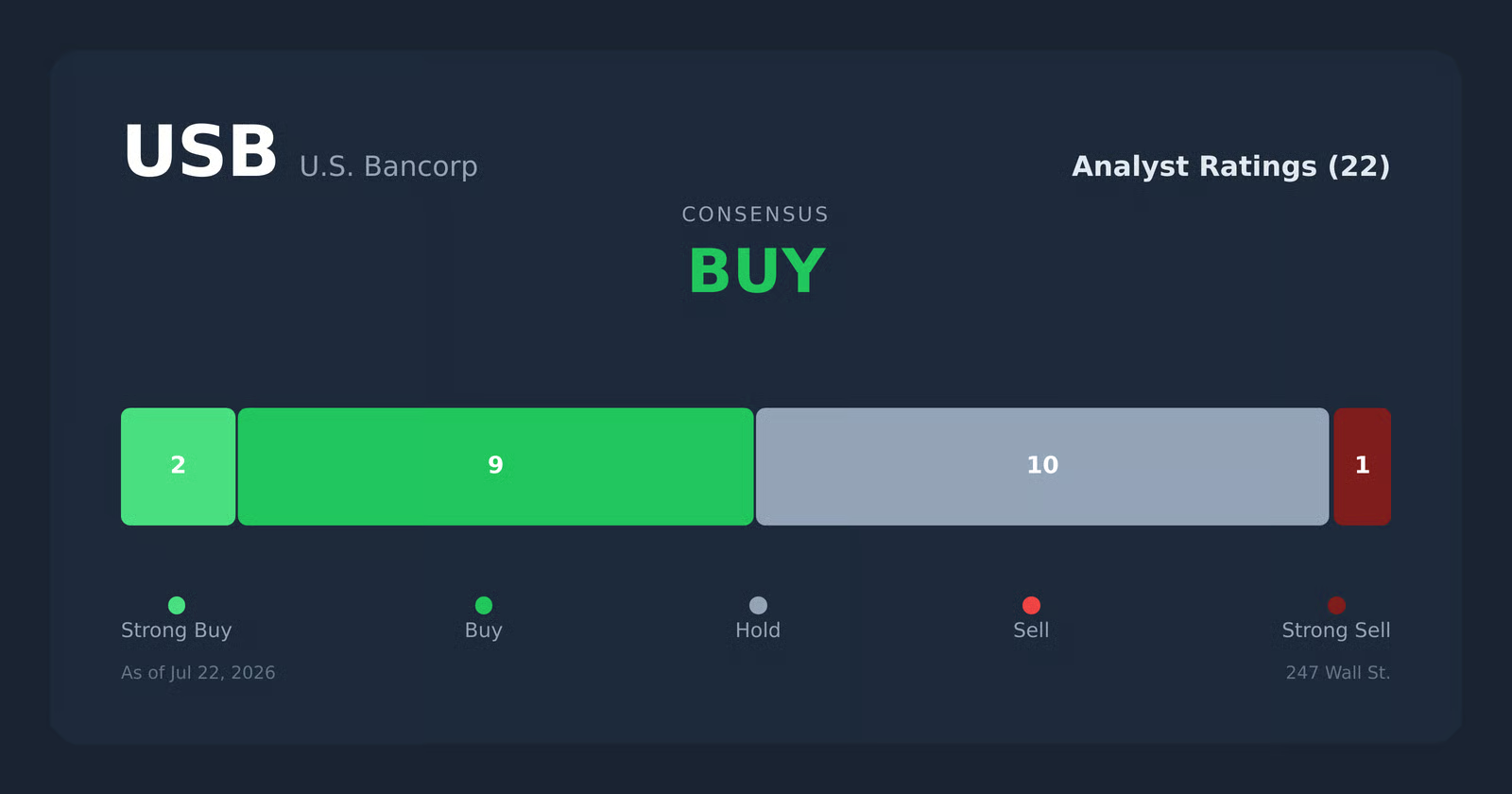
Analyst Sentiment

64%
Buy

Based on 49 ratings

Analyst 1Y Forecast: $59.72

Average target (based on 4 sources)

Consensus Price Target

Low

$53

Median

$63

High

$73

Average

$63

Potential Upside: 10.6%

Price & Moving Averages

Loading chart...

πŸ“˜ Full Research Report

ℹ️

AI-Generated Research: This report is for informational purposes only.

πŸ“˜ U.S. Bancorp (USB) β€” Investment Overview

🧩 Business Model Overview

U.S. Bancorp operates as a leading diversified financial services holding company. Its primary wholly owned subsidiary, U.S. Bank, is among the largest commercial banks in the United States. The company serves a broad spectrum of clients, including retail consumers, small businesses, middle-market corporations, large enterprises, public sector entities, and institutional clients. Product and service offerings encompass traditional commercial and consumer banking, wealth management, payment services, trust and asset management, mortgage banking, and specialized financial offerings. The bank operates a widespread physical branch network complemented by advanced digital platforms, enhancing accessibility and engagement for a modern clientele across the U.S.

πŸ’° Revenue Model & Ecosystem

U.S. Bancorp derives its revenues from multiple complementary streams. Core interest income is driven by lending activitiesβ€”both consumer and commercialβ€”including mortgages, credit cards, and business loans. Non-interest income plays a significant role, sourced from payment processing, wealth and asset management fees, treasury and corporate trust services, and various account-related service charges. The bank serves both individual consumers and enterprise-level clients, fostering recurring revenue through ongoing service relationships, subscription-like fee arrangements, and payment processing volumes. Its ecosystem supports cross-selling opportunities, enabling deeper wallet share across banking, lending, and advisory products.

🧠 Competitive Advantages

  • Brand strength: U.S. Bancorp enjoys a reputation for stability, prudent risk management, and high customer satisfaction, reinforcing its trusted status within the market.
  • Switching costs: Deep financial relationships, bundled product offerings, and the complexity of migrating services help ensure customer retention and deter switching to competitors.
  • Ecosystem stickiness: Integrated digital tools, combined with robust branch support, generate an environment where clients can manage a variety of financial needs within a single, cohesive platform.
  • Scale + supply chain leverage: The company’s significant size enables efficiency in costs, broad access to capital markets, and the ability to invest in cutting-edge technology and compliance infrastructure at scale.

πŸš€ Growth Drivers Ahead

Growth prospects stem from both organic initiatives and strategic expansion avenues. U.S. Bancorp continues to enhance its suite of digital banking capabilities, seeking to capture new demographics and build deeper engagement among existing clients. Its payments business, including credit and debit cards as well as merchant acquiring solutions, addresses secular shifts toward electronic and mobile payments. Expansion into wealth management and advisory strengthens fee-based income, while partnership opportunities and selective M&A can broaden geographic footprint or product reach. The company’s longstanding focus on cost discipline and operational efficiency also underpins margin improvement initiatives over time.

⚠ Risk Factors to Monitor

Investors should monitor a range of risks, including intensifying competition from both traditional banks and fintech disruptors that threaten to erode fees and customer relationships. Regulatory scrutiny remains elevated across consumer protection, capital requirements, and anti-money-laundering standards. The interest rate environment can impact net interest margins. Technological disruption, cybersecurity threats, and shifting consumer preferences represent ongoing sources of uncertainty. Additionally, economic cycles influence credit quality and loan growth, introducing variability to earnings potential.

πŸ“Š Valuation Perspective

U.S. Bancorp is typically valued by the market relative to large regional banking peers. Its historical positioning has often reflected a moderate premium, attributed to superior asset quality, operational efficiency, and a diversified revenue base. However, valuation levels oscillate based on prevailing macroeconomic sentiment, perceived risk appetite, and the relative outlook for earnings growth versus the broader sector.

πŸ” Investment Takeaway

U.S. Bancorp offers investors exposure to a well-established, conservatively managed bank with a balanced revenue mix and a robust national presence. The bull case is anchored on its strong brand, technological investments, diverse income streams, and disciplined management. Conversely, the bear case centers on industry headwinds including competitive threats, regulatory burdens, margin pressures, and digital disruption risks that could challenge growth or compress returns. Investors should weigh U.S. Bancorp’s stability and incremental growth potential against the evolving landscape for financial services.


⚠ AI-generated research summary β€” not financial advice. Validate using official filings & independent analysis.

Fundamentals Overview

Loading fundamentals overview...

πŸ“Š AI Financial Analysis

Powered by StockMarketInfo
Earnings Data: Q Ending 2026-03-31

"Headline metrics for USB (most recent quarter ended 2026-03-31): Revenue $10.84B and Net Income $1.95B, with EPS of $1.18. QoQ, Revenue declined -1.31% (from $10.98B) and Net Income fell -5.24% (from $2.05B); EPS decreased -6.35%. YoY growth for this quarter was not computable from the provided history because 2025-03-31 data is missing. Across the 4-quarter window, profitability is broadly stable: net margin improved from ~17.25% (2025-06-30) to ~18.69% (2025-12-31) before easing to ~17.96% (2026-03-31). Balance-sheet resilience looks solid for a bank: total assets rose to ~$701.0B (from ~$686.4B in 2025-06-30) and equity increased to ~$66.2B (from ~$61.9B), supporting leverage and downside absorption. Cash flow quality is mixed in the tape providedβ€”FCF is missing for the latest quarter, but prior quarters show positive operating cash flow with dividends paid. Shareholder returns have been strong: the stock is up +50.53% over 1 year (and +24.71% over 6 months), significantly boosting total return versus dividend yield levels near ~1.1–1.25%. With a consensus price target of $62.88 vs. $56.93, valuation sentiment appears moderately constructive."

Revenue Growth

Neutral

QoQ Revenue -1.31% (10.98B -> 10.84B) and the latest quarter shows a mild pullback; over the 4-quarter span Revenue is modestly higher (10.53B -> 10.84B, ~+2.9%). YoY for the latest quarter is not available due to missing 2025-03-31 data.

Profitability

Positive

Net Income fell QoQ -5.24% (2.05B -> 1.95B) and EPS -6.35%. Net margin peaked near 18.69% (2025-12-31) and eased to ~17.96% (2026-03-31), indicating slight margin contraction rather than a structural decline.

Cash Flow Quality

Neutral

FCF is not provided for the latest quarter, limiting forward cash-quality assessment. Earlier quarters show positive operating cash flow (e.g., 2025-09-30: ~$3.39B; 2025-06-30: ~$2.03B) while dividends were paid, suggesting ongoing capital return capacity, but data gaps reduce confidence.

Leverage & Balance Sheet

Strong

Total assets increased to ~$701.0B (from ~$686.4B). Equity strengthened to ~$66.2B (from ~$61.9B). While net debt increased from 2025-09 to 2026-03, equity growth and asset stability support resilience typical for a scaled bank.

Shareholder Returns

Excellent

Total return is strongly supported by price momentum: +50.53% over 1Y (plus +24.71% over 6M). Dividend levels appear steady around $0.52/share with dividend yield historically near ~1.1–1.25% (using available ratio history). Buybacks were not provided.

Analyst Sentiment & Valuation

Positive

Valuation multiples are reasonable (P/E ~10.39 on 2026-03-31). Consensus target $62.88 vs. current $56.93 implies ~+10.5% upside, indicating moderately constructive Street expectations.

Disclaimer:This analysis is AI-generated for informational purposes only. Accuracy is not guaranteed and this does not constitute financial advice.

U.S. Bancorp’s Q1 2026 results show strong top-line momentum and cost discipline translating into measurable efficiency gains. EPS rose ~15% YoY to $1.18 and total net revenue increased 4.7% to $7.3B. Management delivered 440 bps positive operating leverage and improved the efficiency ratio by 260 bps YoY, supported by fee strength (6.9% YoY) and unusually strong capital markets growth. Asset quality stayed stable (NPA ratio 0.38%, improving 3 bps QoQ and 7 bps YoY), though credit card seasonality lifted net charge-offs by 2 bps sequentially. Net interest margin was flat at 2.77% (mortgage prepayments and tighter spreads offsetting core loan growth and deposit stability). Guidance keeps full-year revenue growth at 4%–6% and operating leverage at 200 bps-plus, with Q2 targets for NII and fees of 6%–7% YoY. The key upside lever is the Amazon small-business card (Q3 onboarding, ~$75M–$85M per quarter expected), alongside continued automation/AI investment while preserving capital distribution glide-up.

AI IconGrowth Catalysts

  • Business Banking: Business Essentials integrated solutions (banking, card, spend management, merchant) driving high single-digit client and fee CAGR over past 2 years
  • Payments/credit cards: affluent transactor card product push and increased marketing driving double-digit account acquisition growth over last 4 quarters
  • Capital markets: new product penetration with long-standing clients plus favorable volatility driving nearly 30% capital markets fee growth
  • Amazon small-business card: expected to accelerate credit card revenue growth by end of year (included in guidance) after going live in Q3

Business Development

  • Amazon partnership: small-business co-brand card; expected ~$1.6B loan amount and ~70,000 co-brand clients; management expects ~$75M–$85M per quarter incremental revenue (mostly NII) and notes third-quarter onboarding
  • NFL partnership: Financial Edge program for NFL athletes and families and brand nationalization (fully contemplated in guidance)
  • State Farm: co-brand digital platform built to serve co-brand card clients with banking services
  • Edward Jones: co-brand platform improvements to expand service capabilities
  • BTIG pending acquisition: expected close back half of Q2 2026; management guides ~$200M fee revenue contribution per quarter; adds equity/investment banking capabilities
  • Union Bank (CA footprint): merger-related expense savings ~$1B realized; focus on capturing revenue synergies post 2022 acquisition

AI IconFinancial Highlights

  • Reported EPS $1.18 (+~15% YoY) vs prior year
  • Total net revenue $7.3B (+4.7% YoY); net interest income +4.1% YoY (taxable equivalent)
  • Fee income +6.9% YoY; capital markets nearly +30%, trust/institutional nearly +10%
  • Operating leverage +440 bps in the quarter (positive)
  • Efficiency ratio improved 260 bps YoY
  • Net interest margin flat linked quarter at 2.77%; offset by elevated mortgage prepayments and tighter credit spreads
  • Nonperforming assets/loans + other RE 0.38%: improved 3 bps QoQ and 7 bps YoY
  • Net charge-off ratio 0.56%: +2 bps sequentially driven by seasonal credit cards
  • Allowance for credit losses nearly $8B (2.0% of period-end loans)

AI IconCapital Funding

  • CET1 capital ratio 10.8% (9.3% including AOCI)
  • Share repurchases increased from $100M to $200M in the quarter; stated intention to glide up with $200M base case
  • Committed long-term capital distribution targets of 70%–75% with focus on returning to those levels via share repurchases
  • Category II transition: quarter-end assets $701B vs $700B threshold requirement for 4 quarters of average assets

AI IconStrategy & Ops

  • AI/automation deployment highlighted as support for further efficiency and positive operating leverage
  • Ongoing expense discipline: noninterest expense up 0.8% linked quarter; +0.8% linked but funded tech/marketing investments
  • Updated select fee category disclosure classifications during quarter; prior results restated with no effect on total fee revenue
  • Capital markets: organic product expansion plus pending BTIG acquisition positioned to sustain fee growth

AI IconMarket Outlook

  • Q2 2026 guidance: NII growth (fully taxable equivalent) 6%–7% YoY; total fee revenue growth 6%–7% YoY; noninterest expense growth 3%–4% YoY
  • Full-year 2026 guidance: total net revenue growth 4%–6% YoY; positive operating leverage 200 bps or more
  • Guidance notes: excludes pending BTIG impact (~$200M fee revenue per quarter) and anticipates close back half of Q2 2026; Amazon small-business card and NFL partnership impacts fully contemplated

AI IconRisks & Headwinds

  • Net interest margin not yet expanding sequentially; Q1 headwinds included elevated mortgage prepayments and somewhat tighter credit spreads
  • Credit card seasonality: net charge-off ratio up 2 bps sequentially
  • Deposit market remains competitive; management cited pressure risk as banks continue to compete (offset by USB consumer deposit growth and relative price stability)
  • Macro/rate-path uncertainty: management referenced heightened uncertainty tied to Iran war and monetary policy/rate path affecting resi mortgage book and credit spreads
  • Regulatory/timing risk: effectiveness and indexing/tailoring dates for Category II and Basel III proposals could affect capital flexibility timing

Q&A: Analyst Interest

  • Operating leverage mechanics: Management reiterated it will keep the 200-plus bps operating leverage target while prioritizing revenue growth over pure cost cuts, noting operating leverage can be managed via revenue mix (especially faster fee growth increases variable costs) and ongoing flexibility to invest savings in technology/marketing.
  • Margin progression to 3% path: Management confirmed a path to 3% NIM by 2027, emphasizing mortgage-driven plus/minus effects this quarter (mortgage refinance activity 15%–20% more than prior year) and expecting margin improvement as mortgage uncertainty abates and deposit pricing/asset mix stabilize.
  • Amazon economics + capital allocation under Category II/tailoring: Management quantified Amazon onboarding timing (Q3) and economics (~$1.6B loan amount, ~70,000 co-brand clients, ~$75M–$85M per quarter revenue largely NII) while stating Category II/tailoring changes mainly increase flexibility and timing is the key variable; no major change expected to distributions.

Sentiment: POSITIVE

Note: This summary was synthesized by AI from the USB Q1 2026 earnings transcript. Financial data is complex; please verify all metrics against official SEC filings before making investment decisions.

Loading financial data and tables...
πŸ“

SEC Filings (USB)

Β© 2026 Stock Market Info β€” U.S. Bancorp (USB) Financial Profile