
WeRide Inc. (WRD) Market Cap
WeRide Inc. has a market capitalization of $1.77B.
Price: $5.82
▼ -0.13 (-2.18%)
Market Cap: 1.77B
NASDAQ · time unavailable
CEO: Xu Han
Sector: Technology
Industry: Software - Infrastructure
IPO Date: 2024-10-24
Website: https://www.weride.ai
WeRide Inc. (WRD) - Company Information
Market Cap: 1.77B|Sector: Technology
Company Profile
WeRide, Inc. engages in the development of an autonomous driving technology platform. It offers Robotaxi, Robobus, Robovan, Robosweeper, and advanced driving solutions, providing smart services in online ride-hailing, on-demand transport, urban logistics, and environmental sanitation. The company was founded by Xu Han and Yan Li in February 2017 and is headquartered in Guangzhou, China.
Analyst Sentiment
92%
Strong Buy
From 11 Active Polls
1Y Forecast: $17.50
▲ +200.7% Potential Upside
Consensus Target Metrics
Low Bound
$18
Median
$18
High Bound
$18
Average
$18
Price & Moving Averages
Loading chart...
🎯 Wall Street Analyst Intelligence Report
1-Year structural target targets, chart projections, and sentiment maps.
Average 1Y Target
$17.50
▲ +200.69% Upside
Low Target
$17.50
201% Risk
Median Target
$17.50
201% Mid
High Target
$17.50
201% Max
Consensus Trend Projection
Trailing closures vs. 12-month metrics map.
Analyst Vote Distribution
Aggregate institutional coverage sentiment weights.
Sentiment volume allocation data unavailable.
📊 Historical Valuation Multiples
Real-time Trailing Twelve Month (TTM) momentum side-by-side with discrete quarterly metrics.
| Fiscal Quarter | TTM | Q1 2026 | Q4 2025 | Q3 2025 | Q2 2025 | Q1 2025 | Q4 2024 | Q3 2024 | Q2 2024 |
|---|---|---|---|---|---|---|---|---|---|
| Period Ending | Trailing 12M | Mar 31, 2026 | Dec 31, 2025 | Sep 30, 2025 | Jun 30, 2025 | Mar 31, 2025 | Dec 31, 2024 | Sep 30, 2024 | Jun 30, 2024 |
| Market Cap ($M) | 1,767 | 19,049 | 19,737 | 20,052 | 16,060 | 27,476 | 28,504 | 31,878 | 32,242 |
| Enterprise Value ($M) | 7,093 | 14,224 | 13,433 | 16,896 | 12,430 | 23,463 | 24,378 | 30,926 | 30,456 |
| Price to Earnings Ratio (P/E) | -7.39 | -12.57 | -9.03 | -16.31 | -9.80 | -17.84 | -11.98 | -7.62 | -19.66 |
| Price/Earnings-to-Growth Ratio (PEG) | — | — | -0.11 | -0.47 | -0.13 | — | -0.12 | — | -1.76 |
| Price to Sales Ratio (P/S) | 16.52 | 167.91 | 63.74 | 117.27 | 126.28 | 379.31 | 202.41 | 455.30 | 407.49 |
| Price to Book Ratio (P/B) | 1.88 | 2.68 | 2.50 | 3.23 | 2.48 | 4.08 | 4.03 | -7.27 | -8.78 |
| Price to Free Cash Flow Ratio (P/FCF) | — | — | — | — | — | — | — | — | — |
| Enterprise Value to Sales (EV/Sales) | — | 125.37 | 43.38 | 98.82 | 97.73 | 323.91 | 173.11 | 441.72 | 384.91 |
| Enterprise Value to EBITDA (EV/EBITDA) | -4.03 | -37.01 | -24.61 | -44.53 | -27.49 | -53.55 | -26.40 | -34.71 | -96.10 |
| Debt to Equity Ratio | 2.74 | 0.05 | 0.05 | 0.05 | 0.03 | 0.02 | 0.02 | -0.03 | -0.01 |
📘 Full Research Report
ℹ️
AI-Generated Research: This report is for informational purposes only.
📰 Market News & Coverage
15 Stories AvailableReal-time institutional reporting and market updates for WRD.

globenewswire.com•2026-07-22
WeRide to Report Second Quarter and First Half 2026 Financial Results on Wednesday, August 12, 2026
NEW YORK, July 22, 2026 (GLOBE NEWSWIRE) -- WeRide Inc. (“WeRide” or the “Company”) (NASDAQ: WRD; HKEX: 0800), a global leader in autonomous driving technology, today announced that it will release its unaudited financial results for the second quarter 2026 and unaudited interim results for the first half of 2026 on Wednesday, August 12, 2026, before the open of the U.S. markets.
defenseworld.net•2026-07-21
Amova Asset Management Americas Inc. Grows Holdings in WeRide Inc. $WRD
Amova Asset Management Americas Inc. lifted its position in WeRide Inc. (NASDAQ: WRD) by 229.3% in the first quarter, according to the company in its most recent disclosure with the Securities and Exchange Commission (SEC). The institutional investor owned 2,305,997 shares of the company's stock after purchasing an additional 1,605,657 shares during the

globenewswire.com•2026-07-17
WeRide Named Among China's Top 10 AI Case Studies for UAE Autonomous Driving Deployment, the Only Autonomous Driving Company Recognized
SHANGHAI, July 17, 2026 (GLOBE NEWSWIRE) -- WeRide (NASDAQ: WRD; HKEX: 0800), a global leader in autonomous driving technology, today announced that its autonomous driving deployment in the United Arab Emirates (UAE) has been selected as one of the Top 10 examples of international cooperation in Chinese AI technologies and products in AI From China Benefits the World (2026), in a national case collection released at the 2026 World Artificial Intelligence Conference (WAIC). WeRide was the only autonomous driving company included on the list, with its UAE operations recognized as a benchmark for the international deployment of Chinese AI innovation.

globenewswire.com•2026-07-17
WeRide Introduces WITT, a Physical AI Cognitive Foundation Model Built on Atomic Physical Facts
New model transforms real-world operational data into trusted facts and trusted facts into learning signals for Physical AI systems Key Highlights WeRide unveils WITT (World Intelligence Toward Truth), a Physical AI Cognitive Foundation Model designed to build AI cognition of the physical world through trusted facts extracted from real-world experience. WITT introduces Atomic Physical Facts (APFs), the smallest verifiable units of information about the physical world, establishing a new fact-based cognitive framework for Physical AI.

zacks.com•2026-07-15
Uber vs. Pony AI: Who's Winning the Race in Autonomous Ride-Hailing?
Pony AI appears better positioned than Uber in robotaxis, backed by global expansion, China growth and a largely domestic supply chain.

globenewswire.com•2026-07-13
WeRide Accelerates Global Expansion of Its End-to-End Intelligent Driving Solution
Key Highlights WeRide's one-stage end-to-end intelligent driving solution, built on its proprietary end-to-end driving algorithm and co-developed with Bosch, has begun on-road testing and localization validation in Germany, France, Japan and other international markets. WeRide is building a global integrated engineering and validation framework spanning R&D, testing, adaptation across diverse international markets.

globenewswire.com•2026-06-26
WeRide Inc. Announces Results of Annual General Meeting
NEW YORK, June 26, 2026 (GLOBE NEWSWIRE) -- WeRide Inc. (“WeRide” or the “Company”) (NASDAQ: WRD; HKEX: 0800), a global leader in autonomous driving technology, today announced that each of the proposed resolutions submitted for shareholders' approval (the “Proposed Resolutions”) as set forth in the notice of the annual general meeting dated May 8, 2026, Beijing time (the “AGM Notice”), has been adopted at the annual general meeting held in Guangzhou, Guangdong Province, China today.
globenewswire.com•2026-06-25
WeRide GENESIS Named “Generative AI Platform of the Year,” Following ATTI Simulation Innovation Award
WeRide GENESIS received two major industry awards within days, including the 2026 ATTI Simulation Innovation Award and "Overall Gen-AI Solution of the Year" at the 2026 AI Breakthrough Awards. Physical AI world model enables large-scale autonomous driving simulation, training, and validation.

globenewswire.com•2026-06-25
WeRide GENESIS Named “Generative AI Platform of the Year,” Following ATTI Simulation Innovation Award
WeRide GENESIS received two major industry awards within days, including the 2026 ATTI Simulation Innovation Award and Overall Gen-AI Solution of the Year.

globenewswire.com•2026-06-22
WeRide, Geely Farizon and Kwoon Chung Launch Right-Hand-Drive Robotaxis at the 2026 International Automotive & Supply Chain Expo (Hong Kong), Accelerating Global Expansion
HONG KONG, June 22, 2026 (GLOBE NEWSWIRE) -- WeRide (NASDAQ: WRD, HKEX: 0800), a global leader in autonomous driving technology, today announced the joint development of Robotaxis specifically designed for right-hand-drive markets, as part of a strategic partnership with Geely Farizon New Energy Commercial Vehicle Group (Geely Farizon), China's top new energy commercial vehicle brand, and Kwoon Chung Bus Holdings Limited, a leading public transport operator in Hong Kong at the 2026 International Automotive & Supply Chain Expo (Hong Kong). Given the current lack of right-hand-drive Robotaxis in the market, this collaboration delivers a customized solution specifically tailored for right-hand-drive systems.
globenewswire.com•2026-06-17
WeRide and Uber Plan to Launch Commercial Robotaxi Service in Zurich, Expanding European Partnership
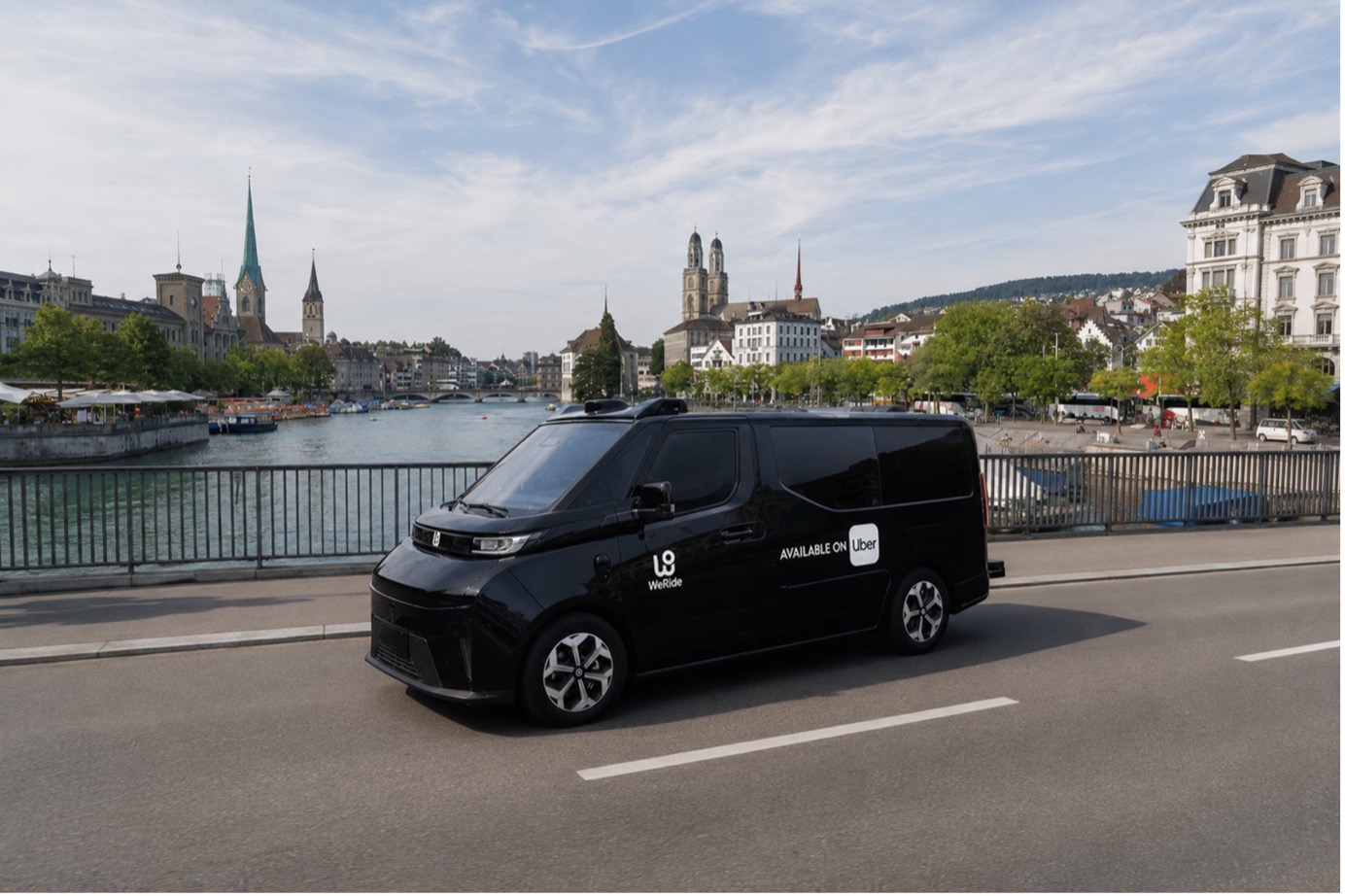
Second European announcement, with public operations expected later this year via the Uber app Zurich will serve as the companies' first deployment region in Switzerland, subject to regulatory approval WeRide's asset-light operating strategy continues with Rydera as fleet operator, supporting scalable deployment ZURICH, June 17, 2026 (GLOBE NEWSWIRE) -- WeRide (NASDAQ: WRD, HKEX: 0800), a global leader in autonomous driving technology, and Uber Technologies, Inc. (NYSE: UBER) today announced plans to launch commercial Robotaxi services in the Greater Zurich Region, marking their second joint deployment in Europe within weeks of announcing Madrid . Illustration of WeRide and Uber's Robotaxi GXR in Zurich Operations are expected to begin later this year in collaboration with Switzerland's Federal Roads Office (FEDRO).

globenewswire.com•2026-06-15
WeRide Achieves Record Six Consecutive Wins at China Urban Intelligent Driving Competition
TIANJIN, China, June 15, 2026 (GLOBE NEWSWIRE) -- At the Tianjin event of the Second China Intelligent Driving Competition hosted by D1EV.COM, a leading electric and intelligent vehicle media platform, the Chery Exeed Sterra ES equipped with WeRide Driving (WRD 3.0), co-developed by WeRide and Bosch, took first place with its stable and efficient driving performance throughout the competition. This landmark victory secures the first and only six-win streak in the history of the competition, further solidifies WRD 3.0's industry-leading position in consistent full-scene performance.

zacks.com•2026-06-11
Top Stocks Powering the Future of Electric and Self-Driving Vehicles
From EVs and robotaxis to charging networks and lithium, NIO, WeRide, ChargePoint and Lithium Americas offer exposure to the future of mobility.

globenewswire.com•2026-06-10
Slovak Prime Minister Meets WeRide, Signals Support for Multi-Product Autonomous Vehicle Deployment
WeRide outlined plans to commercialize its L4 AV portfolio in Slovakia during a meeting with His Excellency Mr. Robert Fico Prime Minister of Slovakia.

seekingalpha.com•2026-06-05
WeRide: Focus On Geographical Diversification And Regulatory Developments
WeRide Inc. remains a Buy; I remain positive on the profitability upside relating to international expansion and see risks regarding China's suspension of new autonomous vehicle approvals as overblown. WRD's non-China operations achieved a 50% gross profit margin in 2025, or 20 percentage points above the group average, supporting aggressive overseas growth plans. Regulatory headwinds in China are likely temporary; WRD's existing domestic robotaxi fleets are still up and running, and management expects permit issuance to resume within two months.
Related Companies in Technology





Fundamentals Overview
Loading fundamentals overview...
So what: Q3 shows strong commercial traction and a credible path to profitability, but the margin story hinges on utilization and regulatory speed. Management highlighted “citywide fully driverless” commercialization in Abu Dhabi via Uber—coverage ~50% of the city core, up to 20 trips per vehicle per 12-hour shift—and laid out a next-step operating plan: extend to 24/7, push utilization >25 orders/day, and reach a 1:10 human-to-vehicle ratio. The Q&A quantification is the real signal: international revenue economics are framed using a USD 90k+ annual platform revenue per car at ~25 orders/day, with WeRide’s implied take-rate ranging (example: 30% => ~$30k/car/year vs 70% => ~$60k). However, analysts’ concerns about scalability get a clear gating factor: regulatory hurdles/permits and “prudence” outside the Abu Dhabi success case. Net: management’s tone is optimistic, but analyst pressure centers on how quickly permits and utilization economics can replicate globally.
 Growth Catalysts
- Abu Dhabi citywide fully driverless robotaxi commercial permit (removes in-car safety officer requirement)
- Operational launch in Abu Dhabi via Uber; coverage ~50% of Yas Island core area; up to 20 trips per vehicle per 12-hour shift
- EU/Switzerland deployment: first driverless robotaxi license enabling autonomous operation in the Furttal region; public service targeted H1 2026
- Singapore expansion with Grab: LTA approval for robotaxi + robobus in Punggol District; AV test volume targeted 4x by end of 2025
- China ramp: 24/7 driverless commercial service in Guangzhou (Huangpu District), 150 km² area; >300 robotaxi in Guangzhou and >100 in Beijing by October
Business Development
- Uber (UAE/Abu Dhabi driverless robotaxi commercialization and revenue streams internationally)
- Grab (Singapore robotaxi + robobus approval and planned integration into Grab fleet management/routing)
- SBB, TXAI mentioned as international platform partners (collaboration model)
- Kwoon Chung Bus Holding (Hong Kong partnership for >500 L4 vehicles over next 3 years)
- Bosch (WePilot 3.0 start of production; end-to-end ADAS for mass production, OTA to Chery EXEED ES/ET owners)
- GAC (Guangzhou Automotive Group): WePilot selected as major ADAS provider for multiple passenger car models
Financial Highlights
- Revenue: RMB 171m in Q3 2025 (+144% YoY)
- Product revenue: RMB 79m (+428% YoY); Service revenue: RMB 92m (+67% YoY); service surpassed product
- Robotaxi revenue: RMB 35m (+761% YoY), 21% of total revenue
- Gross profit: RMB 56m (+1,124% YoY); gross margin: 33%
- Operating expenses: RMB 436m (-51% YoY)
- Net loss: RMB 307m (-71% YoY); adjusted net loss: RMB 276m (+15% YoY)
- Liquidity: cash/cash equivalents & time deposits RMB 4.5b; wealth management products RMB 926m; restricted cash RMB 18m; short-term bank borrowing RMB 245m (as of Sept 30, 2025)
Capital Funding
- No buyback disclosed
- Short-term bank borrowing: RMB 245m
- Cash runway supported by RMB 4.5b cash/time deposits + RMB 926m wealth products; Hong Kong secondary primary listing proceeds in November cited as supporting liquidity
Strategy & Ops
- Abu Dhabi unit-economics operating plan: extend service hours to 24/7; target >25 trips per vehicle per day; improve human-to-vehicle ratio to 1:10
- International business model shift: asset-light international model via partners (Uber/Grab/etc.) where WeRide sells vehicles to partners and earns revenue share + annual licensing
- China service/product: PU/DO (free pickup & drop-off) feature to recommend optimal boarding locations; operational adoption indicators include up to 25 daily trips (Guangzhou, November) and 23 (Beijing)
Market Outlook
- Abu Dhabi operational targets: 24/7 hours next year; daily utilization target >25 orders/vehicle/day
- Global fleet expansion plan: scale Abu Dhabi fleet to >500 vehicles by next year; tens of thousands by 2030
- China economics targets (Tier 1 cities): achieve high double-digit orders/day, explicitly 'more than 20 orders per day' as an economics driver
- UAE trial/launch roadmap: Dubai supervised trial on Uber targeted this year; driverless commercial operation targeted for 2026
Risks & Headwinds
- Key hurdle emphasized in Q&A: regulatory permits—countries are 'more prudent' and regulatory issues can slow replication of the Abu Dhabi model
- Operational hurdle/catalyst dependence: achieving utilization thresholds (breakeven referenced at ~12 orders per vehicle per 12-hour shift; profitability tied to reaching ~25 orders/day when hours extend to 24/7)
- Competitive landscape risk: OEM/platform entry into robotaxi is increasing, but management argued robotaxi execution is 'not easy' and maturity/experience is required (implying continued competitive/regulatory pressure)
Sentiment: POSITIVE
Note: This summary was synthesized by AI from the WRD Q3 2025 earnings transcript. Financial data is complex; please verify all metrics against official SEC filings before making investment decisions.
📋 Official Regulatory 10-K / 10-Q SEC Filings
Direct authenticated documentation links to audited SEC database reports for WRD.
SEC EDGAR Live Feed
No recent 10-K available.
No recent 10-Q available.
Loading financial data and tables...
📁