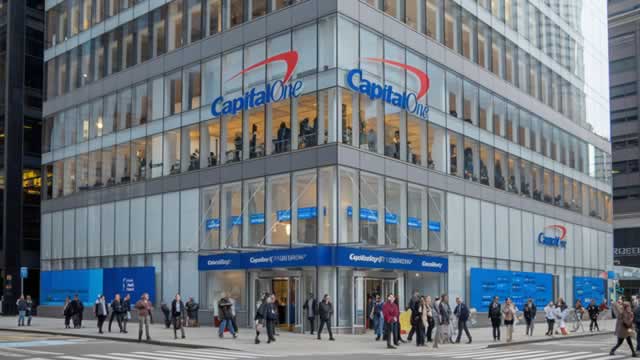
Capital One Financial Corporation

Capital One Financial Corporation (COF) Market Cap

Capital One Financial Corporation has a market capitalization of .

No quote data available.

CEO: Richard D. Fairbank

Sector: Financial Services

Industry: Financial - Credit Services

IPO Date: 1994-11-16

Website: https://www.capitalone.com

Capital One Financial Corporation (COF) - Company Information

Market Cap: -|Sector: Financial Services

Company Profile

Capital One Financial Corporation operates as the financial services holding company for the Capital One Bank (USA), National Association; and Capital One, National Association, which provides various financial products and services in the United States, Canada, and the United Kingdom. It operates through three segments: Credit Card, Consumer Banking, and Commercial Banking. The company accepts checking accounts, money market deposits, negotiable order of withdrawals, savings deposits, and time deposits. Its loan products include credit card loans; auto and retail banking loans; and commercial and multifamily real estate, and commercial and industrial loans. The company also offers credit and debit card products; online direct banking services; and treasury management and depository services. It serves consumers, small businesses, and commercial clients through digital channels, branches, cafés, and other distribution channels located in New York, Louisiana, Texas, Maryland, Virginia, New Jersey, and California. Capital One Financial Corporation was founded in 1988 and is headquartered in McLean, Virginia.

Analyst Sentiment

81%
Strong Buy

From 23 Active Polls

1Y Forecast: $267.18

▲ +0.0% Potential Upside

Consensus Target Metrics

Low Bound

$213

Median

$270

High Bound

$300

Average

$267

Price & Moving Averages

Loading chart...

🎯 Wall Street Analyst Intelligence Report

1-Year structural target targets, chart projections, and sentiment maps.

Average 1Y Target
$267.18
▲ +47.88% Upside
Low Target
$213.00
18% Risk
Median Target
$270.00
49% Mid
High Target
$300.00
66% Max

Consensus Trend Projection

Trailing closures vs. 12-month metrics map.

Analyst Vote Distribution

Aggregate institutional coverage sentiment weights.

Sentiment volume allocation data unavailable.

Historical valuation matrix unavailable.

📘 Full Research Report

ℹ️

AI-Generated Research: This report is for informational purposes only.

📘 CAPITAL ONE FINANCIAL CORP (COF) — Investment Overview

🧩 Business Model Overview

Capital One operates primarily as a consumer credit franchise, sourcing funding through deposits and capital markets while deploying capital into revolving and installment lending (most notably credit cards and auto loans). The company generates earnings by (1) underwriting consumer risk, (2) managing portfolio performance through servicing and collections, and (3) balancing funding costs with earning-asset yields. A meaningful part of the value chain is “behind-the-scenes”: data-led credit decisions, ongoing account management, and cost discipline that convert market demand for consumer credit into attractive risk-adjusted returns.

💰 Revenue Streams & Monetisation Model

Monetisation is a blend of interest income and fee income. The key drivers typically include:

  • Net interest income: interest earned on credit card and loan assets, net of funding costs on deposits and borrowings. Net interest margin and the spread over funding are central margin levers.
  • Interchange and card-related fees: revenue tied to card usage patterns and merchant processing economics. Interchange tends to be sensitive to network and regulatory dynamics.
  • Other revenue: servicing and ancillary products that broaden profitability per customer relationship.

The company’s operating model aims to sustain profitability by keeping credit losses within an expected range and by using expense efficiency to support returns through cycles. As portfolios season and underwriting tightens/loosens across risk segments, the mix between yield, fees, and credit costs becomes the dominant earnings driver.

🧠 Competitive Advantages & Market Positioning

Capital One’s structural moat is most evident in three areas relevant to financials: (1) Cost of Deposits, (2) Credit Culture and underwriting/portfolio management, and (3) Regulatory/Compliance Scale.

  • Cost of Deposits: a large and diversified deposit base can lower blended funding costs relative to peers that rely more heavily on wholesale funding. Lower funding cost supports net interest income even when asset yields normalize.
  • Credit Culture: disciplined underwriting, robust risk models, and active account management can reduce severity in downturns and improve risk-adjusted returns over the cycle. For card portfolios, loss performance and recoveries are crucial.
  • Regulatory Moats: operating at scale with mature compliance, capital planning, and risk governance creates execution barriers. The cost and sophistication required for stress testing, underwriting governance, and consumer protections can be material for challengers.

COMPETITIVE BENCHMARKING

  • JPMorgan Chase and large diversified banks: compete with strong funding access and broad consumer banking relationships. Capital One’s focus is more concentrated in credit products and deposit-funded lending, which can produce sharper execution on underwriting and expense efficiency when risk is managed.
  • American Express: strong in premium card economics and proprietary underwriting, with a historically different merchant and network structure. Capital One competes more directly on mass-market credit availability and cross-sell using a deposit-funded balance sheet.
  • Discover Financial Services and Synchrony: each emphasizes distinct funding and partnerships (including network and co-brand/private label structures). Capital One generally competes through its own card and lending origination engine and a broad suite of consumer credit products, rather than relying primarily on partner-program economics.

Net effect: while peers can compete on marketing, pricing, and product design, Capital One’s advantage is tied less to short-term promotional strength and more to recurring profitability from disciplined risk selection, deposit-based funding economics, and operational execution at scale.

🚀 Multi-Year Growth Drivers

Over a 5–10 year horizon, growth is anchored in credit demand, balance sheet expansion capacity, and improving per-customer economics, supported by risk discipline:

  • Secular shift toward electronic and card-based spending: consumer spending increasingly flows through card rails, supporting long-run account base growth and utilization-related revenue.
  • Share gains in targeted segments: disciplined underwriting and data-driven decisioning can enable measured portfolio growth where competitors may be constrained by risk appetite or operational bandwidth.
  • Cross-sell and product expansion: converting deposit relationships into broader lending and card products supports higher lifetime value while maintaining controllable risk.
  • Operating leverage from scale and technology: automation in servicing, underwriting workflow, fraud controls, and collections can moderate expense growth relative to revenue growth.
  • Capital allocation and balance sheet optimization: returns can improve through portfolio mix optimization, securitization strategy where applicable, and capital management aligned to regulatory requirements.

These drivers matter because the credit cycle can move spreads and losses; the durable element is the ability to expand earnings capacity while keeping credit performance within modeled expectations.

⚠ Risk Factors to Monitor

  • Credit cycle deterioration: worsening unemployment or consumer stress can raise delinquency and charge-off rates, compressing profitability despite stable underwriting.
  • Funding and interest rate risk: deposit pricing dynamics, wholesale funding availability, and changes in the yield curve can affect net interest income and the spread between earning assets and liabilities.
  • Regulatory and policy risk: changes to interchange rules, consumer protection enforcement, capital requirements, or debt collection practices can alter revenue and cost structures.
  • Model and execution risk: underwriting models, fraud detection, and collections strategies depend on stable customer behavior; regime shifts can reduce effectiveness.
  • Operational and cyber risk: digital servicing and data infrastructure create ongoing risks related to system availability, privacy, and fraud.

📊 Valuation & Market View

Equity markets typically value consumer lenders and banks using a framework centered on earnings power and balance-sheet quality rather than pure growth multiple. Key valuation indicators include:

  • Return on equity and economic profitability: sustainable ROE driven by net interest margin, fee generation, and credit cost control.
  • Credit performance vs. pricing: how losses track relative to expectations and how recoveries behave across cycles.
  • Efficiency and operating leverage: the ability to keep expense growth below revenue and to scale technology responsibly.
  • Capital adequacy: market attention to CET1 strength and the ability to fund growth without sacrificing risk-adjusted returns.
  • Funding cost trajectory: deposit beta and the resilience of funding under stress influence earnings durability.

Drivers that typically move the market view include changes in interest rate environment, credit quality trends, regulatory outcomes affecting card economics, and evidence that management can sustain risk-adjusted profitability through downturns.

🔍 Investment Takeaway

Capital One’s long-term investment case rests on repeatable profitability from a deposit-funded consumer credit platform, reinforced by underwriting and portfolio management discipline. The core moat is not promotional intensity but the combination of cost-efficient funding, credit culture, and scale-driven compliance and risk execution barriers that make it difficult for competitors to replicate outcomes consistently through credit and rate cycles.


⚠ AI-generated — informational only. Validate using filings before investing.

📊 AI Financial Analysis

Powered by StockMarketInfo
Earnings Data: Q Ending 2026-03-31

"COF (Capital One) delivered Revenue of $19.3B and Net Income of $2.17B in the latest quarter (EPS $3.34). YoY, Revenue rose about +44% (vs. $13.4B) and Net Income increased about +55% (vs. $1.40B). QoQ, Revenue dipped roughly -2.0% (vs. $19.7B) while Net Income edged up about +1.9% (vs. $2.13B). Profitability looks modestly healthier: net margin improved to ~11.3% from ~10.8% QoQ and ~10.5% YoY, indicating margin expansion despite the slight topline softness. On the balance sheet, Total Assets were up to ~$682.9B versus ~$669.0B last quarter, with Equity relatively stable around ~$112.3B (vs. ~$113.6B). However, leverage/liquidity quality worsened: net debt moved from net cash in prior quarters (negative net debt of about -$6.4B in 2025-12-31) to +$44.6B at 2026-03-31. Shareholder returns were strong: the stock is up ~29% over the last year (capital appreciation tailwind >20% threshold). Dividend yield is modest (~0.44% latest), and the dataset does not show meaningful share count reduction (shares increased materially YoY), suggesting buybacks may not have offset dilution in this sample. Valuation appears supportive: consensus target ~$269 implies ~30% upside from the $206.47 price, alongside a reasonable ~13x P/E."

Revenue Growth

Positive

Latest quarter Revenue of $19.3B fell ~-2.0% QoQ but surged ~+44% YoY, showing strong year-over-year momentum.

Profitability

Good

Net Income increased ~+1.9% QoQ and ~+55% YoY; net margin improved to ~11.3% from ~10.8% QoQ, indicating margin expansion. EPS declined QoQ (3.34 vs 4.32) likely influenced by higher share count.

Cash Flow Quality

Neutral

Net Income is positive and grew YoY, supporting earnings quality; dividend payout ratio decreased to ~0.23 (from ~0.56 prior quarter), but dividend yield remains low (~0.44%). No explicit buyback/cash flow detail provided.

Leverage & Balance Sheet

Neutral

Total Assets rose QoQ and Equity is stable (~$112B). Liquidity/leverage deteriorated materially: net debt shifted from net cash (about -$6B to -$4B) to +$44.6B.

Shareholder Returns

Good

Total return tailwind is strong: price up ~29% over 1 year (>20% momentum). Dividend yield is modest; share count increased in this history, implying buybacks are not clearly net accretive in the provided quarters.

Analyst Sentiment & Valuation

Good

Consensus target ~$269 vs. ~$206.47 current implies ~30% upside. Valuation is reasonable with P/E ~13.1 on the latest quarter.

Disclaimer:This analysis is AI-generated for informational purposes only. Accuracy is not guaranteed and this does not constitute financial advice.

Fundamentals Overview

Loading fundamentals overview...

COF delivered solid underlying momentum in Q1 2026: EPS of $3.34 (adjusted $4.42) with pre-provision earnings up 8% sequentially, while provisions were roughly flat at ~$4.1B. Credit quality remained strong—coverage ratios improved 12 bps to 5.28%—though Domestic Card charge-offs rose 17 bps QoQ to 5.1% (seasonal) and commercial criticized rates ticked higher. The main earnings headwind was NIM at 7.87%, down 39 bps QoQ, driven by fewer days (~18 bps) and elevated cash levels. Management expects NIM to normalize seasonally (9 bps step-ups into Q2/Q3/Q4) and cash to decline over time with ~$8B Q2 maturities and tax payments. Strategic catalysts are accelerating: Brex closed April 7 (~$4.5B consideration; “a little over 40 bps” CET1 drag expected in Q2) and Hopper travel technology moved in-house with a new app—both likely lifting expense run-rate from Q2. Macro risk centers on elevated energy prices and geopolitical uncertainty, but management reported no adverse spend or credit impact so far.

AI IconGrowth Catalysts

  • Domestic Card top-line growth supported by Discover purchase volume; YOY purchase volume up 40% (about 8% excluding Discover)
  • Consumer Banking: auto originations up 21% YOY and Consumer Banking ending loans up ~10% YOY (driven by Discover operations/synergies plus auto loan growth)
  • Successful conversion of Capital One debit customers to the Discover Network (supported payment volume resilience)
  • Strategic momentum from full in-sourcing of Capital One travel technology (post Hopper partnership) and launch of new Capital One travel app (impacts from Q2 onward)

Business Development

  • Brex acquisition closed April 7; consideration to shareholders ~ $4.5B; expected CET1 decrease a little over 40 bps in Q2
  • Discover integration continues; disclosed effects include addition of Discover purchase volume, loans, deposits, and conversion of Capital One debit customers to Discover network
  • Hopper partnership: Capital One fully owns the travel technology in April; Hopper talent joins Capital One; launch of Capital One travel app

AI IconFinancial Highlights

  • Reported EPS: $3.34 diluted/common share; adjusted EPS net of adjusting items: $4.42
  • Relative to prior quarter: revenue declined 2% while noninterest expense declined 9%
  • Pre-provision earnings: +$530M (+8%) sequentially; adjusted pre-provision earnings +$430M (+6%)
  • Provision for credit losses: ~ $4.1B (roughly flat); includes $3.8B net charge-offs and $230M allowance build
  • Allowance build drove allowance balance to $23.6B; total portfolio coverage ratio increased 12 bps to 5.28%
  • Domestic Card coverage ratio +23 bps to 7.4%; Consumer Banking coverage ratio +13 bps to 2.36%; Commercial coverage ratio +7 bps to 1.7%
  • Net interest margin (NIM): 7.87%, down 39 bps QoQ; drivers: 2 fewer days (~18 bps), seasonal lower average card balances, and elevated cash levels (including full quarter impact of last quarter Discover Home Loans sale)
  • Capital position: CET1 14.4%, +10 bps QoQ; offsetting items included $2.5B share repurchases

AI IconCapital Funding

  • Share repurchases: $2.5B during Q1 (explicitly cited as offsetting income/seasonal risk-weight decline)
  • Brex acquisition consideration: ~ $4.5B paid at close (post-quarter); expected CET1 decrease a little over 40 bps in Q2
  • Cash position: ended Q1 at ~$76B (up ~$19B QoQ); total liquidity reserves ~$165B (up ~$21M QoQ)

AI IconStrategy & Ops

  • Brex and Hopper travel infrastructure expected to enter second-quarter and “numbers starting in the second quarter will include Brex and the in-sourcing of our travel business”
  • Discover integration milestones: converted Capital One debit customers to Discover network (April close synergy progress cited as on track)
  • Credit/allowance: management incorporated heightened geopolitical uncertainty via qualitative factors into allowance build
  • Marketing: total company marketing ~$1.5B, +25% YOY; management attributed investment mix and shifting planned spend into later quarters to seasonally low Q1 marketing

AI IconMarket Outlook

  • NIM seasonality expectations: one more day in Q2 expected to add 9 bps to NIM; same 9 bps jump into Q3 and Q4 (directionally described)
  • Liquidity/cash expectation: management expects cash position to trend down over time from Q1’s elevated levels, with ~$8B debt maturities in Q2 plus tax payments in Q2
  • Earnings power framework: management reiterated earnings power on the other side of Discover integration expected consistent with deal-model assumptions, inclusive of Brex and Hopper infrastructure; earnings power anchored to 12.5% capital level

AI IconRisks & Headwinds

  • Charge-off rate: Domestic Card 5.1% for Q1, up 17 bps QoQ (in line with seasonality); auto charge-offs 1.64% up 9 bps YOY but down 18 bps sequentially
  • Consumer macro risk: management highlighted potential headwind from elevated energy prices and a “new conflict in the Persian Gulf”; stated they have not seen adverse portfolio/spend impacts yet but remain watchful
  • Discover growth headwind: legacy Discover card loans contracting slightly; outlined “temporary growth headwind” due to Discover prior credit policy cutbacks and additional credit policy changes post-acquisition
  • Commercial credit watch: commercial criticized performing loan rate up 31 bps QoQ to 4.99%; criticized nonperforming loan rate up 4 bps QoQ to 1.4%
  • Expense/efficiency uncertainty: management declined to give efficiency ratio targets, citing continued investment agenda and variable timing/seasonality

Q&A: Analyst Interest

  • Consumer resilience & macro risk: Management said the U.S. consumer stayed healthy with resilient spending, low/steady jobless claims, and income growth running ahead of inflation. They acknowledged elevated energy-price risk from the Persian Gulf conflict and said they incorporated qualitative macro risk into the allowance while seeing no adverse effects yet.
  • NIM and liquidity go-forward: Andrew explained Q1’s 39 bp NIM decline was driven by 2 fewer days (~18 bps) plus seasonal card paydowns and elevated cash from factors like the Discover Home Loans sale full-quarter impact and strong retail deposit growth. He expects cash to trend down, with ~$8B debt maturities in Q2 and tax payments.
  • Efficiency trajectory and investment magnitude: Rich reiterated that Brex and Hopper are not in current efficiency ratio and that marketing levels will be heavier through the year. He emphasized no fixed efficiency guidance, but reinforced that “earnings power” (ROTCE at constant capital) remains consistent with deal assumptions inclusive of Brex/Hopper.

Sentiment: MIXED

Note: This summary was synthesized by AI from the COF Q1 2026 earnings transcript. Financial data is complex; please verify all metrics against official SEC filings before making investment decisions.

Loading financial data and tables...
© 2026 Stock Market Info — Capital One Financial Corporation (COF) Financial Profile