
📘 CAMPBELL SOUP (CPB) — Investment Overview
🧩 Business Model Overview
Campbell Soup operates in the U.S. and international consumer packaged goods (“CPG”) value chain: it sources food ingredients, manufactures shelf-stable and refrigerated products, and sells to large retailers, wholesalers, and foodservice customers. The economic model depends on (1) efficient, high-utilization production across branded and private-label SKUs, (2) distribution reach and trading relationships that secure shelf and promotional access, and (3) mix management to sustain gross margin through pricing, cost productivity, and formulation strategies.
💰 Revenue Streams & Monetisation Model
Revenue is primarily driven by branded packaged foods and, to a meaningful extent, private-label and contracted supply. Monetisation follows a typical staples pattern: a large portion of demand is repeat purchase at the household level, supporting stable baseline volumes, while incremental profitability is earned through margin discipline.
- Branded packaged foods: Monetises consumer preference and retailer shelf placement; margin sensitivity to input costs (e.g., vegetables, protein, packaging).
- Private label / store brands: Monetises manufacturing capability and supply reliability; typically lower gross margin but supports utilization and volume stability.
- Foodservice and international channels: Provides additional volume opportunities and mix benefits, though margins can vary by customer contracting terms.
Key margin drivers include manufacturing efficiency (cost per unit), procurement and co-packing advantages, packaging and freight management, and the ability to offset commodity inflation through pricing and product mix.
🧠 Competitive Advantages & Market Positioning
Campbell Soup’s competitive position is rooted less in network effects and more in scale/distribution leverage and cost advantages in manufacturing and procurement, complemented by intangible assets (established brands and product formulations) that support consumer trust and retailer shelf commitment.
- Scale/Distribution leverage: Broad retailer presence and category management relationships allow Campbell to defend placement and execute mix/pricing strategies across a large SKU portfolio.
- Manufacturing cost advantages: Multi-plant production and continuous operational focus supports unit-cost competitiveness and flexibility across branded and private-label demand.
- Intangible assets: Trusted product identities and established recipes reduce perceived substitution risk versus smaller challengers, supporting stable demand even when promotional intensity rises.
Competitive benchmarking (primary competitors):
- General Mills (Progresso, among other meal solutions): Competes in adjacent packaged soup and meal categories, often emphasizing brand extensions and consumer-facing marketing.
- Conagra Brands (e.g., frozen/meal and pantry categories): Competes via portfolio breadth across meal solutions, sometimes reallocating promotional spend across categories.
- Unilever (Knorr and related global soup/seasoning franchises): Participates through strong international brands and seasoning-led meal solutions, with different regional demand drivers.
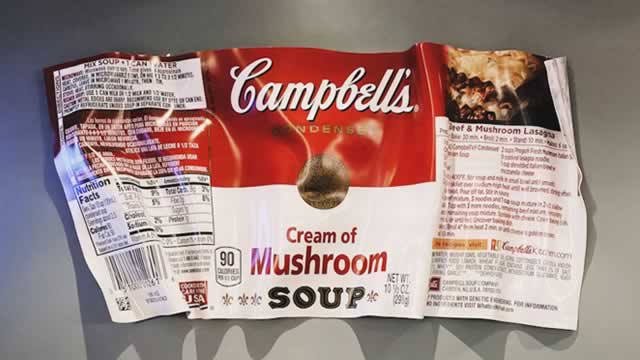
Campbell’s positioning differs in its sustained focus on condensed/shelf-stable soup heritage combined with a scalable manufacturing base and a value-engineering approach that supports both branded and private-label supply—an advantage when retailer mix shifts or promotional intensity compresses industry pricing.
🚀 Multi-Year Growth Drivers
- Category demand for convenient, at-home meal solutions: Long-run structural preference for quick preparation supports baseline volumes in soup and meal categories.
- Premiumization and formulation-based differentiation: Product innovation aligned to nutrition (e.g., sodium reduction, protein-forward variants, and better-for-you positioning) can improve mix and reduce reliance on price-only growth.
- Retail and e-commerce share capture: Ability to maintain availability and manage assortment supports growth where distribution channels increasingly reward reliable supply and SKU rationalization.
- Utilization-led profitability: Leveraging production capacity across branded and private-label demand can improve returns on fixed manufacturing costs over a full cycle.
Over a 5–10 year horizon, growth is more likely to be driven by mix and category share than by unit volume expansion, consistent with mature CPG market dynamics.
⚠ Risk Factors to Monitor
- Commodity and input-cost volatility: Changes in agricultural inputs and packaging costs can pressure gross margins if pricing power lags inflation.
- Retailer bargaining power and promotion intensity: Large customers can increase promotional requirements, demand co-investment, or shift mix toward private label.
- Private-label substitution: Store brands can compress branded margins, especially when consumer trade-down becomes more pronounced.
- Regulatory and labeling/sodium targets: Compliance costs and formulation changes can affect product economics and innovation timelines.
- Food safety and quality events: Operational risks can lead to recalls, reputational damage, and incremental costs.
- Currency and international execution: International exposure can introduce FX volatility and channel-specific margin variation.
📊 Valuation & Market View
Valuation for consumer staples companies like Campbell is typically anchored to earnings durability and cash generation, often expressed through EV/EBITDA and earnings multiples rather than revenue growth-based metrics. Key valuation sensitivities include:
- Gross margin trajectory: Input costs and pricing/mix effectiveness move the multiple and influence perceived earnings quality.
- Volume stability: Mature category stability supports a premium versus cyclical food peers, provided promotional intensity remains controlled.
- Free cash flow conversion: Working capital management and capex discipline influence valuation through cash-return capacity.
- Capital allocation credibility: Dividend and buyback execution can support shareholder returns when earnings growth is modest.
In this sector, markets typically reward evidence of sustained unit-cost control, resilient demand, and disciplined capital allocation rather than aggressive top-line expansion assumptions.
🔍 Investment Takeaway
Campbell Soup offers an evergreen staples profile supported by manufacturing and procurement efficiency, scale/distribution leverage, and intangible brand/formulation assets that help defend demand through retailer and promotional cycles. The investment thesis is strongest when execution maintains gross margin resilience (cost control and mix), sustains distribution placement, and limits branded-versus-private-label erosion—positioning CPB to generate dependable cash flows over a full business cycle.
⚠ AI-generated — informational only. Validate using filings before investing.


















 Growth Catalysts