Corvus Pharmaceuticals, Inc.

Corvus Pharmaceuticals, Inc. (CRVS) Market Cap

Corvus Pharmaceuticals, Inc. has a market capitalization of $1.12B.

Price: $13.26

0.07 (0.53%)

Market Cap: 1.12B

NASDAQ · time unavailable

CEO: Richard A. Miller

Sector: Healthcare

Industry: Biotechnology

IPO Date: 2016-03-23

Website: https://www.corvuspharma.com

Corvus Pharmaceuticals, Inc. (CRVS) - Company Information

Market Cap: 1.12B|Sector: Healthcare

Company Profile

Corvus Pharmaceuticals, Inc. is a clinical-stage biopharmaceutical firm specializing in the development and commercialization of immuno-oncology therapies. Their leading investigational compound, Mupadolimab (CPI-006), an anti-CD73 monoclonal antibody, is currently progressing through Phase Ib/II clinical trials for the treatment of non-small cell lung cancer and head and neck cancers. Another promising candidate, CPI-818, functions as a covalent ITK inhibitor. This therapy is undergoing Phase I/Ib clinical evaluation for patients battling various malignant T-cell lymphomas, aiming to impede the proliferation of specific malignant T-cells. Additionally, Ciforadenant (CPI-444), an oral, small molecule antagonist of the A2A receptor, is in Phase II clinical trials for individuals diagnosed with either advanced or refractory renal cell carcinoma. Beyond these clinical-stage assets, Corvus maintains a preclinical portfolio including CPI-182, an antibody designed to block inflammation and myeloid suppression, and CPI-935, an adenosine A2B receptor antagonist intended to prevent fibrosis. The company also benefits from a strategic collaboration with Angel Pharmaceuticals, which aids in advancing its diverse pipeline of targeted experimental drugs. Founded in 2014, Corvus Pharmaceuticals is headquartered in Burlingame, California.

Analyst Sentiment

92%
Strong Buy

From 7 Active Polls

1Y Forecast: $40.00

▲ +201.7% Potential Upside

Consensus Target Metrics

Low Bound

$40

Median

$40

High Bound

$40

Average

$40

Price & Moving Averages

Loading chart...

🎯 Wall Street Analyst Intelligence Report

1-Year structural target targets, chart projections, and sentiment maps.

Average 1Y Target
$40.00
▲ +201.66% Upside
Low Target
$40.00
202% Risk
Median Target
$40.00
202% Mid
High Target
$40.00
202% Max
Consensus
Buy
12 / 13 Buys

Consensus Trend Projection

Trailing closures vs. 12-month metrics map.

Analyst Vote Distribution

Aggregate institutional coverage sentiment weights.

📊 Historical Valuation Multiples

Real-time Trailing Twelve Month (TTM) momentum side-by-side with discrete quarterly metrics.

Fiscal QuarterTTMQ1 2026Q4 2025Q3 2025Q2 2025Q1 2025Q4 2024Q3 2024Q2 2024
Period EndingTrailing 12MMar 31, 2026Dec 31, 2025Sep 30, 2025Jun 30, 2025Mar 31, 2025Dec 31, 2024Sep 30, 2024Jun 30, 2024
Market Cap ($M)1,1151,317608611311229366352110
Enterprise Value ($M)1,0761,27760460929722635834896
Price to Earnings Ratio (P/E)-24.11-24.38-10.69-15.35-10.003.79-7.43-2.20-6.61
Price/Earnings-to-Growth Ratio (PEG)
Price to Sales Ratio (P/S)
Price to Book Ratio (P/B)4.965.479.938.513.884.6511.2328.382.16
Price to Free Cash Flow Ratio (P/FCF)-31.73-125.81-65.98-63.82-52.82-27.64-43.20-55.72-20.15
Enterprise Value to Sales (EV/Sales)
Enterprise Value to EBITDA (EV/EBITDA)-25.45-107.53-49.16-60.09-37.3314.82-29.61-8.65-22.71
Debt to Equity Ratio0.930.000.020.010.010.020.030.030.01

📘 Full Research Report

ℹ️

AI-Generated Research: This report is for informational purposes only.

```html

📘 CORVUS PHARMACEUTICALS INC (CRVS) — Investment Overview

🧩 Business Model Overview

Corvus Pharmaceuticals is an oncology-focused biopharmaceutical company that creates and develops immune-mediated therapies, with value creation driven by translating preclinical biology into human clinical outcomes and ultimately into regulatory approvals and commercial adoption. The business model is fundamentally pipeline-based: it invests capital to advance investigational assets through clinical trials, then monetizes through (i) commercialization of approved products where feasible and (ii) partnering and licensing arrangements that share development and/or commercialization economics with larger pharmaceutical companies.

Customer “stickiness” in biotech is less about procurement contracts and more about clinical standard-of-care integration. Once a therapy demonstrates durable benefit in specific tumor types and biomarker-defined populations, oncologists and treatment guidelines tend to embed it into care pathways—creating persistence in demand and reducing the probability of rapid displacement without new superior data.

💰 Revenue Streams & Monetisation Model

For many development-stage oncology biotechs, revenue typically emerges in stages:

  • Milestone- and royalty-based partnering: Upfront fees, development milestones, regulatory milestones, and royalties tied to commercial performance—often the dominant model prior to sustained product revenues.
  • Commercial product economics (post-approval): Gross margin depends on manufacturing and distribution structure; partnering can shift economics from company-operated sales toward royalty streams.
  • Out-licensing / co-development: Corvus can monetize components of the development plan by transferring parts of the risk and execution burden to larger players.

Margin structure is principally driven by the stage of the pipeline: the nearer a program is to approval, the larger the portion of economics that can flow from royalties and product sales relative to ongoing trial spending. The key investor lever is whether clinical outcomes support premium positioning in combination regimens—typically the highest-leverage scenario for immune-oncology assets.

🧠 Competitive Advantages & Market Positioning

Corvus operates in a crowded immuno-oncology landscape, where differentiation depends on biological plausibility, clinical differentiation (efficacy/safety), and the defensibility of intellectual property and development strategy. The most durable moats available in this context are:

  • Patent protection & IP ownership: Immunotherapy assets rely heavily on proprietary constructs, methods of use, and combination frameworks that can extend competitive durability beyond the first filing.
  • Regulatory and clinical data barriers: Demonstrating benefit to regulatory standards in defined indications creates practical barriers to entry; competitor replication requires comparable clinical effort and patient enrollment capacity.
  • Integrated development positioning: Strengthening the clinical “fit” into existing standard-of-care combinations (and, where supported, biomarker-driven patient selection) increases the probability of guideline adoption and clinician familiarity.

COMPETITIVE BENCHMARKING: Corvus’s closest competitive set includes large, established immune-oncology developers such as Bristol Myers Squibb, Merck & Co., and Roche/Genentech. These incumbents generally compete with broad oncology franchise assets and scale advantages in late-stage development and commercialization.

Compared with these rivals, Corvus focuses on advancing next-generation immune-modulating therapeutics—seeking differentiation through specific mechanism design, combination strategy, and clinical performance in targeted settings rather than relying on franchise breadth alone.

🚀 Multi-Year Growth Drivers

Over a 5–10 year horizon, Corvus’s growth path is primarily a function of pipeline probability-adjusted value creation and market expansion in immuno-oncology combinations:

  • Expansion of immuno-oncology treatment frameworks: Growth is not only from new monotherapies but from combination regimens intended to improve response rates, durability, and patient subsets.
  • Biomarker-enabled patient selection: As clinical practice increasingly aligns with biomarker-defined populations, assets that can demonstrate consistent efficacy in specific patient groups can gain disproportionate uptake.
  • Platform learning and iterative development: Mechanism-based development and improved trial design can increase efficiency of future studies by focusing on responsive disease settings.
  • Partnering leverage: If clinical signals strengthen, larger pharmaceutical partners can become more willing to co-develop and fund late-stage trials, reducing capital intensity relative to fully independent development.

⚠ Risk Factors to Monitor

  • Clinical trial risk and probability of success: Immuno-oncology has a history of late-stage failures; efficacy and safety must scale beyond early signals.
  • Regulatory risk: Demonstrating benefit in adequately powered endpoints and acceptable safety profiles is critical; regulatory decisions can be binary and time-sensitive to disease context.
  • Capital structure and dilution: Pipeline-driven companies can require frequent financing until approval; equity dilution can materially impact per-share value.
  • Competitive displacement: Incumbents may introduce new combinations or expand indications, reducing the room for differentiated positioning.
  • Manufacturing and scale-up execution: While small-molecule risk is lower here, biologics manufacturing quality and scale reliability remain important for approval and supply.

📊 Valuation & Market View

Biopharmaceutical markets typically value development-stage oncology companies using probability-adjusted approaches rather than purely accounting-based metrics. Common valuation frameworks include:

  • Risk-adjusted NPV (discounted cash flow): Valuing expected future cash flows by explicitly discounting probability of technical and regulatory success for each asset.
  • Revenue-based multiples for later stages: Once product revenues exist, valuation can shift toward EV/Sales or EV/EBITDA-like measures, though oncology pricing and duration of benefit heavily influence outcomes.
  • Event-driven expectations: Market value often re-prices on data readouts, trial design changes, regulatory interactions, and partnering terms that clarify commercialization pathways.

Key valuation drivers moving the needle include clinical differentiation (efficacy vs. standard-of-care), evidence of durable benefit, clarity on indication expansion potential, and economics of partnerships that convert development progress into lower-cost capital and royalty-like revenue streams.

🔍 Investment Takeaway

Corvus Pharmaceuticals presents an oncology-focused, pipeline-driven investment thesis anchored in the potential defensibility of immune-therapy assets through patent protection, regulatory and clinical data barriers, and the ability to establish integrated standard-of-care positioning in combination regimens. The long-term upside depends on clinical outcomes that support meaningful differentiation in specific patient subsets and on financing/partnering strategies that reduce probability-adjusted capital risk. The core diligence focus should remain on probability-weighted development execution, regulatory tractability, and durability of competitive positioning versus major immuno-oncology incumbents.


⚠ AI-generated — informational only. Validate using filings before investing.

```

📰 Market News & Coverage

15 Stories Available

Real-time institutional reporting and market updates for CRVS.

globenewswire.com2026-07-30

Corvus Pharmaceuticals to Provide Business Update and Second Quarter 2026 Financial Results on August 6, 2026

Company to host conference call and webcast at 4:30 pm ET / 1:30 pm PT Company to host conference call and webcast at 4:30 pm ET / 1:30 pm PT

defenseworld.net2026-07-19

Corvus Pharmaceuticals (NASDAQ:CRVS) Trading Up 5.1% – Should You Buy?

Shares of Corvus Pharmaceuticals, Inc. (NASDAQ: CRVS - Get Free Report) were up 5.1% during mid-day trading on Friday. The company traded as high as $14.91 and last traded at $14.9910. 120,438 shares traded hands during mid-day trading, a decline of 95% from the average session volume of 2,365,483 shares. The stock had previously closed

fool.com2026-06-23

Corvus Pharmaceuticals Director Buys 21,700 Shares. Does This Mean CRVS a Buy?

David Scott Moore acquired 21,700 common shares for a transaction value of approximately $250,000 on June 11, 2026. This transaction marks Moore's first investment in the business.

globenewswire.com2026-06-09

Corvus Pharmaceuticals Announces Additional Investment in Angel Pharmaceuticals to Advance the Development of Soquelitinib in China

SOUTH SAN FRANCISCO, Calif. , June 09, 2026 (GLOBE NEWSWIRE) -- Corvus Pharmaceuticals, Inc. (Nasdaq: CRVS), a clinical-stage biopharmaceutical company, today announced that it has participated in a new $13. 5 million financing for Angel Pharmaceuticals Ltd. (Angel Pharma), the Company's collaboration partner in China.

globenewswire.com2026-06-09

Corvus Pharmaceuticals Announces Additional Investment in Angel Pharmaceuticals to Advance the Development of Soquelitinib in China

$13.5 million financing, including $5 million from Corvus, supports ongoing generation of soquelitinib clinical data in China for atopic dermatitis and asthma, which are indications also in development by Corvus in the United States $13.5 million financing, including $5 million from Corvus, supports ongoing generation of soquelitinib clinical data in China for atopic dermatitis and asthma, which are indications also in development by Corvus in the United States

seekingalpha.com2026-06-08

Corvus Pharmaceuticals, Inc. (CRVS) Presents at Goldman Sachs 47th Annual Global Healthcare Conference 2026 Transcript

Corvus Pharmaceuticals, Inc. (CRVS) Presents at Goldman Sachs 47th Annual Global Healthcare Conference 2026 Transcript

globenewswire.com2026-05-20

Corvus Pharmaceuticals to Present at the 2026 Jefferies Global Healthcare Conference and Goldman Sachs 47th Annual Global Healthcare Conference

SOUTH SAN FRANCISCO, Calif., May 20, 2026 (GLOBE NEWSWIRE) -- Corvus Pharmaceuticals, Inc. (NASDAQ: CRVS), a clinical-stage biopharmaceutical company, today announced that members of its leadership team will conduct one-on-one meetings with investors and present a corporate overview at the 2026 Jefferies Global Healthcare Conference, to be held in New York, NY, and the Goldman Sachs 47th Annual Global Healthcare Conference, to be held in Miami, FL. The Jefferies presentation is scheduled for Wednesday, June 3, 2026 at 3:45 PM ET, and the Goldman Sachs presentation is scheduled for Monday, June 8, 2026 at 11:20 AM ET.

seekingalpha.com2026-05-19

Corvus Pharmaceuticals: The Market Is Pricing Atopic Dermatitis Success Too Early

Corvus Pharmaceuticals, Inc. remains a Sell as its valuation has run ahead of fundamentals following encouraging but limited Phase 1 AD data. Soquelitinib shows activity in atopic dermatitis, but questions remain on safety, durability, and efficacy in broader populations versus established treatments. My DCF analysis yields a fair value of $10.07/share, implying 16% downside from current levels, with significant future cash needs likely requiring dilution.

fool.com2026-05-17

Boxer Capital’s $18 Million Corvus Pharma Bet Signals Confidence in This Biotech’s Next Phase

Corvus Pharmaceuticals develops immuno-oncology therapies, advancing clinical candidates for cancer and immune-related conditions.

seekingalpha.com2026-05-14

Corvus Pharmaceuticals, Inc. (CRVS) Shareholder/Analyst Call Transcript

Corvus Pharmaceuticals, Inc. (CRVS) Shareholder/Analyst Call Transcript

globenewswire.com2026-05-14

Corvus Pharmaceuticals Presents Soquelitinib Phase 1 Atopic Dermatitis Data at the Society for Investigative Dermatology (SID) Annual Meeting

New immunologic and biomarker data supports the potential of ITK inhibition with soquelitinib to increase persistent Treg cells and influence multiple inflammatory pathways. Data supports potential for soquelitinib to rebalance the immune system and produce drug-free remissions following discontinuation of therapy Immunologic markers consistent with soquelitinib's novel mechanism of action and clinical results SID data included in late-breaking oral presentation; company to review data at investor and analyst meeting today at 1:30 pm ET (12:30 pm CT) SOUTH SAN FRANCISCO, Calif.

globenewswire.com2026-05-07

Corvus Pharmaceuticals Provides Business Update and Reports First Quarter 2026 Financial Results

Soquelitinib clinical development for atopic dermatitis advancing with Phase 1 cohort 4 positive data and initiation of Phase 2 trial during the quarter New immunologic and biomarker data supporting the potential for drug-free remissions with soquelitinib to be presented at Society for Investigative Dermatology (SID) annual meeting Company hosting investor and analyst meeting to review SID data on May 14, 2026 at 1:30 pm ET (12:30 pm CT) SOUTH SAN FRANCISCO, Calif., May 07, 2026 (GLOBE NEWSWIRE) -- Corvus Pharmaceuticals, Inc. (Nasdaq: CRVS), a clinical-stage biopharmaceutical company, today provided a business update and reported financial results for the first quarter ended March 31, 2026.

globenewswire.com2026-04-23

Corvus Pharmaceuticals Appoints Andrew C. Chan, M.D.

SOUTH SAN FRANCISCO, Calif., April 23, 2026 (GLOBE NEWSWIRE) -- Corvus Pharmaceuticals, Inc. (Nasdaq: CRVS), a clinical-stage biopharmaceutical company, announced today that Andrew C. Chan, M.D., Ph.D., has been appointed to the Company's Board of Directors. Dr. Chan recently served as Senior Vice President, Research Biology during a distinguished 25 year career at Genentech. In this role, he led biological research across all therapeutic areas, contributing to the development of several FDA-approved medicines for oncology, neurology and immunology.

globenewswire.com2026-04-21

Corvus Pharmaceuticals to Host Investor and Analyst Meeting on May 14, 2026 to Highlight Soquelitinib Data Being Presented at the Society for Investigative Dermatology (SID) Annual Meeting

Two oral presentations including late-breaker at SID  Data will cover Phase 1 clinical trial of soquelitinib for atopic dermatitis, including new immunologic and biomarker data supporting drug-free remissions Investor and analyst meeting scheduled for 1:30 pm ET (12:30 pm CT) on May 14, 2026 Company to report first quarter 2026 financial results on May 7, 2026 SOUTH SAN FRANCISCO, Calif., April 21, 2026 (GLOBE NEWSWIRE) -- Corvus Pharmaceuticals, Inc. (Nasdaq: CRVS), a clinical-stage biopharmaceutical company, announced today that it will host an in-person and virtual investor and analyst meeting on May 14, 2026 to highlight soquelitinib data being presented at the Society for Investigative Dermatology (SID) Annual Meeting, which is taking place May 13-16, 2026 in Chicago.

defenseworld.net2026-04-06

Corvus Pharmaceuticals, Inc. (NASDAQ:CRVS) Given Average Rating of “Moderate Buy” by Analysts

Shares of Corvus Pharmaceuticals, Inc. (NASDAQ: CRVS - Get Free Report) have been given a consensus recommendation of "Moderate Buy" by the seven analysts that are currently covering the company, MarketBeat.com reports. One investment analyst has rated the stock with a sell recommendation and six have assigned a buy recommendation to the company. The average 12-month

📊 AI Financial Analysis

Powered by StockMarketInfo
Earnings Data: Q Ending 2026-03-31

"CRVS reported Q1’26 (ended 2026-03-31) with Revenue of $0 and EPS of -$0.15; net income was -$13.69M. On a YoY basis versus Q1’25 (net income +$15.19M, EPS ~+0.21), profitability deteriorated materially (net income down ~190.2% YoY). Sequentially (QoQ), losses widened versus Q4’25 net income of -$12.32M (net income down ~11.2% QoQ) and EPS declined from -$0.18 to -$0.15 (less negative EPS but larger operating loss pressure). Across the quarter, operating expenses were the primary driver of results: R&D was $11.18M and G&A $3.70M (total operating expenses $14.88M). Gross/operating margins were effectively not meaningful given the $0 reported revenue. Cash flow remained firmly loss-making: operating cash flow was -$10.37M and free cash flow was -$10.47M. Balance-sheet liquidity improved sharply, with cash + short-term investments rising to $236.7M from $56.8M in Q4’25, while total assets increased to $253.2M. Financing activity was strong (common stock issued of ~$189.4M), supporting runway. Total shareholder returns outlook is bullish on market momentum: the stock is up ~418% over 1 year (per provided market data), with no dividends and no buybacks reported this quarter. Revenue/Earnings-based metrics were not applicable for this analysis due to the company's pre-revenue status. The evaluation focused on cash runway, burn rate, and market sentiment instead."

Revenue Growth

Neutral

Revenue was $0 in Q1’26; meaningful YoY/QoQ growth rates were not applicable due to pre-revenue reporting.

Profitability

Neutral

Net income was -$13.69M in Q1’26 vs +$15.19M in Q1’25 (~-190% YoY) and -$12.32M in Q4’25 (~-11% QoQ). Losses widened sequentially; margins are not meaningful with $0 revenue.

Cash Flow Quality

Neutral

Burn remains material: operating cash flow -$10.37M and free cash flow -$10.47M in Q1’26. However, cash runway improved due to large financing inflows (common stock issued ~$189.4M) and no dividends/buybacks.

Leverage & Balance Sheet

Positive

Strong liquidity: cash + short-term investments grew to ~$236.7M from ~$56.8M QoQ. Total assets rose to $253.2M and total liabilities were relatively low ($12.5M) with modest debt (~$0.83M), indicating resilience.

Shareholder Returns

Strong

High capital appreciation: 1Y_change ~+418%. No dividend yield reported and no buybacks in the quarter, so returns are driven by price momentum.

Analyst Sentiment & Valuation

Positive

Provided consensus target is $33.17 vs current ~$16.74 (material upside implied), with high upside/upcoming execution optionality reflected in the strong stock momentum.

Disclaimer:This analysis is AI-generated for informational purposes only. Accuracy is not guaranteed and this does not constitute financial advice.

Fundamentals Overview

Loading fundamentals overview...

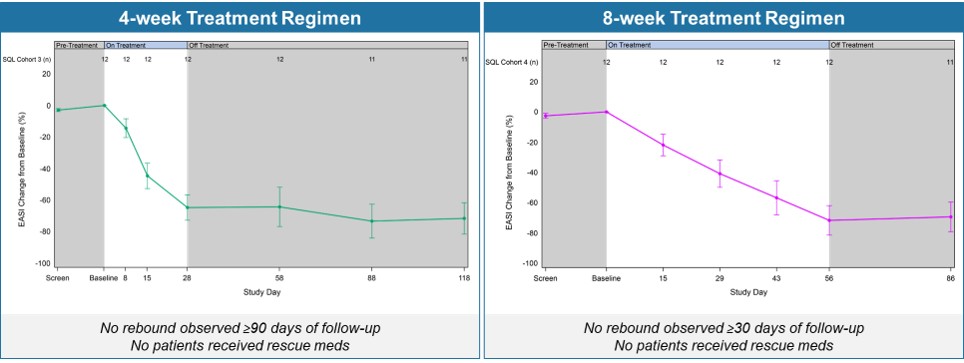
Management’s tone is strongly optimistic: they emphasize a differentiated atopic dermatitis profile (mean EASI 72% at 8 weeks, durable responses with no rebound out to 90 days, and activity in prior-therapy failures) plus continued, on-track PTCL enrollment and cash runway into Q2 2028 ($189M net proceeds; ~$246M pro forma). However, the Q&A revealed concrete information-gating risks. For the global Phase II AD trial, the company explicitly said there will be no blinded interim efficacy/safety data updates until completion (unlike the China partner’s cohort-by-cohort readouts). Analysts also focused on how to “read through” to expectations for the 400 mg QD dose, underscoring uncertainty that only longer-duration (12-week) cohort data can resolve (Angel unblinded late this year; more in mid-2027). Additionally, HS success is handicapped by acknowledged lack of good animal models—despite management relying on IL-17 proof-of-principle and multi-cytokine effects. Overall: bullish narrative, but with clear near-term evidence checkpoints and limited Phase II AD news flow.

AI IconGrowth Catalysts

  • Phase I/ I b atopic dermatitis (cohort 4) efficacy: mean EASI reduction 72% vs 40% placebo; 75% (9/12) achieved EASI 75 and 25% achieved EASI 90 (placebo 20% EASI 75; 17% excluding 2 missed day-56 evals)
  • Durability signal: no disease rebound observed with 90-day blinded post-treatment follow-up (cohort 3) vs rapid rebound typical of systemic agents
  • SID (mid-May) abstract planned to emphasize durability biomarkers, including induction of circulating Tregs and JAK/STAT pathway changes
  • Phase II atopic dermatitis trial initiated (200 pts; dosing 200 mg QD, 200 mg BID, 400 mg QD; 12 weeks tx + 90-day off-treatment follow-up)
  • Phase III PTCL enrollment progressing with interim analysis/futility+safety review expected later in 2026

Business Development

  • Angel Pharmaceuticals (China) partner: enrolling blinded placebo-controlled Phase Ib/II atopic dermatitis trial; regimen includes 100 mg BID, 200 mg QD, 200 mg BID, 400 mg QD with Phase II potentially adding 60–90 additional patients

AI IconFinancial Highlights

  • R&D: Q4 2025 $9.9M vs $6.0M YoY; full-year 2025 $33.7M vs $19.4M
  • Net loss: Q4 2025 -$12.3M vs -$12.1M
  • Cash runway: cash/cash equivalents/marketable securities $56.8M at 12/31/2025 vs $52.0M at 12/31/2024; January upsized underwritten public offering generated net proceeds $189M and pro forma cash ~$246M (runway into Q2 2028)
  • No explicit margin/“bps” metrics or EPS/revenue vs expectations disclosed in provided transcript

AI IconCapital Funding

  • January upsized underwritten public offering: net proceeds $189M
  • Pro forma cash at 12/31/2025: ~$246M
  • Cash runway extended into Q2 2028

AI IconStrategy & Ops

  • Phase II atopic dermatitis program initiated as international, randomized, placebo-controlled, blinded; 200 patients total (4 cohorts of 50); primary endpoint median % reduction in EASI at 12 weeks
  • PTCL Phase III is enrolling “perfectly according to plan” with FDA-discussed control arm based on conditional/accelerated approval therapies (belinostat or pralatrexate) vs soquelitinib monotherapy 200 mg BID
  • Operational/clinical safety process: Data Safety Monitoring Board review completed on PTCL interim stage—no new safety/different safety signals observed

AI IconMarket Outlook

  • Angel China atopic dermatitis data: initial cohorts expected “late this year” (100 mg BID and 200 mg QD; 12-week treatment unblinded after each cohort)
  • Angel China subsequent Phase II dosing expansion: 200 mg BID and 400 mg QD data expected “middle of 2027” (with Phase II rolling into ~130–140 total patient completion by mid-2027 or early 2027)
  • Corvus Phase II atopic dermatitis topline timing: data available mid-2027
  • PTCL Phase III interim analysis: formal review with futility analysis expected later this year; complete trial results expected late 2027
  • SID meeting: SID Annual Meeting mid-May presentation planned (durability + new biomarkers emphasis)

AI IconRisks & Headwinds

  • Phase II atopic dermatitis: no interim visibility expected due to blinded placebo-controlled/randomized design; management stated no data updates until completion (in contrast to Angel trial cohort-by-cohort unblinding)
  • High-dose safety/efficacy read-through uncertainty: Phase II AD design includes 400 mg QD; analysts asked how PTCL/China 12-week read-through should inform expectations specifically for 400 mg QD
  • HS development model risk acknowledged: management stated “you are correct” that there are not good animal models for hidradenitis suppurativa, relying on human IL-17 proof-of-principle and multi-cytokine blockade rationale
  • Abstract acceptance uncertainty: management characterized AAD late-breaker selection as “capricious,” with no clear causal explanation (not directly scientific performance, but indicates non-technical presentation-channel risk)

Sentiment: POSITIVE

Note: This summary was synthesized by AI from the CRVS Q4 2025 earnings transcript. Financial data is complex; please verify all metrics against official SEC filings before making investment decisions.

📋 Official Regulatory 10-K / 10-Q SEC Filings

Direct authenticated documentation links to audited SEC database reports for CRVS.

SEC EDGAR Live Feed
Loading financial data and tables...
📁

SEC Filings (CRVS)

© 2026 Stock Market Info — Corvus Pharmaceuticals, Inc. (CRVS) Financial Profile