Dollar Tree, Inc.

Dollar Tree, Inc. (DLTR) Market Cap

Dollar Tree, Inc. has a market capitalization of $20.91B.

Price: $108.80

β–Ό -0.47 (-0.43%)

Market Cap: 20.91B

NASDAQ Β· time unavailable

CEO: Michael C. Creedon Jr.

Sector: Consumer Defensive

Industry: Discount Stores

IPO Date: 1995-03-07

Website: https://www.dollartree.com

Dollar Tree, Inc. (DLTR) - Company Information

Market Cap: 20.91B|Sector: Consumer Defensive

Company Profile

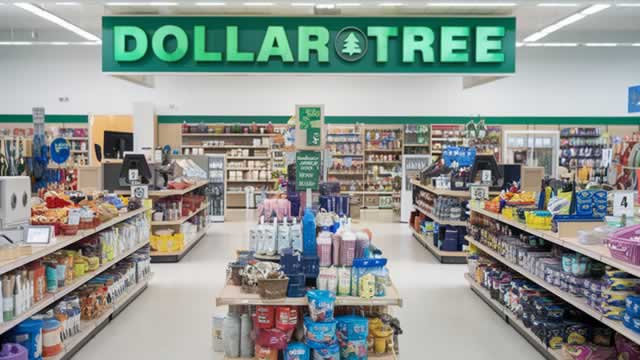
Dollar Tree, Inc. operates discount variety retail stores. It operates in two segments, Dollar Tree and Family Dollar. The Dollar Tree segment offers merchandise at the fixed price of $ 1.25. It provides consumable merchandise, including candy and food, and health and personal care, as well as everyday consumables, such as household paper and chemicals, and frozen and refrigerated food; variety merchandise comprising toys, durable housewares, gifts, stationery, party goods, greeting cards, softlines, arts and crafts supplies, and other items; and seasonal goods that include Christmas, Easter, Halloween, and Valentine's Day merchandise. As of January 29, 2022, this segment operated 8,061 stores under the Dollar Tree and Dollar Tree Canada brands, as well as 15 distribution centers in the United States and 2 distribution centers in Canada. The Family Dollar segment operates general merchandise retail discount stores that offer consumable merchandise, which comprise food and beverages, tobacco, health and personal care, household chemicals, paper products, hardware and automotive supplies, diapers, batteries, and pet food and supplies; and home products, including housewares, home dΓ©cor, and giftware, as well as domestics, such as comforters, sheets, and towels. It also provides apparel and accessories merchandise comprising clothing, fashion accessories, and shoes; and seasonal and electronics merchandise that include Christmas, Easter, Halloween, and Valentine's Day merchandise, as well as personal electronics, which comprise pre-paid cellular phones and services, stationery and school supplies, and toys. As of January 29, 2022, this segment operated 8,016 stores under the Family Dollar brand; and 11 distribution centers. The company was founded in 1986 and is based in Chesapeake, Virginia.

Analyst Sentiment

54%
Hold

From 26 Active Polls

1Y Forecast: $124.25

β–² +14.2% Potential Upside

Consensus Target Metrics

Low Bound

$85

Median

$129

High Bound

$165

Average

$124

Price & Moving Averages

Loading chart...

🎯 Wall Street Analyst Intelligence Report

1-Year structural target targets, chart projections, and sentiment maps.

Average 1Y Target
$124.25
β–² +14.20% Upside
Low Target
$85.00
-22% Risk
Median Target
$128.50
18% Mid
High Target
$165.00
52% Max
Consensus
Buy
25 / 49 Buys

Consensus Trend Projection

Trailing closures vs. 12-month metrics map.

Analyst Vote Distribution

Aggregate institutional coverage sentiment weights.

πŸ“Š Historical Valuation Multiples

Real-time Trailing Twelve Month (TTM) momentum side-by-side with discrete quarterly metrics.

Fiscal QuarterTTMQ2 2026Q1 2026Q4 2025Q3 2025Q2 2025Q1 2025Q4 2024Q3 2024
Period EndingTrailing 12MMay 2, 2026Jan 31, 2026Nov 1, 2025Aug 2, 2025May 3, 2025Feb 1, 2025Nov 2, 2024Aug 3, 2024
Market Cap ($M)20,90918,63123,41220,15123,78118,00415,77814,31921,399
Enterprise Value ($M)24,56222,28427,31824,78430,45824,90422,35224,17131,626
Price to Earnings Ratio (P/E)16.6413.4111.5620.6031.5613.11-1.0715.3440.41
Price/Earnings-to-Growth Ratio (PEG)β€”β€”0.795.21β€”β€”β€”5.980.52
Price to Sales Ratio (P/S)1.063.744.304.245.203.883.161.892.90
Price to Book Ratio (P/B)6.115.316.245.826.604.613.971.882.90
Price to Free Cash Flow Ratio (P/FCF)13.4147.5924.14-110.3062.5776.9113.3939.86-109.23
Enterprise Value to Sales (EV/Sales)β€”4.485.015.226.665.374.473.194.29
Enterprise Value to EBITDA (EV/EBITDA)12.0748.1940.6848.8277.4241.7239.7141.0156.01
Debt to Equity Ratio1.801.331.231.512.042.031.971.381.46
⚠️

Valuation Model Suspended

API Payload Error: Inverted or negative baseline Free Cash Flow margin detected (-0.9%).

Troubleshooting Notice: The upstream financial data supplier has uploaded corrupted or inverted baseline metrics for DLTR. The server sandbox cannot calculate an intrinsic value path from negative cash generation baselines.

πŸ“˜ Full Research Report

ℹ️

AI-Generated Research: This report is for informational purposes only.

πŸ“˜ DOLLAR TREE INC (DLTR) β€” Investment Overview

🧩 Business Model Overview

Dollar Tree operates a value-focused retail model built around high-frequency, everyday merchandise purchasing at disciplined price points. The value chain centers on (1) sourcing and procurement at scale, (2) distribution and logistics that keep store replenishment efficient, and (3) store-level execution that translates lower price architecture into consistent customer traffic.

Store customers exhibit repeat behavior because the offering targets routine consumption categories (consumables and household needs), and the format is designed for rapid, convenience-driven trips rather than destination shopping.

πŸ’° Revenue Streams & Monetisation Model

Revenue is primarily transactional, generated through merchandise sales across company-operated stores. Monetisation is driven by merchandise margin and inventory discipline rather than recurring subscription-like revenue.

Key margin drivers include: (1) procurement economics (unit costs and payment terms), (2) freight and distribution efficiency, (3) merchandise mix (more profitable categories and private-label penetration), and (4) shrink management and inventory turns. Pricing strategy is implemented through everyday value positioning, where the company’s economics depend on sustaining gross margin while maintaining attractive shelf prices.

🧠 Competitive Advantages & Market Positioning

The core moat is scale/distribution leverage combined with private-label resistance.

  • Scale/Distribution leverage: A larger, dense store footprint supports higher throughput through distribution centers, improving replenishment frequency and lowering per-unit logistics cost. This matters because value retail is structurally sensitive to freight, labor, and inventory handling costs.
  • Private-label resistance: Private-label and exclusive sourcing reduce direct comparability and can stabilize margins when branded supplier costs rise. Competitive pricing pressure is harder to β€œmatch” without accepting margin dilution.

Competitive benchmarking

  • Dollar General (DG): Competes in the discount retail space with a similar customer base but a broader price-band strategy. The competitive focus differs in format and assortment cadence, which can influence which categories dominate basket composition.
  • Walmart (WMT): Competes on everyday low prices and broad assortment powered by massive scale. Walmart’s advantage often appears through category breadth and supply chain scale, while Dollar Tree’s positioning leans more toward value specificity and category concentration at the store level.
  • TJX Companies (TJ Maxx/Marshalls) (TJX): Operates off-price with a different inventory sourcing model (more opportunistic buying). TJX’s moat centers on discount sourcing and inventory rotation, whereas Dollar Tree emphasizes disciplined pricing architecture and procurement repeatability.

πŸš€ Multi-Year Growth Drivers

A 5–10 year outlook for Dollar Tree is supported by secular demand for value retail and continued gains from retail operating leverage.

  • Category demand tailwinds toward value: Consumer focus on household essentials and discretionary small-ticket items tends to be more resilient during periods of cost pressure.
  • Store network expansion and productivity: Additional stores and improved productivity (traffic, units per transaction, inventory availability) can expand total sales while leveraging existing distribution infrastructure.
  • Private-label and assortment evolution: Greater proprietary mix can support gross margin stability and reduce reliance on high-variability branded sourcing.
  • Operational execution and working capital discipline: Efficient inventory management supports inventory turns, reduces markdown risk, and can protect cash flow generationβ€”critical for value retailers with thin margin structures.

⚠ Risk Factors to Monitor

  • Competitive pricing intensity: In value retail, peers can compress margins through aggressive pricing and promotional activity. Maintaining margin while protecting traffic is an execution risk.
  • Inventory and supply chain disruption: Forecasting errors, vendor issues, or freight volatility can lead to stock availability problems or higher costs that are difficult to offset quickly.
  • Labor and occupancy cost inflation: Value formats remain sensitive to wage trends, benefits, and lease/occupancy economics, which can pressure store-level profitability.
  • Regulatory and local permitting risk: Store openings, zoning approvals, and labor regulations can affect rollout pace and operating costs.
  • Consumption downturn risk: A demand shock can reduce units per transaction and traffic, impacting store economics more than in diversified retailers with stronger higher-margin categories.

πŸ“Š Valuation & Market View

The market typically values dollar-store retailers primarily on earnings power and cash flow durability, often using frameworks such as EV/EBITDA and P/E-style earnings multiples, alongside sensitivity to store-level margins and operating leverage.

Key valuation β€œdrivers” that tend to move the narrative include: gross margin stability (procurement and mix), operating expense discipline (labor and shrink), cash flow conversion (working capital and capex efficiency), and the sustainability of unit growth without margin dilution. Because the business is largely transaction-driven, sustained investment returns depend on consistent traffic and disciplined inventory turns.

πŸ” Investment Takeaway

Dollar Tree’s long-term investment case rests on a durable value retail operating model supported by distribution scale and private-label/exclusive sourcing that help defend margin against discount peers. The primary question for multi-year returns is execution: sustaining inventory and cost discipline while maintaining attractive pricing and store productivity in an environment where competition can pressure economics.


⚠ AI-generated β€” informational only. Validate using filings before investing.
πŸ“° Market News & Coverage

15 Stories Available

Real-time institutional reporting and market updates for DLTR.

zacks.comβ€’2026-06-04

Do Options Traders Know Something About Dollar Tree Stock We Don't?

Investors need to pay close attention to DLTR stock based on the movements in the options market lately.

fool.comβ€’2026-05-31

Why Dollar Tree Stock Surged This Week

Dollar Tree's profits rose sharply in the first quarter. Management sees decades of growth ahead.

gurufocus.comβ€’2026-05-29

Dollar Tree Surges 17% As Bigger Baskets Boost Sales

Dollar Tree (DLTR) gave investors a sharp reminder that value retail still has room to surprise. Comparable sales rose 3.5% in the first quarter, beating estima

seekingalpha.comβ€’2026-05-29

Dollar Tree: The Multi-Price Strategy Is Yielding Strong Comps

Dollar Tree remains a buy, offering value and diversification amid a top-heavy, speculative market. DLTR's multi-price strategy is driving comp sales growth and increasing average ticket size while preserving its value ethos. Sales per square foot rose 4% y/y to $242, reflecting strong execution and comp sales focus over new store expansion.

zacks.comβ€’2026-05-29

Dollar Tree's Q1 Earnings Call Centers on Execution & Outlook

DLTR's Q1 earnings call highlights margin gains from tighter execution and shrink control. It raises the EPS outlook, but warns on fuel, tariffs and traffic.

seekingalpha.comβ€’2026-05-28

Dollar Tree, Inc. (DLTR) Q1 2027 Earnings Call Transcript

Dollar Tree, Inc. (DLTR) Q1 2027 Earnings Call Transcript

seekingalpha.comβ€’2026-05-28

Dollar Tree Did The Unthinkable

Dollar Tree, Inc. delivered a double-line beat, raising its outlook and demonstrating robust sales and margin expansion. Same-store sales grew 3.5%, with a 4.5% increase in average ticket offsetting a 1% decline in traffic. Gross margin expanded 120 basis points to 36.9%, driven by price increases, lower freight, and reduced shrink.

zacks.comβ€’2026-05-28

DLTR Q1 Earnings Beat Estimates on Margin Gains and Higher Comps

Dollar Tree beats Q1 estimates as stronger comps, margin gains and lower freight costs lift earnings, while FY26 EPS guidance moves higher.

proactiveinvestors.comβ€’2026-05-28

Dollar Tree surges on strong first quarter earnings, boosted profit guidance

Dollar Tree, Inc. (NASDAQ:DLTR) shares jumped almost 18% on Thursday morning after the discount retailer reported stronger-than-expected earnings and upwardly revised its full-year profit guidance. Adjusted earnings per share were $1.74, above analyst expectations of $1.55.

invezz.comβ€’2026-05-28

Why are investors rushing back into Dollar Tree stock?

Shares of Dollar Tree DLTR surged on Thursday after the discount retailer reported stronger-than-expected fiscal first-quarter earnings, raised its full-year profit outlook, and announced a new delivery partnership with DoorDash. Dollar Tree stock jumped roughly 17% during trading, putting the shares on pace for their best single-day performance in nearly four years.

zacks.comβ€’2026-05-28

Dollar Tree (DLTR) Q1 Earnings: Taking a Look at Key Metrics Versus Estimates

Although the revenue and EPS for Dollar Tree (DLTR) give a sense of how its business performed in the quarter ended April 2026, it might be worth considering how some key metrics compare with Wall Street estimates and the year-ago numbers.

marketbeat.comβ€’2026-05-28

Dollar Tree Q1 Earnings Call Highlights

Dollar Tree NASDAQ: DLTR reported stronger-than-expected first-quarter fiscal 2026 results, with executives pointing to improved merchandising, lower shrink and disciplined cost control as key drivers behind margin expansion and earnings growth.

schaeffersresearch.comβ€’2026-05-28

Stock Futures Mixed After Inflation Data, Iran Updates

Stock futures are easing from earlier losses after inflation and GDP data released

marketwatch.comβ€’2026-05-28

Dollar Tree's sales top forecasts as fewer people are shopping β€” but they're spending more

Dollar Tree's stock soars after earnings beat expectations and the full-year profit outlook was raised.

proactiveinvestors.comβ€’2026-05-28

Dollar Tree surges on strong first quarter earnings, boosted profit guidance

Dollar Tree, Inc. (NASDAQ:DLTR) shares jumped almost 18% on Thursday morning after the discount retailer reported stronger-than-expected earnings and...

πŸ“Š AI Financial Analysis

Powered by StockMarketInfo
Earnings Data: Q Ending 2026-05-02

"Headline (Q1’26, ended 2026-05-02): Revenue $4.98B; Net Income $347.3M; EPS $1.76. YoY growth (vs Q1’25): Revenue +7.3% and Net Income +1.1% (Net margin eased). QoQ growth (vs Q4’25): Revenue -8.7% and Net Income -31.4%. Profitability: Gross margin expanded from 35.6% (Q1’25) to 36.9% in Q1’26, but operating/net margins softened on a lower Q/Q profit base (net margin: 7.4% in Q1’25, 9.3% in Q4’25, down to 7.0% in Q1’26). Operating income fell QoQ, consistent with a seasonal downturn in retail results. Cash flow & capital returns: Operating cash flow was $644M and free cash flow $391.5M in Q1’26, with capex of $252.5M. Buybacks appear absent in the quarter’s reported cash flow (repurchases 0), and dividends are reported as $0 paid. Balance sheet (not a bank): Total assets were $13.82B. Equity was $3.51B, down vs Q4’25, while net debt was reduced to ~$3.65B from ~$3.91B prior quarter, improving financial resilience. Total shareholder returns: DLTR stock price is up 44.7% over 1 year (momentum >20%), which is a meaningful positive alongside strong earnings power, despite quarter-to-quarter earnings variability."

Revenue Growth

Positive

QoQ revenue declined 8.7% (from $5.45B in Q4’25 to $4.98B in Q1’26), but YoY revenue increased 7.3% (from $4.64B in Q1’25), indicating solid underlying demand despite seasonality.

Profitability

Neutral

Gross margin improved YoY (35.6% to 36.9%), but net margin softened vs both Q4’25 (9.3% -> 7.0%) and slightly vs Q1’25 (7.4% -> 7.0%). Net income grew only 1.1% YoY, suggesting margin headwinds more than revenue acceleration.

Cash Flow Quality

Positive

Q1’26 operating cash flow was $644M and free cash flow $391.5M, supporting profitability. However, buybacks were not reflected in the quarter’s financing cash flow and dividends remain $0.

Leverage & Balance Sheet

Positive

Total assets increased to $13.82B vs $13.47B in Q4’25. Equity fell to $3.51B (from $3.75B), but net debt improved to ~$3.65B from ~$3.91B QoQ, improving balance-sheet resilience.

Shareholder Returns

Strong

1-year price momentum is strong (+44.7%), which materially lifts total shareholder return potential. Dividend yield is 0% in the provided data and buybacks are not evident in this quarter’s cash flow.

Analyst Sentiment & Valuation

Neutral

Current price ~$105.93 vs consensus target ~$122.47 implies moderate upside. Valuation appears not inexpensive (price/EPS ~13.4 in Q1’26), but recent momentum supports sentiment.

Disclaimer:This analysis is AI-generated for informational purposes only. Accuracy is not guaranteed and this does not constitute financial advice.

Fundamentals Overview

Loading fundamentals overview...

DLTR delivered a strong Q1 2026 with net sales +7.2% and comp +3.5% despite traffic of -1% (in line) and an Easter calendar headwind. The key financial lever was margin: gross margin expanded 120 bps YoY to reflect higher merchandise margin, favorable freight, and lower shrink, with tariffs and markdowns partially offsetting. Management repeatedly attributed improvements to β€œgold store standards,” nonnegotiable shrink audits, product protection, and disciplined merchandising controls. On capital return, the company repurchased ~$595M during the quarter plus $98M afterward, reducing share count ~8% over 12 months and supporting EPS (+38% to $1.74). Guidance raises FY26 adjusted EPS to $6.70–$7.10, but doesn’t fully extrapolate Q1 outperformance because the back half is buffered by assumptions: tariffs revert higher after July, higher fuel prices are assumed to persist, and no tariff refunds or further repurchases are included. Market tone is constructive but cautious due to fuel/freight and tariff uncertainty.

AI IconGrowth Catalysts

  • Multi-price assortment expansion into everyday consumables/household categories (incremental strength cited in toys and beverages).
  • Higher multi-price penetration contributing to 4.5% ticket growth and 3.5% comparable sales growth.
  • Gold store standards and shrink-prevention/audit discipline improving store execution and reducing shrink/losses.
  • Expanded targeted, data-driven marketing capabilities to drive incremental trips and improve engagement/frequency.
  • Improving store trip efficiency via smaller/more affordable pack sizes and clearer value communication.

Business Development

  • No named partnerships/customers/vendors explicitly mentioned in the provided transcript.
  • Brand repopulation at higher center-store food price points (examples named: Rice-A-Roni, SPAM, Frank's hot sauce).

AI IconFinancial Highlights

  • Net sales increased 7.2% to $5.0B; comparable sales increased 3.5%.
  • Adjusted EPS up 38% YoY to $1.74; exceeded high end of full-year outlook range (as described by management).
  • Gross margin expanded 120 bps YoY, driven by higher merchandise margin, freight favorability, and lower shrink; offset partially by higher tariffs and markdowns.
  • Total SG&A deleveraged 10 bps (driven by increased marketing investments, higher general liability costs, and higher depreciation), partially offset by TSA income and lower payroll.
  • Adjusted operating margin expanded 110 bps to 9.5%; adjusted operating income dollars increased 22% YoY.
  • Traffic down 1% (in line with expectations); +20 bps sequential improvement vs Q4; +~200 bps sequential improvement on a 2-year basis vs Q4 2-year stack.
  • Inventory declined 9% vs prior year while sales rose 7.2%, improving inventory-to-sales spread (capital efficiency tailwind).
  • Tariff assumptions: current tariff rates assumed through July; increases in back half to pre-Feb 20 Supreme Court levels; no tariff refunds included in outlook.

AI IconCapital Funding

  • Share repurchases: ~5.5M shares for $595M during the quarter; additional $98M repurchased subsequent to quarter end (as of call date).
  • Past 12 months: reduced share count ~8%; returned $1.7B to investors via share repurchases.
  • Balance sheet liquidity: ended quarter with $1B cash; no commercial paper outstanding.
  • Cash flow: $644M cash from operations; $253M capex; $392M free cash flow for the quarter.

AI IconStrategy & Ops

  • Shrink: management indicated early curve-bending impact from shrink-reduction initiatives (nonnegotiable audit plus teaching/coaching/training; product protection to reduce loss on higher-risk items; tightened merchandising standards and at-risk category controls; focused training and stronger oversight).
  • Marketing: scaling targeted/data-driven engagement and improving measurement/ROI of marketing channels and messaging precision.
  • Pricing/assortment: multi-price evolution to align price points with product attributes; maintain opening price point as an anchor while expanding above entry price point.
  • Store operations: emphasis on consistent cashier coverage, tighter field accountability for underperforming stores, disciplined store refreshes/renovations to improve productivity and customer experience.
  • Store model economics: ~85% of sales mix remains at $2 and below (affordability anchor reiterated).
  • Pricing reset mechanics discussed: major pricing reset shifts balance between traffic and ticket temporarily; ongoing belief that traffic response normalizes more quickly due to targeted/strategic pricing actions.

AI IconMarket Outlook

  • Full-year FY2026 (updated): net sales $20.5B to $20.7B; comp store sales growth 3% to 4%.
  • FY2026 updated adjusted diluted EPS: $6.70 to $7.10 (assumes 194M shares outstanding; reflects repurchases through call date).
  • Q2 guidance: net sales $4.8B to $4.9B; comp store sales growth 2.5% to 3.5%; adjusted diluted EPS $1.00 to $1.15.
  • Tariff rate assumptions explicitly tied to July timing: current tariff rates assumed through July, then increase in back half to pre-Feb 20 Supreme Court levels; no tariff refunds assumed.

AI IconRisks & Headwinds

  • Macro: higher fuel costs and broader uncertainty for lower-income households; customers shopping closer to need and more value-focused.
  • Tariffs: management highlighted tariff uncertainty and explicitly planned higher tariff levels in back half (post-July) to pre-Feb 20 Supreme Court levels; no refund benefit included.
  • Fuel/conflict duration: management now assumes higher fuel prices last throughout the year (conflict end date unknown) and that increased fuel costs are absorbed by the business.
  • Freight/transportation and fuel cost volatility: updated guidance reflects more cautious transportation/fuel assumptions vs prior entry into the year.
  • Lapping comps/events: earlier Easter timing creates a natural comp headwind; Q2 difficult compare referenced.

Q&A: Analyst Interest

  • Topic: Drivers of the Q1 beat vs March outlook; quantify role of tariffs and fuel. Management said the beat came mainly from shrink (plus favorable freight and merchandising margin), explaining 120 bps gross margin expansion. They stated tariffs were offset and β€œnot a factor” in the quarter and that fuel volatility was timing-related and would show in the back part.
  • Topic: Why updated FY2026 EPS guidance doesn’t fully flow through Q1 upside/share repurchases. Management emphasized prudence amid dynamic tariffs, fuel, freight, and consumer pressure. They noted higher fuel prices assumed longer due to conflict duration, no share repurchases modeled after today, and no tariff refunds assumed; upside scenarios include oil declines, tariffs extending, and reinvestment flywheel.
  • Topic: Pricing actions in center-store food; competitiveness at new prices. Management said the affected assortment is <5% of stores, aimed at improving relevance and price clarity. They attributed higher prices to regaining brands lost at $1/$1.25, citing Rice-A-Roni, SPAM, and Frank’s hot sauce; competitors benchmarked with value/pack-size methodology showing positive relative value.

Sentiment: POSITIVE

Note: This summary was synthesized by AI from the DLTR Q1 2026 (quarter ended in May 2026; call dated 2026-05-28) earnings transcript. Financial data is complex; please verify all metrics against official SEC filings before making investment decisions.

πŸ“‹ Official Regulatory 10-K / 10-Q SEC Filings

Direct authenticated documentation links to audited SEC database reports for DLTR.

SEC EDGAR Live Feed
Loading financial data and tables...
πŸ“

SEC Filings (DLTR)

Β© 2026 Stock Market Info β€” Dollar Tree, Inc. (DLTR) Financial Profile