Liberty Broadband Corporation

Liberty Broadband Corporation (LBRDK) Market Cap

Liberty Broadband Corporation has a market capitalization of $4.44B.

Price: $30.91

0.74 (2.45%)

Market Cap: 4.44B

NASDAQ · time unavailable

CEO: Martin Edward Patterson

Sector: Communication Services

Industry: Telecommunications Services

IPO Date: 2014-11-05

Website: https://www.libertybroadband.com

Liberty Broadband Corporation (LBRDK) - Company Information

Market Cap: 4.44B|Sector: Communication Services

Company Profile

Liberty Broadband Corporation engages in the communications businesses. It operates through GCI Holdings and Charter segments. The GCI Holdings segment provides a range of wireless, data, video, voice, and managed services to residential customers, businesses, governmental entities, and educational and medical institutions primarily in Alaska under the GCI brand. The Charter segment offers subscription-based video services comprising video on demand, high-definition television, and digital video recorder service; local and long-distance calling, voicemail, call waiting, caller ID, call forwarding, and other voice services, as well as international calling services; and Spectrum TV. It also provides internet services, including an in-home Wi-Fi product that provides customers with high-performance wireless routers and managed Wi-Fi services; advanced community Wi-Fi; mobile internet; and a security suite that offers protection against computer viruses and spyware. In addition, this segment offers internet access, data networking, fiber connectivity to cellular towers and office buildings, video entertainment, and business telephone services; advertising services on cable television networks and digital outlets; and operates regional sports and news networks. Liberty Broadband Corporation was incorporated in 2014 and is based in Englewood, Colorado.

Analyst Sentiment

82%
Strong Buy

From 3 Active Polls

1Y Forecast: $108.33

▲ +250.5% Potential Upside

Consensus Target Metrics

Low Bound

$89

Median

$91

High Bound

$145

Average

$108

Price & Moving Averages

Loading chart...

🎯 Wall Street Analyst Intelligence Report

1-Year structural target targets, chart projections, and sentiment maps.

Average 1Y Target
$108.33
▲ +250.47% Upside
Low Target
$89.00
188% Risk
Median Target
$91.00
194% Mid
High Target
$145.00
369% Max
Consensus
Buy
9 / 11 Buys

Consensus Trend Projection

Trailing closures vs. 12-month metrics map.

Analyst Vote Distribution

Aggregate institutional coverage sentiment weights.

📊 Historical Valuation Multiples

Real-time Trailing Twelve Month (TTM) momentum side-by-side with discrete quarterly metrics.

Fiscal QuarterTTMQ1 2026Q4 2025Q3 2025Q2 2025Q1 2025Q4 2024Q3 2024Q2 2024
Period EndingTrailing 12MMar 31, 2026Dec 31, 2025Sep 30, 2025Jun 30, 2025Mar 31, 2025Dec 31, 2024Sep 30, 2024Jun 30, 2024
Market Cap ($M)4,4417,1816,9289,05613,10512,15510,63310,9857,711
Enterprise Value ($M)6,9509,6958,61710,77516,06415,81314,29814,60811,328
Price to Earnings Ratio (P/E)-1.618.84-0.55-14.708.5511.349.1419.349.89
Price/Earnings-to-Growth Ratio (PEG)9.9423.932.9724.22
Price to Sales Ratio (P/S)17.0050.2145.7040.4341.9331.34
Price to Book Ratio (P/B)0.751.221.221.021.261.211.091.150.83
Price to Free Cash Flow Ratio (P/FCF)-26.56-97.05-29.9989.67354.18935.00-168.79-305.15-220.30
Enterprise Value to Sales (EV/Sales)61.5559.4554.3755.7646.05
Enterprise Value to EBITDA (EV/EBITDA)-1.88-1939.09-2.1138.07172.73164.72226.96171.86155.17
Debt to Equity Ratio-0.680.430.310.200.300.390.390.400.39

LBRDK Growth Runway Model

Standard long term linear growth fade

Multi-Stage Discounted Cash Flow Sandbox

Market Price$30.91
Intrinsic Value$0.00
Market Alignment
Overvalued by 218.3%relative to calculated intrinsic value
9.00%
Exp: 7%7%
i

Growth runway slowdown

This value provides a time window for the growth rate to decline beyond Stage 1 toward the terminal rate. Longer windows are most useful for companies with high growth starting conditions or strong competitive advantages. This option stretches out the growth rate slowdown across 5, 10, or 15-year steps. A high-growth starting condition (exceeding a 25% initial growth rate) automatically applies a curve decay to simulate realistic, rapid market saturation.
i

Terminal growth rate

With long-term inflation between 3-5%, revenue must grow by that baseline to maintain flat real-world market share. This value sets the permanent terminal growth rate to factor into the valuation beyond the growth slowdown runway toward maturity.

3-Stage Financial Runway Horizon

🧠 Perpetuity Horizon Engine (Stage 3: Post-2035)

Terminal FCF Base$0.00B
Perpetuity TV Value$0.00B
Discounted TV (PV)$0.00B
TV Weighting %0%
⚠️
Financial Model Disclaimer & Risk Disclosure: This interactive scenario simulator is an educational sandbox provided strictly for informational and analytical research purposes. Core historical financial statements and consensus estimates are sourced directly via Financial Modeling Prep (FMP). All downstream outputs are entirely deterministic, hypothetical projections generated by combining automated mathematical formulas (including linear interpolation and Gaussian bell-curve decay models) with user-selected variables and third-party financial data inputs. Users assume all liability for trading decisions executed based on these sandbox calculations.

📘 Full Research Report

ℹ️

AI-Generated Research: This report is for informational purposes only.

📘 LIBERTY BROADBAND CORP SERIES C (LBRDK) — Investment Overview

🧩 Business Model Overview

Liberty Broadband Corp Series C is best understood as an equity investment vehicle with meaningful exposure to the U.S. cable broadband ecosystem, primarily through its controlling/major investments in Charter Communications (and related interests). The economic engine of the underlying businesses is the provision of fixed-line connectivity—delivering high-speed internet (and related services) through a physically built last-mile network.

In the cable value chain, capital is required to deploy and maintain coaxial/fiber plant and headend/distribution infrastructure. Once deployed, the business monetizes recurring residential and small-business subscriptions, supplemented by usage-driven upgrades and ancillary services. Customer stickiness is supported by (i) the technical and logistical difficulty of switching home/enterprise internet providers and (ii) the operational scale required to serve densely located footprint areas efficiently.

💰 Revenue Streams & Monetisation Model

Monetisation is dominated by recurring subscription revenue: broadband internet is the anchor, with additional revenue streams typically including pay-TV/streaming bundles (where applicable), voice, and other connectivity-related offerings. Revenue growth tends to come from a combination of:

  • ARPU expansion via tier upgrades, promotional renewals, and multi-product bundling.
  • Subscriber mix and retention as customers migrate to higher-speed service levels.
  • Enterprise/small-business monetisation where the network footprint supports scalable service delivery.

Margin structure is primarily driven by: (1) incremental network capacity and cost per unit of throughput at scale, (2) content/programming and customer acquisition costs where subscription TV exists, and (3) leverage of fixed operating cost bases over a large, retained subscriber base. Capital spending is a continuing requirement to refresh and upgrade network capability (e.g., modernization of cable plant and continued fiber-related densification where it improves performance and long-run cost).

🧠 Competitive Advantages & Market Positioning

Cable broadband’s competitive set is shaped less by technology novelty and more by deployment scale, last-mile footprint, and customer switching frictions. Liberty’s exposure to this ecosystem tends to benefit from structural incumbency advantages.

  • Switching Costs (High): Residential broadband is deeply embedded in daily life and often bundled with other services. Switching typically involves installation scheduling, equipment changes, and potential service disruption—creating practical inertia even when competitors offer promotional pricing.
  • Infrastructure Barriers / Cost Advantages (Structural): Replicating a dense last-mile network is capital-intensive and constrained by right-of-way access, permitting, and engineering complexity. Existing operators can spread overhead and maintenance costs across large subscriber bases.
  • Operational Scale (Economies of Density): Dense footprint areas allow better utilization of network segments and field operations, lowering cost per subscriber served relative to less scaled peers or fragmented entrants.

Competitive benchmarking:

  • Comcast: Another large U.S. cable operator with comparable infrastructure economics and competitive emphasis on broadband reliability and bundling.
  • AT&T and Verizon: Telco-focused competitors (fiber and fixed wireless mix). Their economics are driven by access to fiber buildout and spectrum/coverage strategy, which can shift upgrade paths but face different deployment constraints than cable operators.
  • Altice USA: A cable operator with different scale and footprint density, which can affect cost structure and the ability to finance upgrades on comparable terms.

Liberty’s industry focus (through Charter exposure) aligns with the cable broadband incumbency model—where network footprint scale and customer stickiness are the primary sources of durable market positioning, rather than differentiation through network effects or proprietary platforms.

🚀 Multi-Year Growth Drivers

  • Long-duration demand for higher-capacity broadband: Consumer and enterprise usage expansion supports periodic plan upgrades and sustained revenue per user improvement.
  • Network modernization and utilization: Ongoing upgrades increase usable capacity and improve performance, enabling higher tiers and better retention without commensurate proportional cost increases.
  • Bundle economics: Bundling (where offered) supports churn reduction and improves lifetime value by increasing the number of services tied to one provider.
  • Underpenetrated enterprise connectivity: Small business and higher-requirement residential segments can be served with packaging that typically yields better monetisation than basic plans, where network capability allows.

Over a 5–10 year horizon, the TAM expansion is less about introducing a new category of broadband and more about absorbing incremental capacity needs, maintaining service affordability through cost discipline, and selectively improving network economics through technology and operational execution.

⚠ Risk Factors to Monitor

  • Capital intensity and upgrade cadence risk: Broadband economics rely on sustained network investment. If upgrade costs rise faster than revenue and efficiency gains, free cash flow durability can be pressured.
  • Competitive pricing and promotions: Competition from telcos (fiber) and fixed wireless can intensify promotional pressure and raise churn, particularly in areas where alternative coverage is strong.
  • Regulatory and operational constraints: Right-of-way access, franchise obligations, and consumer protection rules can affect deployment timelines and operating costs.
  • Technology substitution risk: Fixed wireless improvements and capacity growth could shift share in specific geographies if service experience and price parity improve.
  • Holding-company structural risk: As an investment vehicle, Liberty’s per-share economics depend on the performance, capital needs, and distributions of underlying investments; corporate actions and market sentiment can influence outcomes independent of operating fundamentals.

📊 Valuation & Market View

Cable broadband and related telecom equities are typically valued using enterprise-value based metrics (e.g., EV/EBITDA) alongside cash flow durability considerations. For equity holders exposed through Liberty’s structure, investors often focus on:

  • Free cash flow conversion after network maintenance and modernization capex.
  • Distribution/disciplined capital allocation and the credibility of long-run payout capacity.
  • Competitive moat signals such as retention trends, ARPU trajectory, and the ability to limit churn through service quality and bundling.

Valuation sensitivity generally increases when markets anticipate either accelerated capex needs (reducing near-term cash flow) or intensifying competition (compressing margins through promotional activity).

🔍 Investment Takeaway

LBRDK offers exposure to the U.S. cable broadband incumbency model, where durable economics are supported by high practical switching costs, infrastructure and scale barriers, and ongoing capacity upgrades that enable monetisation through customer plan upgrades. The long-term thesis rests on maintaining network investment efficiency, defending retention through service quality and bundling, and limiting competitive erosion from fiber and fixed wireless across the footprint.


⚠ AI-generated — informational only. Validate using filings before investing.

📰 Market News & Coverage

13 Stories Available

Real-time institutional reporting and market updates for LBRDK.

seekingalpha.com2026-06-05

A Gift From A Confusing Situation: Liberty Broadband Preferreds, The To-Be Charter Preferreds

Liberty Broadband preferreds present a compelling opportunity, trading at $22 versus a $25 par with mandatory 2039 redemption. LBRDP offers an 8%+ annual yield at the current trading price, a guaranteed capital gain at par, and a seamless transition to Charter Communications preferreds post-merger. Recent agreements ensure Liberty Broadband's liquidity and dividend safety, with Charter's $100M monthly buybacks and term loan facility reducing balance sheet risk.

forbes.com2026-05-10

What The Latest Media Earnings Blitz Reveals About Hollywood's Future

If there was a common message to be found in the flood of entertainment media company earnings reports over the last several days, one could argue it's that Hollywood appears to finally be done chasing streaming growth at all costs.

seekingalpha.com2026-05-08

Liberty Broadband Corporation (LBRDK) Q1 2026 Earnings Call Transcript

Liberty Broadband Corporation (LBRDK) Q1 2026 Earnings Call Transcript

defenseworld.net2026-04-01

31,650 Shares in Liberty Broadband Corporation $LBRDK Bought by Elser Financial Planning Inc

Elser Financial Planning Inc bought a new stake in shares of Liberty Broadband Corporation (NASDAQ: LBRDK) in the fourth quarter, according to its most recent 13F filing with the Securities and Exchange Commission. The fund bought 31,650 shares of the company's stock, valued at approximately $1,538,000. Liberty Broadband accounts for about 1.1% of

defenseworld.net2026-03-09

DLD Asset Management LP Makes New $4.64 Million Investment in Liberty Broadband Corporation $LBRDK

DLD Asset Management LP acquired a new position in shares of Liberty Broadband Corporation (NASDAQ: LBRDK) during the third quarter, according to the company in its most recent Form 13F filing with the Securities and Exchange Commission. The institutional investor acquired 72,957 shares of the company's stock, valued at approximately $4,636,000. DLD Asset

seekingalpha.com2026-02-15

Baron Discovery Fund Q4 2025: Winners, Laggards, Buys & Sells

In the fourth quarter of 2025, the Baron Discovery Fund returned 0.19% (Institutional Shares), trailing the Russell 2000 Growth Index by 1.03%. In these periods, low quality (high debt and poor profitability) and short-term price momentum-oriented stocks outperformed. Exact Sciences Corporation received a buyout offer in the fourth quarter by Abbott Laboratories (ABT) for a price of $105 in cash.

gurufocus.com2026-02-12

Wallace Weitz Exits CarMax Inc, Impacting Portfolio by -1.58%

Insight into Wallace Weitz (Trades, Portfolio)'s Strategic Moves in Q4 2025 Wallace Weitz (Trades, Portfolio) recently submitted the 13F filing for the fourth

seekingalpha.com2026-02-11

Liberty Broadband Corporation (LBRDK) Q4 2025 Earnings Call Transcript

Liberty Broadband Corporation (LBRDK) Q4 2025 Earnings Call Transcript

defenseworld.net2025-11-29

Charles Schwab Investment Management Inc. Raises Position in Liberty Broadband Corporation $LBRDK

Charles Schwab Investment Management Inc. raised its holdings in shares of Liberty Broadband Corporation (NASDAQ: LBRDK) by 0.6% in the undefined quarter, according to the company in its most recent disclosure with the Securities and Exchange Commission. The firm owned 1,025,474 shares of the company's stock after buying an additional 5,763 shares during

gurufocus.com2025-11-14

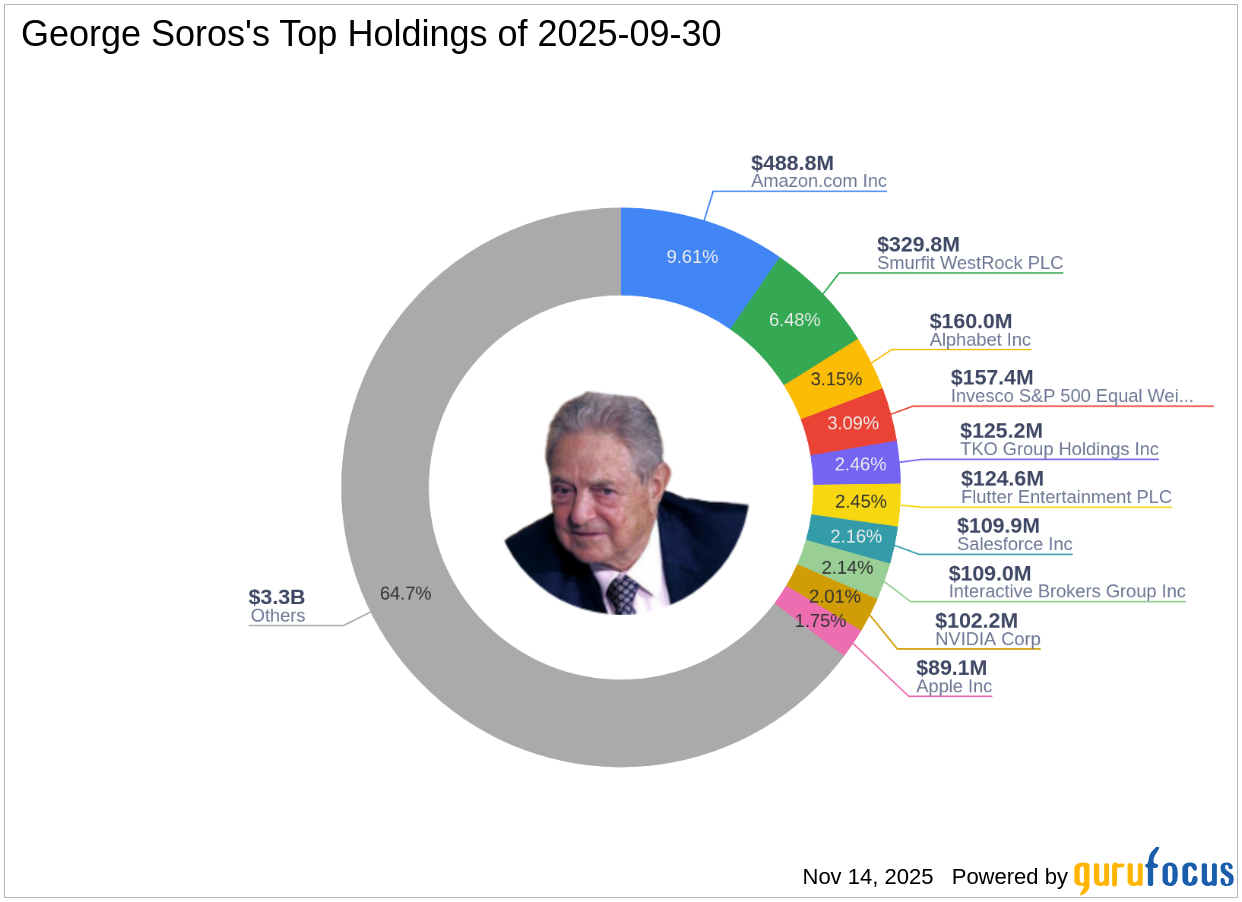
George Soros Significantly Increases Stake in Amazon.com Inc

Insight into Soros's Strategic Moves in Q3 2025 George Soros (Trades, Portfolio) recently submitted the 13F filing for the third quarter of 2025, providing ins

gurufocus.com2025-11-13

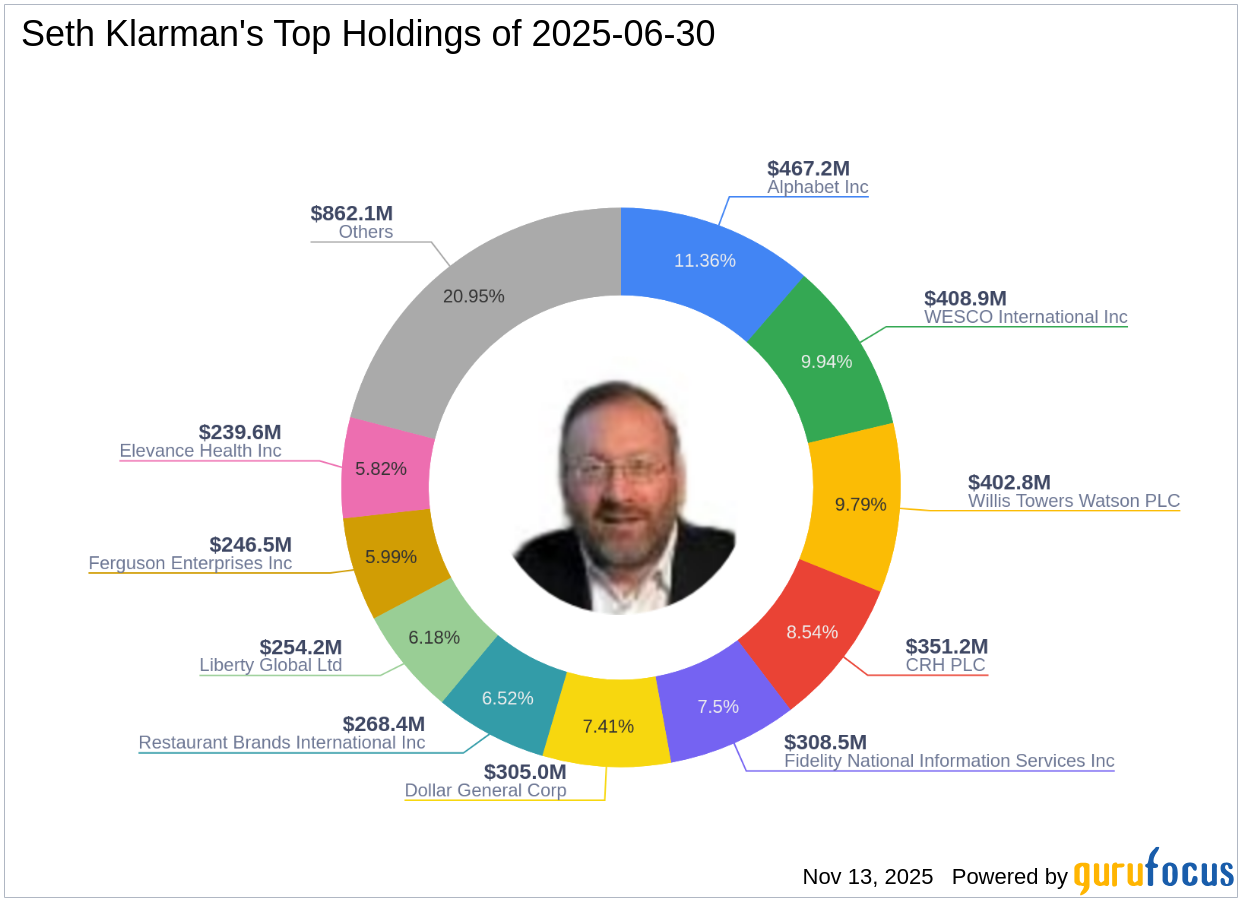
Seth Klarman's Strategic Moves: Union Pacific Corp Takes Center Stage with 7.43% Portfolio Share

Insight into Seth Klarman (Trades, Portfolio)'s Third Quarter 2025 Investment Adjustments Seth Klarman (Trades, Portfolio) recently submitted the 13F filing fo

seekingalpha.com2025-11-05

Liberty Broadband Corporation (LBRDK) Q3 2025 Earnings Call Prepared Remarks Transcript

Liberty Broadband Corporation ( LBRDK ) Q3 2025 Earnings Call November 5, 2025 11:15 AM EST Company Participants Shane Kleinstein - Head of Investor Relations Ronald Duncan - Co-Founder, CEO & Director Brian Wendling - Chief Accounting Officer & Principal Financial Officer Presentation Operator Greetings. Welcome to the GCI Liberty 2025 Q3 Earnings Call.

seekingalpha.com2025-10-19

The Opportunity To Buy Charter Communications Preferreds Below Par Before They Launch

Liberty Broadband preferreds will convert to Charter Communications preferreds following Charter's acquisition of Liberty Broadband. LBRDP currently trades below par value, offering an over 7% yield, which is more attractive than comparable preferred stocks. The preferreds feature a rare mandatory redemption at par in 2039, enhancing their safety and appeal for income investors.

📊 AI Financial Analysis

Powered by StockMarketInfo
Earnings Data: Q Ending 2025-12-31

"For the quarter ending December 31, 2025, LBRDK reported no revenue, with a net loss of $3.17 billion and an EPS of -$22.11. The company generated a free cash flow of $101 million, despite operating cash outflows. Total assets are $8.83 billion, with liabilities of $3.13 billion, resulting in equity of $5.70 billion and net debt at $1.69 billion. Growth remains challenging due to the absence of revenue, with high net losses reflecting struggles in profitability. The positive free cash flow indicates competent management of capital expenditures and financial flexibility. The debt-to-equity ratio, while relatively moderate, suggests reliability on external financing, requiring careful monitoring. The absence of dividends or share buybacks affects immediate shareholder returns, though FCF remains a potential source for future enhancements. Analyst sentiment reflects a cautious outlook, with a consensus price target of $108.33, highlighting valuation challenges given current losses and cash flow volatility."

Revenue Growth

Neutral

Growth is absent with no revenue reported; underlying business model adaptation is necessary.

Profitability

Neutral

With a substantial net loss and negative EPS, operational efficiency is in question.

Cash Flow Quality

Neutral

Positive free cash flow despite negative operating cash flow suggests good capex management.

Leverage & Balance Sheet

Fair

Moderate net debt with a manageable debt/equity ratio, yet vigilance needed on debt levels.

Shareholder Returns

Neutral

No dividends or buybacks limit immediate shareholder returns, though FCF is a positive indicator.

Analyst Sentiment & Valuation

Fair

Mixed analyst sentiment with a median price target reflecting valuation concerns amidst ongoing losses.

Disclaimer:This analysis is AI-generated for informational purposes only. Accuracy is not guaranteed and this does not constitute financial advice.

Fundamentals Overview

Loading fundamentals overview...

LBRDK’s Q1 2026 results are mixed: consumer wireless grew with promotional momentum (consumer lines +2% YoY; postpaid driven by GCI+ free-for-a-year), but data subs fell (down 3% YoY; 700 lost) from ongoing wireless substitution. Importantly, management claims broadband loss pace is stabilizing due to speed/reliability improvements and continued promotions. Financially, revenue was $256m (-4% YoY) and adjusted OIBDA $93m (-18% YoY), with roughly $13m of comparability items (mostly nonrecurring) and continued public company costs (~$3m) plus higher operating expenses from efficiency investments. The key catalyst is the $310m Quintillion acquisition (plus up to $50m CapEx reimbursement, potential earn-outs) expected to be accretive to free cash flow in the first year after closing, while also improving fiber ring/sub-ring resilience versus LEO alternatives. Leverage risk rises pro forma (up to ~2.7x after the $160m unsecured loan), while CapEx peaks in 2026 at ~$290m, pressuring free cash flow despite a $448m cash position.

AI IconGrowth Catalysts

  • Definitive agreement to acquire Quintillion (complementary subsea/terrestrial fiber routes and rural microwave), expected to be accretive to free cash flow in the first year after closing
  • Stabilizing broadband losses driven by new GCI+ promotional offer and network speed/reliability improvements
  • Wireless growth supported by GCI+ 'free for a year' promotion (500 postpaid lines added in the quarter; +1,000 consumer wireless lines total)

Business Development

  • Agreed acquisition of Quintillion for $310 million cash; reimbursement of up to $50 million for pre-closing CapEx; potential earn-out payments
  • GCI Liberty invested ~$107 million to acquire Searchlight Capital Partners equity interest in Liberty Latin America; subsequent to quarter end acquired an additional 6% equity interest
  • In discussions with Dr. John Malone (Chairman, GCI Liberty; Director Emeritus, Liberty Latin America) and certain affiliates to acquire additional shares to increase equity/voting stake in Liberty Latin America

AI IconFinancial Highlights

  • GCI total revenue: $256 million, down 4% YoY
  • Adjusted OIBDA: $93 million, down 18% YoY (about $13 million of year-over-year items impacting comparability; most nonrecurring)
  • Consumer revenue: down 5% YoY (video shutdown and data subscriber losses partially offset by wireless growth); consumer gross margin: 72.2%
  • Business revenue: down 3% YoY; business gross margin: 77.3% (primarily higher distribution costs from restored Quintillion fiber service versus prior year)
  • Adjusted OIBDA decline impacted by incremental operating business efficiency investments (+~$4 million operating expenses) and ~ $3 million public company costs expected to continue
  • Free cash flow (TTM through end of Q1): $99 million, down ~13% YoY (driven largely by higher CapEx net of grant proceeds)
  • Net leverage: 1.6x consolidated at quarter end (including parent cash/rights proceeds and nonvoting preferred); GCI net leverage 2.3x (credit agreement definition); pro forma leverage increases to 2.3x at parent level and ~2.7x after the $160 million unsecured Quintillion loan

AI IconCapital Funding

  • Cash, cash equivalents and restricted cash: $448 million consolidated at quarter end (including $131 million at GCI)
  • Total principal debt: approximately $1 billion at quarter end
  • Undrawn capacity on GCI credit facility: $377 million net of letters of credit
  • GCI Liberty will provide $160 million unsecured loan to Quintillion under the acquisition agreement
  • TTM free cash flow: $99 million, down ~13% YoY; company expects 2026 CapEx to peak and then step down toward historical 15%–20% of revenue, pressuring future FCF year-over-year

AI IconStrategy & Ops

  • Consumer wireless lines: 207,700 total at quarter end (+2% YoY); 200,000 consumer wireless lines; 7,700 business wireless lines included
  • Added 1,000 consumer wireless lines during the quarter, including 500 postpaid lines, largely from GCI+ 'free for a year' promotion
  • Data subscribers: 150,500 at quarter end (down 3% YoY); lost 700 data subscribers during the quarter attributed to wireless substitution and limited competition from Starlink
  • Broadband loss pace decreasing, attributed to promotional offer success and network speed/reliability improvements
  • Alaska plan build-out nearing completion; company expects increasing wireless speeds across served communities and continued focus on 5G coverage over coming years
  • Exit of video business completed in 3Q 2025; consumer revenue declines still reflect video shutdown contribution
  • CapEx net of grant proceeds: $55 million in Q1; expects 2026 CapEx of ~$290 million (includes $20 million carryover from 2025 timing)
  • Planned acquisition/architecture: more robust fiber architecture using multiple rings/sub-rings to enhance resilience/routing diversity

AI IconMarket Outlook

  • Expect 2026 CapEx of approximately $290 million (peak year), including $20 million carried over from 2025
  • Expect CapEx (including Quintillion) to peak in 2026 and step down over subsequent years to 15%–20% of revenue
  • Transaction timing/guidance not quantified; free cash flow accretion targeted 'in the first year after closing' for Quintillion

AI IconRisks & Headwinds

  • Data subscriber losses continue (down 3% YoY; 700 lost in the quarter) due to wireless substitution and limited competition effects from Starlink
  • Adjusted OIBDA down 18% YoY despite stabilization signs, with operating cost impacts and public company costs continuing
  • Regulatory/financial leverage pressure: Quintillion loan and transactions increase pro forma leverage (to ~2.7x for GCI after $160 million loan), which may constrain flexibility
  • Potential operational reliability impact implied by prior Quintillion fiber disruption (referenced fiber break repaired; higher distribution costs in Q1 2026 vs prior period)

Q&A: Analyst Interest

  • Topic: Drivers of business wireless losses and whether magnitude is material; Management's detailed response: Ron Duncan said business wireless losses are a small portion of the overall company, describing them as ordinary churn. He added that the firm has been gradually transitioning business accounts toward the consumer side and emphasized the loss magnitude is not material to the company’s overall situation.
  • Topic: Liberty Latin America investment rationale—tax attributes versus strategic value; Management's detailed response: Duncan said the preferred distribution (9% later this summer) could be sheltered by tax attributes, but that is not the principal driver. He characterized Liberty Latin America as undervalued with an asset footprint in an under-invested market and expected an inflection in free cash flow.
  • Topic: Quintillion economics and customer base—payments, fiber breaks, and whom the network serves; Management's detailed response: Duncan declined to break out total Quintillion payments. He stated they are more than half of Quintillion’s total revenues, that Quintillion is primarily wholesale, and they buy services and remarket to business/rural health care customers, including ACS and smaller local telephone companies.

Sentiment: MIXED

Note: This summary was synthesized by AI from the LBRDK Q1 2026 earnings transcript. Financial data is complex; please verify all metrics against official SEC filings before making investment decisions.

📋 Official Regulatory 10-K / 10-Q SEC Filings

Direct authenticated documentation links to audited SEC database reports for LBRDK.

SEC EDGAR Live Feed
Loading financial data and tables...
📁

SEC Filings (LBRDK)

© 2026 Stock Market Info — Liberty Broadband Corporation (LBRDK) Financial Profile