Constellation Brands, Inc.

Constellation Brands, Inc. (STZ) Market Cap

Constellation Brands, Inc. has a market capitalization of .

No quote data available.

CEO: Nicholas Ian Fink

Sector: Consumer Defensive

Industry: Beverages - Wineries & Distilleries

IPO Date: 1992-03-17

Website: https://www.cbrands.com

Constellation Brands, Inc. (STZ) - Company Information

Market Cap: -|Sector: Consumer Defensive

Company Profile

Constellation Brands, Inc., together with its subsidiaries, produces, imports, markets, and sells beer, wine, and spirits in the United States, Canada, Mexico, New Zealand, and Italy. It provides beer primarily under the Corona Extra, Corona Premier, Corona Familiar, Corona Light, Corona Refresca, Corona Hard Seltzer, Modelo Especial, Modelo Negra, Modelo Chelada, Pacifico, and Victoria brands. The company offers wine under the 7 Moons, Cook's California Champagne, Cooper & Thief, Crafters Union, Kim Crawford, Meiomi, Mount Veeder, Ruffino, SIMI, The Dreaming Tree, Charles Smith, The Prisoner Wine Company, Robert Mondavi, My Favorite Neighbor, and Schrader; and spirits under the Casa Noble, Copper & Kings, High West, Mi CAMPO, Nelson's Green Brier, and SVEDKA brands. It provides its products to wholesale distributors, retailers, on-premise locations, and state alcohol beverage control agencies. Constellation Brands, Inc. was founded in 1945 and is headquartered in Victor, New York.

Analyst Sentiment

67%
Buy

From 24 Active Polls

1Y Forecast: $175.70

▲ +0.0% Potential Upside

Consensus Target Metrics

Low Bound

$154

Median

$180

High Bound

$197

Average

$176

Price & Moving Averages

Loading chart...

🎯 Wall Street Analyst Intelligence Report

1-Year structural target targets, chart projections, and sentiment maps.

Average 1Y Target
$175.70
▲ +24.69% Upside
Low Target
$154.00
9% Risk
Median Target
$180.00
28% Mid
High Target
$197.00
40% Max

Consensus Trend Projection

Trailing closures vs. 12-month metrics map.

Analyst Vote Distribution

Aggregate institutional coverage sentiment weights.

Sentiment volume allocation data unavailable.

Historical valuation matrix unavailable.

📘 Full Research Report

ℹ️

AI-Generated Research: This report is for informational purposes only.

📘 CONSTELLATION BRANDS INC CLASS A (STZ) — Investment Overview

🧩 Business Model Overview

Constellation Brands is a consumer packaged goods (CPG) beverage company operating primarily in beer, wine, and spirits. The business converts branded product demand into revenue through (1) ownership of or strategic positioning in key brands, (2) a large-scale route-to-market footprint that reaches wholesalers and retailers, and (3) operational execution across sourcing, production, logistics, and marketing.

Customer stickiness is driven less by direct “switching” mechanics and more by brand preference and retailer/wholesaler ordering behavior: once brands are entrenched in menus and shelf space, the system tends to be sticky because changes require retailer approval and inventory reallocation. This creates a durable environment for volume retention and pricing discipline.

💰 Revenue Streams & Monetisation Model

Revenue is primarily transactional (product sales) rather than contract-based recurring revenue, but the monetisation profile can be relatively steady because alcoholic beverage consumption is habitual and replenishment cycles are frequent for distributors and retailers.

  • Beer and imported brands: typically the largest contributor, with margin sensitivity to mix (premium vs. value), freight, and foreign exchange for imported components.
  • Spirits and wine: profit tends to reflect brand strength and the ability to sustain price/mix through category shifts (e.g., tequila/ready-to-mix trends in spirits, varietal and style mix in wine).
  • Other investments/adjacencies: can add optionality, but the core earnings power is tied to beverage operations.

Margin drivers generally include premium mix, packaging and input cost control, effective promotional intensity, and utilization of manufacturing/logistics capacity. The model benefits when brand pull-through allows pricing and volume to move together rather than fighting each other.

🧠 Competitive Advantages & Market Positioning

Constellation’s moat is best described as a combination of intangible assets (brands), scale/distribution leverage, and operational cost advantages that reinforce brand economics. While beverage categories are competitive, brand ownership plus a mature route-to-market can make share gains difficult to sustain for entrants without heavy investment.

  • Intangible assets: strong brand portfolios support pricing power and shelf stability. Brand equity reduces the need for excessive discounting to maintain distribution.
  • Scale/distribution leverage: large-scale operations improve bargaining power with suppliers and distributors and help spread fixed costs across higher production volumes.
  • Distribution relationships: once wholesaler/retailer channels integrate a brand into planning cycles, changes create coordination friction (inventory, forecasting, promotion calendars).

COMPETITIVE BENCHMARKING

Key comparables span both beer and spirits/wine, reflecting Constellation’s diversified beverage exposure:

  • AB InBev (beer): operates a broad global beer portfolio with dominant scale; competition often centers on global brewing logistics and brand marketing budgets.
  • Diageo (spirits): emphasizes global spirits brands and premiumization; rivalry is strongest where consumers trade into spirits and where retailer shelf space shifts.
  • Pernod Ricard (spirits/wine): competes through established spirits/wine portfolios and regional strength; rivalry often focuses on mix, distribution execution, and promotional effectiveness.

Compared with these rivals, Constellation’s focus places a larger emphasis on North American beverage positioning and on the earning profile of its flagship brand franchises, while peers may be more diversified across broader geographic brewing or spirits portfolios.

🚀 Multi-Year Growth Drivers

Over a 5–10 year horizon, the primary growth narrative is category mix and share maintenance rather than reliance on a single product cycle. The most durable drivers include:

  • Premiumization within alcohol: sustained consumer preference for higher-quality offerings supports price/mix, particularly in beer and spirits.
  • Category innovation and format expansion: new flavors, pack sizes, and consumption occasions can expand TAM within existing brand families.
  • Retail and channel execution: shelf placement, distributor alignment, and promotional productivity are structural advantages for established players.
  • International and cross-brand learning: brand building practices and sourcing/logistics know-how can be leveraged across product lines.

The TAM expands as consumers shift toward premium products and new occasions, but the investment case is rooted in Constellation’s ability to translate those shifts into earnings through brand and distribution strength.

⚠ Risk Factors to Monitor

  • Regulatory and tax risk: excise taxes, age verification rules, and state-level enforcement can affect demand elasticity and retail ordering patterns.
  • Foreign exchange and import/input exposure: parts of the mix depend on imported or globally priced inputs; currency movements can pressure gross margins.
  • Brand concentration: earnings resilience depends on maintaining the performance of key franchises; adverse brand momentum can be difficult to offset quickly.
  • Promotional intensity and competitor actions: if peers increase promotional spend to defend or gain share, margins can compress.
  • Capital allocation discipline: the beverage profile is cash generative, but maintaining returns on any non-core investments requires careful capital stewardship.

📊 Valuation & Market View

Beverage alcohol equities are typically valued on cash flow power rather than pure growth. Market multiples often track expectations for:

  • Operating margin sustainability: premium mix durability and input cost management.
  • Volume stability vs. mix-driven growth: investors generally prefer stable volume supported by favorable mix.
  • Capital structure and free cash flow conversion: the sector’s ability to convert earnings into cash supports valuation resilience through cycles.

Drivers that can move the market view include pricing/mix execution, steady distributor inventory behavior, and evidence that brand investments translate into sustainable earnings rather than short-term volume boosts.

🔍 Investment Takeaway

Constellation Brands offers a structurally defensible earnings profile anchored in brand intangible assets, scale/distribution leverage, and execution across premium mix. The investment thesis centers on the durability of premium demand, the stickiness of channel relationships, and the company’s ability to defend margins through input cost and competitive promotion cycles. Primary risks relate to regulation, currency/input exposure, and brand concentration—areas that merit disciplined monitoring.


⚠ AI-generated — informational only. Validate using filings before investing.

📊 AI Financial Analysis

Powered by StockMarketInfo
Earnings Data: Q Ending 2026-02-28

"STZ reported Revenue of $1.92B in the latest quarter (2026-02-28) and Net Income of $201.8M (EPS $1.16). On a QoQ basis, Revenue fell from $2.22B to $1.92B (-13.6%) and Net Income dropped from $502.8M to $201.8M (-59.9%), indicating a profitability contraction. Versus the same quarter last year, Revenue declined from $2.16B to $1.92B (-11.3%); however, Net Income swung materially from a loss (-$375.3M) to a profit (+$201.8M), a large YoY improvement. Net margin compressed to ~10.5% (from ~22.6% QoQ). Balance sheet resilience looks better: Total Assets were roughly flat-to-up QoQ ($21.90B vs. $21.68B), Total Equity increased ($8.39B vs. $8.00B), and Net Debt improved versus last year ($10.47B vs. $12.05B on 2025-02-28), reflecting deleveraging. Shareholder returns were mixed. The stock is down -11.34% over the last 1y; dividends (~$1.02–$1.03 quarterly, ~2.5% run-rate yield) partially offset price weakness. Shares outstanding have trended down YoY (~179.9M to ~173.5M), consistent with buyback support, but the near-term earnings slowdown limits upside."

Revenue Growth

Caution

Revenue declined QoQ (-13.6% from $2.22B to $1.92B) and also YoY (-11.3% from $2.16B to $1.92B), showing a weakening top line trend.

Profitability

Fair

Net Income fell sharply QoQ (-59.9%) and net margin compressed (~22.6% to ~10.5%). YoY profitability improved from a loss (EPS -$2.09) to profit (EPS $1.16).

Cash Flow Quality

Neutral

Cash flow metrics weren’t provided; however, earnings turned positive YoY and dividends continue. Latest payout ratio is elevated (~0.88), suggesting less cushion in the face of lower earnings.

Leverage & Balance Sheet

Positive

Total Assets/equity stabilized to improve QoQ, and leverage improved YoY: net debt decreased from ~$12.05B (2025-02-28) to ~$10.47B (2026-02-28).

Shareholder Returns

Fair

1y price performance is negative (-11.34%) and total return likely remains muted despite a ~2.5% dividend run-rate. Buyback pressure is suggested by declining shares outstanding YoY.

Analyst Sentiment & Valuation

Positive

Consensus target ($175.7) is above the current price ($162.28), implying ~8% upside; valuation appears less demanding versus the latest quarter’s earnings regime.

Disclaimer:This analysis is AI-generated for informational purposes only. Accuracy is not guaranteed and this does not constitute financial advice.

Fundamentals Overview

Loading fundamentals overview...

Constellation’s FY27 outlook is framed as momentum improving after FY26, but with “limited visibility” and continued consumer caution limiting confidence in the path to full-year outcomes. Beer remains the core profit engine, yet operating margins guide down to 37%–38% from prior 39%–40% due to Veracruz brewery startup (mid-year production) driving fixed-cost absorption headwinds plus higher SG&A and marketing investment. Offsets are expected from 1%–2% price delivery (positioned at the low end), tariff relief from aluminum, and cost savings progress. Management highlights strong hedging entering FY27 (notably fuel ~100%, aluminum ~90%, and currencies ~80%), reducing input-cost volatility. For wine & spirits, category and channel headwinds persist: high-end wine now projected to decline and spirits flat/slightly down, with distributor inventory rebalancing and Napa/international weakness (Canada U.S. ban). Despite this, they still target structurally “low 20s” wine & spirits margins over the medium term as inventory normalizes.

AI IconGrowth Catalysts

  • Modelo Especial momentum—#1 beer brand by dollars in the U.S.; March momentum increasing vs planned
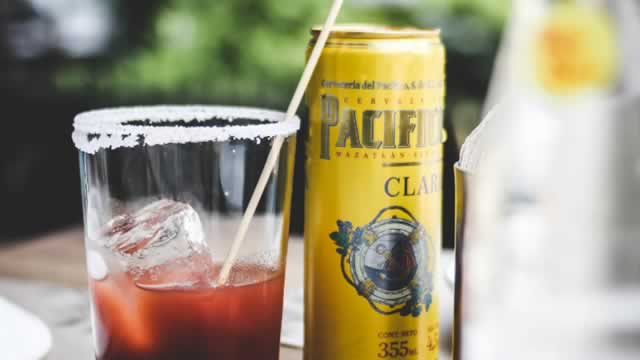
  • Pacifico growth acceleration—“on a tear” with continued nationwide broadening; new campaign around yellow can cans (shelf/cold box stand-out)
  • High-end light beer strategy investment (oral and premier momentum after price-point repositioning)
  • World Cup summer event driving heavier brand investment in H1
  • Wine & spirits portfolio reshaping traction (named: Kim Crawford; also cited: Mecampo)

Business Development

  • Agreed inventory rebalancing with key wine & spirits distributors (inventory reductions/normalization referenced)

AI IconFinancial Highlights

  • Beer operating margin guidance: 37% to 38% for FY27 vs prior guidance 39% to 40% (step down)
  • Primary FY27 margin headwinds: Veracruz brewery startup—fixed cost absorption headwinds; plus SG&A increase from lower incentive comp in FY26 and incremental marketing investments
  • Offsetting margin drivers: 1% to 2% price delivery expected, positioned at the lower end of that range in FY27
  • Aluminum tariff relief expected in FY27
  • Input cost hedging entering FY27: fuel ~100% hedged; aluminum ~90%; natural gas ~80%; corn ~75%; currencies ~80% overall
  • Wine & spirits: target margins “low 20s” structurally over medium term; short-term constrained by category and channel headwinds plus cost deleveraging timing
  • Wine category outlook shift (U.S. high-end wine): expected low single-digit growth -> low single-digit declines
  • U.S. high-end spirits outlook shift: plus mid-single-digit growth -> flat to slightly down
  • Corona Extra: no explicit margin number; guidance framed as not expected to be the growth driver
  • Reported mix drag in Q4 referenced as 50 basis points drag to beer top line (packaging type / mix behavior referenced, but no quantified breakdown beyond the mention)

AI IconCapital Funding

  • Shareholder returns: “Over $900 million” returned to shareholders last year (FY26)
  • CapEx approach: continuing spend aligned with long-run requirements; FY26 CapEx spent “significantly less than” initial expectations; FY27 CapEx decisions managed modularly with potential delays/avoidance as capacity comes online later than expected
  • No explicit FY27 ending cash/debt/buyback amount stated in transcript

AI IconStrategy & Ops

  • Veracruz brewery expected to begin production around the middle of FY27 (fixed cost absorption and depreciation step-up anticipated)
  • Depreciation: expecting a step-up as Veracruz comes online mid-year
  • Operational footprint: production capacity added “modularly” to manage uncertainty and timing
  • Marketing spend: stated “thinking about 9.5% of sales on marketing” (cadence heavily weighted to H1)
  • Marketing emphasis planned by brand: Modelo (World Cup), Pacifico (increased investment vs historical), high-end light beer strategy, Victoria, and other momentum brands (e.g., Sunbrew momentum in first full year)

AI IconMarket Outlook

  • Beer top-line guidance framework referenced as: “negative 1 is a positive one” (exact numeric guidance not provided in transcript)
  • March start: “better than planned” with continued increasing momentum
  • Limited visibility and high volatility emphasized as the key constraint on forecasting
  • Wine & spirits medium-term margin objective reiterated (low 20s), while distributor inventory normalization expected to help over time

AI IconRisks & Headwinds

  • Limited visibility and high volatility: consumer reaction still cautious
  • Beer: gross margin expense-related headwinds from Veracruz startup costs and SG&A increases; price delivery only at the lower end of 1%–2%
  • Wine & spirits category pressure: U.S. high-end wine downgraded to low single-digit declines; high-end spirits decelerating to flat/slightly down
  • Channel headwinds: tasting room softness in Napa-based wineries; distributor inventory rebalancing required due to category softness
  • International: weakness in U.S.-made/sourced wines & spirits, especially Canada where ban on U.S. wine and spirits remains in place
  • Mix risk: referenced 50 bps drag to beer top line tied to packaging/mix behavior changes (no further numeric decomposition provided)

Sentiment: CAUTIOUS

Note: This summary was synthesized by AI from the STZ Q4 2026 (FY26 Q4; guidance discussed for FY27) earnings transcript. Financial data is complex; please verify all metrics against official SEC filings before making investment decisions.

Loading financial data and tables...
© 2026 Stock Market Info — Constellation Brands, Inc. (STZ) Financial Profile