TTM Technologies, Inc.

TTM Technologies, Inc. (TTMI) Market Cap

TTM Technologies, Inc. has a market capitalization of $17.41B.

Price: $167.62

-17.22 (-9.32%)

Market Cap: 17.41B

NASDAQ · time unavailable

CEO: Edwin Roks

Sector: Technology

Industry: Hardware, Equipment & Parts

IPO Date: 2000-09-25

Website: https://www.ttm.com

TTM Technologies, Inc. (TTMI) - Company Information

Market Cap: 17.41B|Sector: Technology

Company Profile

TTM Technologies, Inc., together with its subsidiaries, engages in the manufacture and sale of printed circuit boards (PCBs) worldwide. The company operates in two segments, PCB and RF&S Components. It offers PCB products, radio frequency (RF) components, conventional PCBs, RF and microwave circuits, high density interconnect PCBs, substrate-like PCBs, flexible PCBs, rigid-flex PCBs, custom assemblies and system integration products, IC substrates, passive RF components, advanced ceramic RF components, multi-chip modules, and beamforming and switching networks. The company also produces printed circuits with heavy copper cores, as well as embedded and press-fit coins; PCBs with electrically passive heat sinks; and PCBs with electrically active thermal cores. In addition, it offers value-added services, including RF design to specification capability, design for manufacturability, PCB layout design, simulation and testing, and quick turnaround services. The company serves original equipment manufacturers and electronic manufacturing services companies that primarily serve aerospace and defense, data center computing, automotive components, medical, industrial, and instrumentation related products sectors. TTM Technologies, Inc. was incorporated in 1978 and is headquartered in Santa Ana, California.

Analyst Sentiment

88%
Strong Buy

From 4 Active Polls

1Y Forecast: $209.33

▲ +24.9% Potential Upside

Consensus Target Metrics

Low Bound

$205

Median

$208

High Bound

$215

Average

$209

Price & Moving Averages

Loading chart...

🎯 Wall Street Analyst Intelligence Report

1-Year structural target targets, chart projections, and sentiment maps.

Average 1Y Target
$209.33
▲ +24.88% Upside
Low Target
$205.00
22% Risk
Median Target
$208.00
24% Mid
High Target
$215.00
28% Max
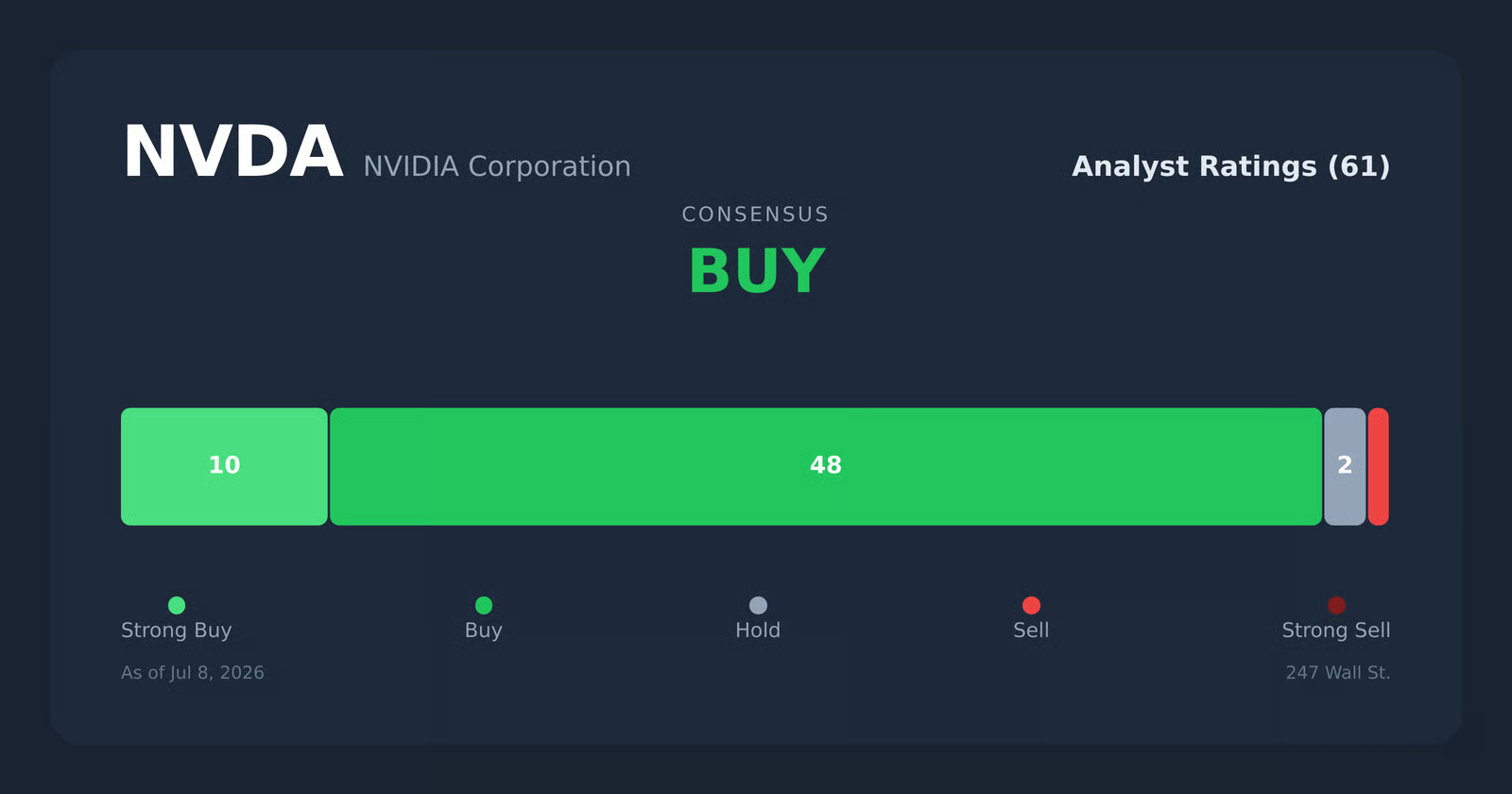
Consensus
Buy
12 / 14 Buys

Consensus Trend Projection

Trailing closures vs. 12-month metrics map.

Analyst Vote Distribution

Aggregate institutional coverage sentiment weights.

📊 Historical Valuation Multiples

Real-time Trailing Twelve Month (TTM) momentum side-by-side with discrete quarterly metrics.

Fiscal QuarterTTMQ1 2026Q4 2025Q3 2025Q2 2025Q1 2025Q4 2024Q3 2024Q3 2024
Period EndingTrailing 12MMar 30, 2026Dec 29, 2025Sep 29, 2025Jun 30, 2025Mar 31, 2025Dec 30, 2024Sep 30, 2024Jul 1, 2024
Market Cap ($M)17,4079,1677,3605,9674,1582,0892,5191,8611,930
Enterprise Value ($M)18,0479,8077,9756,5014,7372,6983,0302,4122,496
Price to Earnings Ratio (P/E)89.1345.8536.3028.1225.0316.23121.8132.5118.31
Price/Earnings-to-Growth Ratio (PEG)4.9512.669.291.9821.8117.252.98
Price to Sales Ratio (P/S)5.6110.849.507.935.693.223.873.023.19
Price to Book Ratio (P/B)9.474.994.183.512.541.321.611.201.26
Price to Free Cash Flow Ratio (P/FCF)-1473.33-107.72-1139.44140.88111.18-28.2483.9076.92808.68
Enterprise Value to Sales (EV/Sales)11.5910.308.646.484.164.653.914.12
Enterprise Value to EBITDA (EV/EBITDA)42.4988.8169.9160.9450.6530.4749.4332.6430.62
Debt to Equity Ratio1.510.570.630.600.630.640.650.660.66
⚠️

Valuation Model Suspended

API Payload Error: Inverted or negative baseline Free Cash Flow margin detected (-0.8%).

Troubleshooting Notice: The upstream financial data supplier has uploaded corrupted or inverted baseline metrics for TTMI. The server sandbox cannot calculate an intrinsic value path from negative cash generation baselines.

📘 Full Research Report

ℹ️

AI-Generated Research: This report is for informational purposes only.

📘 TTM TECHNOLOGIES INC (TTMI) — Investment Overview

🧩 Business Model Overview

TTM Technologies manufactures advanced printed circuit boards (PCBs) and related interconnect products that serve as the “wiring infrastructure” inside electronic systems. The value chain typically starts with customer product design requirements (often driven by performance targets like signal integrity, routing density, and thermal characteristics). TTM supports manufacturability through engineering collaboration, then converts designs into high-complexity boards using processes such as multilayer build-ups, via formation, plating, etching, and controlled impedance routing. In many programs, TTM supplies boards for integration by electronics manufacturing partners or directly into end-system builds.

Customer stickiness is reinforced by program qualification cycles, tight specifications, and the operational need for reliable yield/quality across volume production. Once a board design is qualified for a supply chain, switching suppliers generally requires requalification, engineering effort, and schedule risk—raising the practical barrier to entry at the program level.

💰 Revenue Streams & Monetisation Model

Revenue is primarily generated from the fabrication and delivery of PCBs and advanced interconnect products. Monetisation is largely program- and unit-driven (delivered product tied to customer demand and platform schedules), with recurring elements emerging when customers maintain long-running electronics programs that require steady board replenishment.

Margin drivers typically include:

  • Mix of complexity: higher-layer-count, higher-density, and tighter-tolerance boards generally support superior gross margins.
  • Manufacturing utilization and yield: fixed-cost absorption and yield performance are key to sustaining operating leverage.
  • Material and conversion economics: input costs (e.g., copper and process chemicals) and the ability to manage conversion throughput affect cost of goods.
  • Program stability: stable customer platforms can reduce volatility in capacity planning and working capital.

🧠 Competitive Advantages & Market Positioning

TTM’s moats are best characterized as a combination of switching costs (qualification and process-specific fit), cost and execution advantages (yield, throughput, and scale in advanced PCB manufacturing), and operational know-how embedded in manufacturing process control.

  • Switching costs (program qualification): Advanced boards often require supplier qualification for electrical performance, reliability, and manufacturing capability. Changing suppliers can trigger revalidation and schedule risk, making incumbent vendors difficult to displace for qualified programs.
  • Cost advantages (execution and scale): Advanced PCB manufacturing is execution-intensive; consistent yield and throughput directly influence unit economics. Suppliers with mature process control can sustain better gross margin through cycle volatility.
  • Intangible asset (customer qualification and engineering collaboration): The embedded manufacturing “learning curve” from delivering complex designs supports performance consistency and faster ramp on future derivative designs.

Competitive benchmarking: TTM competes with both advanced PCB-focused manufacturers and broader electronics manufacturing services (EMS)/interconnect suppliers, including:

  • Sanmina and Jabil: diversified EMS/interconnect providers serving wide end markets. Their breadth can be an advantage for customers seeking one-stop manufacturing, but their portfolio spans many end products and may trade off depth in specific advanced PCB niches.
  • Celestica: another large EMS/interconnect competitor with scale and customer coverage.

TTM’s industry focus centers on advanced PCB/interconnect production and the engineering/manufacturing execution required to meet high-performance specifications. Compared with diversified EMS players, that focus can support deeper capabilities in complex board manufacturing and tighter integration of manufacturing process performance with customer program needs.

🚀 Multi-Year Growth Drivers

Over a 5–10 year horizon, demand for advanced interconnect products is supported by structural electronics trends:

  • Data center and high-performance computing buildout: Higher server densities, faster signaling, and more complex backplanes expand the need for advanced PCB architectures.
  • Network infrastructure and edge compute: 5G/telecom modernization and growing network electronics increase the number of high-spec interconnect designs entering production.
  • Automotive electronics content growth: Increasing use of sensors, compute modules, and power electronics drives demand for higher reliability and higher complexity boards.
  • Outsourcing of manufacturing and supply chain specialization: Customers often prefer specialized suppliers who can execute qualification and scale production reliably.
  • Platform-based product lifecycles: When boards become “designed-in,” subsequent product refresh cycles can extend TAM beyond a single generation.

⚠ Risk Factors to Monitor

  • Electronics cycle and customer inventory resets: PCB and EMS demand can be sensitive to end-market spending and customer inventory behavior.
  • Margin pressure from utilization swings: Gross margin can compress when fixed costs are spread over lower volumes.
  • Input cost volatility: Materials and process-related costs can move irregularly; insufficient pass-through can pressure profitability.
  • Quality/reliability execution risk: Advanced boards require tight process control; quality issues can trigger rework costs, warranty exposure, or program loss.
  • Technological evolution: Shifts in packaging/interconnect approaches (and changes in signal/thermal requirements) can require capex and process adaptation.
  • Customer concentration and program timing: Losing a major platform or facing slower ramp can create step-changes in revenue and working capital.
  • Trade and regulatory impacts: Tariffs, export restrictions, and environmental compliance costs can affect costs and supply chain flexibility.

📊 Valuation & Market View

Markets for PCB/EMS and advanced manufacturing businesses commonly value companies through EV/EBITDA and enterprise value per dollar of revenue, adjusted for expected margin durability and cash conversion. The key variables that typically move valuation include:

  • Gross margin structure: sustainability of margin through cycle, supported by product mix and yield.
  • Operating leverage: the ability to expand margins when utilization rises without sacrificing quality.
  • Working capital intensity: cash conversion from revenue, including inventory and payable/receivable dynamics.
  • Program pipeline quality: evidence of qualified wins that can support multi-year revenue visibility.
  • Capex discipline: returns on capacity expansions needed to support advanced product demand.

Because this sector is execution- and utilization-dependent, valuation tends to reflect both industrial performance and the credibility of long-run margins rather than growth alone.

🔍 Investment Takeaway

TTM Technologies is positioned to benefit from the ongoing shift toward higher-performance electronics that require advanced interconnect. The core investment case rests on durable switching costs driven by customer qualification, execution-driven cost advantages via yield and throughput in complex PCB manufacturing, and embedded manufacturing capability that supports continued design-ins and program continuity. The investment risk is primarily cyclical demand and execution margin volatility, making disciplined assessment of utilization, yield, and program mix essential.


⚠ AI-generated — informational only. Validate using filings before investing.

📰 Market News & Coverage

15 Stories Available

Real-time institutional reporting and market updates for TTMI.

fool.com2026-06-05

Which Is the Better iShares Small-Cap Value ETF, the Morningstar-Indexed ISCV or Russell 2000-Based IWN?

Explore how sector exposures and index strategies set these small-cap value ETFs apart for investors seeking different portfolio priorities.

zacks.com2026-06-05

Boost Your Portfolio Returns With These 4 Top-Performing Liquid Stocks

ALHC, TOST, TTMI and WK make the cut as the top liquid stocks, each boasting strong liquidity, growth attributes and operational efficiency.

seekingalpha.com2026-06-05

TTM Technologies: Strong Demand Suggests The Transformation Is Long Over

TTM Technologies is transforming from a cyclical PCB manufacturer to a high-value AI infrastructure and defense supplier. Record Q1 2026 revenue of $846M (+30% YoY) and 61% growth in Data Center & Networking signal structural demand shifts. Robust 1.4 book-to-bill and $1.6B defense backlog provide multi-year revenue visibility and support aggressive growth forecasts.

fool.com2026-06-04

Vanguard vs. JPMorgan: Which is the Better Small-Cap ETF?

Portfolio size and sector mix set these small-cap ETFs apart for investors weighing long-term growth and income potential.

globenewswire.com2026-06-03

TTM Technologies, Inc. Announces New $1.0 Billion Cash Flow Revolver and Upsized Term Loan B

SANTA ANA, Calif., June 03, 2026 (GLOBE NEWSWIRE) -- TTM Technologies, Inc. (NASDAQ: TTMI) (“TTM”), a leading global manufacturer of technology products, including mission systems, radio frequency (“RF”) components, RF microwave/microelectronic assemblies, and technologically advanced interconnect products, including printed circuit boards (“PCB”s) and substrates, announced today that it has completed the closing of a new $1.0 billion cash flow senior secured revolver and a repriced and upsized senior secured Term Loan B (“TLB”) in the aggregate principal amount of $400 million.

seekingalpha.com2026-06-03

TTM Technologies: AI Data Centers, Defense Electronics And Space Tailwinds Can Drive More Upside

TTM Technologies: AI Data Centers, Defense Electronics And Space Tailwinds Can Drive More Upside

zacks.com2026-06-01

Best Momentum Stocks to Buy for June 1st

TTMI, ESLT and KEYS made it to the Zacks Rank #1 (Strong Buy) momentum stocks list on June 1st, 2026.

zacks.com2026-06-01

New Strong Buy Stocks for June 1st

PGY, TTMI, GDOT, OXY and CIVB have been added to the Zacks Rank #1 (Strong Buy) List on June 1st, 2026.

investors.com2026-05-29

TTMI Stock Shows How Swing Trading Rules Lead To Success

Being precise with entries and methodical with stops, helps trades become successful. Even if they're short in duration.

zacks.com2026-05-29

TTM (TTMI) Up 18.7% Since Last Earnings Report: Can It Continue?

TTM (TTMI) reported earnings 30 days ago. What's next for the stock?

zacks.com2026-05-22

Is TTM (TTMI) a Solid Growth Stock? 3 Reasons to Think "Yes"

TTM (TTMI) could produce exceptional returns because of its solid growth attributes.

zacks.com2026-05-22

Are You Looking for a Top Momentum Pick? Why TTM Technologies (TTMI) is a Great Choice

Does TTM Technologies (TTMI) have what it takes to be a top stock pick for momentum investors? Let's find out.

gurufocus.com2026-05-21

Is TTM Technologies Inc (TTMI) Overvalued After 3.1% Rally? GF Value Says Overvalued

On May 21, 2026, TTM Technologies Inc (TTMI) shares rose 3.1% today, currently trading at $174.55. The stock has experienced significant price movement, ranging

zacks.com2026-05-21

Here's Why TTM Technologies (TTMI) is a Strong Growth Stock

Wondering how to pick strong, market-beating stocks for your investment portfolio? Look no further than the Zacks Style Scores.

zacks.com2026-05-19

TTM Technologies vs. SanDisk: Which AI Infra Stock is a Better Buy?

SNDK's AI-driven storage growth, $42B in supply deals and soaring margins position it ahead of TTMI in the AI infrastructure race.

📊 AI Financial Analysis

Powered by StockMarketInfo
Earnings Data: Q Ending 2026-03-30

"TTMI reported Q1’26 revenue of $846.0M and net income of $50.0M, with EPS of $0.48. YoY, revenue rose from $648.7M in Q1’25 to $846.0M in Q1’26 (+30.4%), and net income increased from $32.2M to $49.99M (+55.3%). QoQ, revenue improved from $774.3M in Q4’25 to $846.0M in Q1’26 (+9.2%), while net income was roughly flat to slightly down (from $50.7M in Q4’25 to $49.99M; -1.0%). Profitability was mixed. Gross margin edged up vs Q1’25 (20.19% → 20.78%; +58 bps) and stayed higher than Q4’25 (20.01% → 20.78%; +78 bps). However, net margin was lower QoQ (6.55% → 5.91%; -64 bps) and slightly below Q1’25 (4.96% → 5.91%; actually higher YoY, +95 bps). On cash flow, operating cash flow was $21.7M in Q1’26, down sharply from $62.9M in Q4’25, and free cash flow was $21.7M (CapEx line not recorded as meaningful in this dataset). Balance sheet resilience appears adequate: total assets grew to $3.98B, equity increased to $1.84B, and net debt decreased to ~$506M from ~$616M in Q4’25. Total shareholder returns look strong: the stock is up ~575% over 1 year (price momentum >20% 1y_change), with no dividend paid reported and no buybacks shown in this quarter."

Revenue Growth

Strong

Revenue accelerated YoY to +30.4% ($648.7M → $846.0M) and grew QoQ +9.2% ($774.3M → $846.0M), indicating improving demand/throughput into Q1’26.

Profitability

Neutral

Margins are slightly improving YoY (gross margin 20.19% → 20.78%; net margin 4.96% → 5.91%), but QoQ profitability softened (net margin 6.55% → 5.91%; operating income ratio 9.93% → 8.78%). EPS was down slightly QoQ ($0.49 → $0.48).

Cash Flow Quality

Fair

Operating cash flow declined QoQ ($62.9M → $21.7M). Free cash flow in Q1’26 was $21.7M, but the sequential drop suggests working-capital and cash conversion volatility despite higher earnings.

Leverage & Balance Sheet

Good

Equity increased to $1.84B (from $1.76B in Q4’25) and net debt improved to ~$506M (from ~$616M). Interest coverage remains healthy (~7.0x), supporting financial resilience.

Shareholder Returns

Excellent

Exceptional 1-year price momentum (+575% 1y_change). No dividends reported and no buybacks recorded in Q1’26, so total return is overwhelmingly driven by capital appreciation.

Analyst Sentiment & Valuation

Neutral

Valuation appears demanding (high price/earnings in provided ratios). With a consensus price target around $158 vs current ~$126, upside exists, but multiple risk is elevated given the strength already priced in.

Disclaimer:This analysis is AI-generated for informational purposes only. Accuracy is not guaranteed and this does not constitute financial advice.

Fundamentals Overview

Loading fundamentals overview...

TTMI delivered a strong Q1 2026 beat, with revenue of $846M (+30% YoY) and non-GAAP EPS of $0.75 (+50%), supported by outsized growth in data center/networking (+61% YoY) and ongoing strength in aerospace & defense (40% of sales; +11% YoY). Margin expanded meaningfully: gross margin +150 bps to 22.3% and operating margin +230 bps to 12.8%, while adjusted EBITDA margin rose to 15.7% from 15.3% on favorable mix. Guidance for Q2 calls for $930M-$970M sales and $0.82-$0.88 EPS, with management expecting continued growth trajectory through H2. Operationally, the critical execution point is capacity ramping: Penang yields improved from >40% to ~70%-80% and the previously cited 160 bps headwind is now ~80 bps, targeting breakeven in Q4 or earlier. Capex guidance increased to $300M-$320M centered on ~$310M to secure equipment amid lead-time stretching.

AI IconGrowth Catalysts

  • Data center & networking end market: 61% YoY growth in Q1; expected to rise to 42% of net sales in Q2 as AI data centers build out
  • Aerospace & defense: 40% of Q1 sales; 11% YoY growth; significant A&D bookings tied to specific radar/missile-detection programs
  • Medical, industrial & instrumentation: 61% YoY growth in Q1; examples include continuous glucose monitoring product footprint reduction and performance upgrades
  • Margin expansion from favorable mix into data center/networking and A&D; adjusted EBITDA margin improved to 15.7% from 15.3%

Business Development

  • Artemis-I mission participation: microelectronics, PCBs, and assemblies for Space Launch System large vehicle and Orion crew capsule
  • Award win from an electric autonomous aerospace company: sense-and-void radar system for autonomous light passenger travel aircraft
  • Major continuous glucose monitoring customer: involvement on current and next-generation products with materially smaller footprint and more powerful performance
  • UK facility ramp: anchor customers identified; supplier agreements and equipment-sourcing in progress; building an R&D center co-located with customers
  • A&D program bookings mentioned: AIteams Air Defense Radar, APS 153 maritime surveillance radar, transportable radar system for ballistic missile detection and tracking, and first booking confirmed to support Golden Done

AI IconFinancial Highlights

  • Q1 revenue: $846M vs $649M prior year (+30% YoY), above early-Feb guidance and all-time quarterly high
  • Q1 non-GAAP EPS: $0.75 vs $0.50 prior year (+50% YoY), also above guidance
  • Gross margin: 22.3% vs 20.8% prior year (+150 bps) driven by higher volume and favorable mix (data center/networking and A&D)
  • Operating margin: 12.8% vs 10.5% prior year (+230 bps) driven by improved gross margin and operating leverage from SG&A discipline
  • Adjusted EBITDA margin: 15.7% vs 15.3% prior year (+40 bps) largely from positive mix impacts
  • Effective tax rate: 14.5% vs 15.0% prior year; Q1 non-GAAP tax expense $13.6M
  • FX impact: weakening USD caused ~$7M foreign exchange loss in Q1 vs $0.9M gain prior year; net nonoperating expense $6.8M vs net income $1.5M
  • Book-to-bill: 1.41 overall (commercial 1.65; A&D 1.10); 90-day backlog $787M vs $517M prior year

AI IconCapital Funding

  • CapEx guidance raised: from $250M midpoint (range $240M-$260M) to $300M-$320M centered around ~$310M
  • Q1 CapEx cited as $107M; management attributed acceleration to ordering equipment early due to lead-time stretching, requiring deposits
  • Net leverage referenced as ~1; no explicit buyback/debt figures provided in transcript

AI IconStrategy & Ops

  • Penang ramp yield improvement: yields improving from >40% last quarter to closer to ~70%-80% now; expects breakeven by Q4 and earlier
  • Penang headwind management: prior headwind of 160 bps reduced to ~80 bps for full year (still expects tracking, hopes to do better)
  • Automation emphasis: Penang described as highly automated; ramp ‘going very smooth’ after team changes
  • Accelerated capacity investment tied to AI/data center demand; complex boards described as requiring more facility cycles (volume amplification beyond ASP)
  • UK facility plan: ~750,000 square feet and ‘3 modules’ flexible for commercial and defense; supplier agreements and equipment centers on track; R&D center planned for customer proximity

AI IconMarket Outlook

  • Q2 2026 guidance: net sales $930M-$970M; non-GAAP diluted EPS $0.82-$0.88
  • Q2 EPS share count: ~107.5M diluted shares
  • H1/H2 trajectory: management expects net sales growth trajectory to continue into the second half based on current demand dynamics
  • Q2 expense assumptions: SG&A ~7.4% of net sales; R&D ~1% of net sales; interest expense ~$10.6M; interest income ~$2.5M; FX/nonoperating expense ~$6.9M
  • Q2 tax rate estimate: 13%-17%
  • Investor calendar: Barclays Leverage Finance Conference May 19 (Austin) and B. Riley 2026 Investor Conference May 20 (Los Angeles); Investor Day May 27 at NASDAQ (New York City)

AI IconRisks & Headwinds

  • Laminate cost risk from higher oil prices: management stated supply chain pressure exists (lead times/pricing) but no specific oil-derivative impact observed through current quarter expectations
  • Penang ramp risk: previously disclosed 160 bps yield headwind now reduced to ~80 bps for full year; breakeven expected by Q4 or earlier
  • Equipment lead-time stretching risk: management responded by accelerating orders and paying deposits (capex cash outflows higher)
  • Customer concentration/visibility dependence: management emphasized tight relationships and multi-year alignment; however, demand skew toward complex high-layer boards increases operational dependence on ramp execution

Q&A: Analyst Interest

  • Topic: Penang ramp yields and margin headwind trajectory: Management described a highly automated Penang facility and yield improvement from >40% last quarter to ~70%-80% now. They said the prior 160 bps headwind is down to ~80 bps full-year and expects breakeven by Q4, possibly earlier.
  • Topic: Data center/networking growth split (volume vs price/complexity): Management linked growth primarily to complexity/ASP, calling it complexity-driven (up to ~4x to ~8x) and added that volume also rises because complex panels require more facility cycles. They emphasized year-ahead visibility for larger orders and anchor accounts.
  • Topic: UK facility ramp customers and supply-chain cost exposure: Management said customer identification is underway, focusing on anchor customers with supplier agreements and equipment center sourcing progressing. For higher oil price impact on laminate, they noted supply chain pressure (lead times/pricing) but no specific oil-derivative cost flow-through currently evident.

Sentiment: POSITIVE

Note: This summary was synthesized by AI from the TTMI Q1 2026 earnings transcript. Financial data is complex; please verify all metrics against official SEC filings before making investment decisions.

📋 Official Regulatory 10-K / 10-Q SEC Filings

Direct authenticated documentation links to audited SEC database reports for TTMI.

SEC EDGAR Live Feed
Loading financial data and tables...
📁

SEC Filings (TTMI)

© 2026 Stock Market Info — TTM Technologies, Inc. (TTMI) Financial Profile