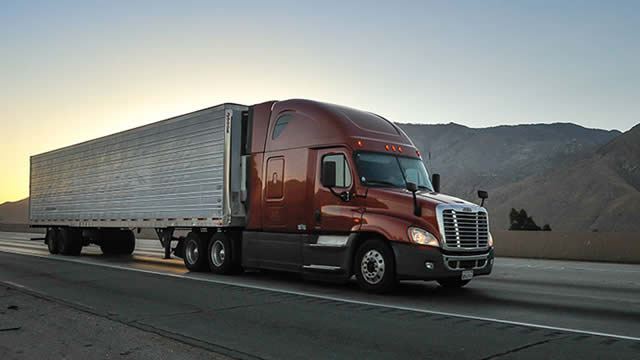
Werner Enterprises, Inc.

Werner Enterprises, Inc. (WERN) Market Cap

Werner Enterprises, Inc. has a market capitalization of $2.61B.

Price: $43.46

0.23 (0.53%)

Market Cap: 2.61B

NASDAQ · time unavailable

CEO: Derek J. Leathers

Sector: Industrials

Industry: Trucking

IPO Date: 1986-06-20

Website: https://www.werner.com

Werner Enterprises, Inc. (WERN) - Company Information

Market Cap: 2.61B|Sector: Industrials

Company Profile

Werner Enterprises, Inc., a transportation and logistics company, engages in transporting truckload shipments of general commodities in interstate and intrastate commerce in the United States, Mexico, and internationally. It operates through Truckload Transportation Services and Werner Logistics segments. The Truckload Transportation Services segment operates medium-to-long-haul van fleet that transports various consumer nondurable products and other commodities in truckload quantities using dry van trailers; the expedited fleet, which offers time-sensitive truckload services using driver teams; regional short-haul fleet that provides comparable truckload van service in the United States; and temperature controlled fleet, which offers truckload services for temperature sensitive products using temperature-controlled trailers. It transports retail store merchandise, consumer products, food and beverage products, and manufactured products. The Werner Logistics segment provides non-asset-based transportation and logistics services, including truck brokerage; logistics management services and solutions; rail transportation through alliances with rail and drayage providers; and residential and commercial deliveries of large or heavy items using liftgate straight truck. As of December 31, 2021, the company had a fleet of 8,340 trucks, which included 8,050 company-operated, as well as 290 owned and operated by independent contractors;27,225 company-owned trailers that comprised dry vans, flatbeds, temperature-controlled, and other trailers; and 55 intermodal drayage trucks. Werner Enterprises, Inc. was founded in 1956 and is headquartered in Omaha, Nebraska.

Analyst Sentiment

32%
Underperform

From 15 Active Polls

1Y Forecast: $39.20

▼ -9.8% Potential Upside

Consensus Target Metrics

Low Bound

$29

Median

$41

High Bound

$47

Average

$39

Price & Moving Averages

Loading chart...

🎯 Wall Street Analyst Intelligence Report

1-Year structural target targets, chart projections, and sentiment maps.

Average 1Y Target
$39.20
▼ -9.80% Upside
Low Target
$29.00
-33% Risk
Median Target
$40.50
-7% Mid
High Target
$47.00
8% Max
Consensus
Hold
11 / 36 Buys

Consensus Trend Projection

Trailing closures vs. 12-month metrics map.

Analyst Vote Distribution

Aggregate institutional coverage sentiment weights.

📊 Historical Valuation Multiples

Real-time Trailing Twelve Month (TTM) momentum side-by-side with discrete quarterly metrics.

Fiscal QuarterTTMQ1 2026Q4 2025Q3 2025Q2 2025Q1 2025Q4 2024Q3 2024Q2 2024
Period EndingTrailing 12MMar 31, 2026Dec 31, 2025Sep 30, 2025Jun 30, 2025Mar 31, 2025Dec 31, 2024Sep 30, 2024Jun 30, 2024
Market Cap ($M)2,6051,7631,7971,6061,6841,8132,2412,3852,222
Enterprise Value ($M)3,5852,7432,5312,3232,4042,4502,9023,0642,866
Price to Earnings Ratio (P/E)-304.24-103.41-16.16-19.519.55-44.8947.1190.8358.68
Price/Earnings-to-Growth Ratio (PEG)-10.75-8.011.6639.13
Price to Sales Ratio (P/S)0.852.182.442.082.242.552.973.202.92
Price to Book Ratio (P/B)1.931.301.321.151.181.261.541.651.53
Price to Free Cash Flow Ratio (P/FCF)-59.5857.50-76.39-187.72-39.78309.61-229.43-32.49-71.15
Enterprise Value to Sales (EV/Sales)3.393.433.013.193.443.844.113.77
Enterprise Value to EBITDA (EV/EBITDA)11.2534.2064.9338.5817.2737.0230.3833.5831.61
Debt to Equity Ratio3.080.770.580.550.540.480.480.510.49

WERN Growth Runway Model

Standard long term linear growth fade

Multi-Stage Discounted Cash Flow Sandbox

Market Price$43.46
Intrinsic Value$2.33
Market Alignment
Overvalued by 94.6%relative to calculated intrinsic value
9.00%
Exp: -1%-1%
i

Growth runway slowdown

This value provides a time window for the growth rate to decline beyond Stage 1 toward the terminal rate. Longer windows are most useful for companies with high growth starting conditions or strong competitive advantages. This option stretches out the growth rate slowdown across 5, 10, or 15-year steps. A high-growth starting condition (exceeding a 25% initial growth rate) automatically applies a curve decay to simulate realistic, rapid market saturation.
i

Terminal growth rate

With long-term inflation between 3-5%, revenue must grow by that baseline to maintain flat real-world market share. This value sets the permanent terminal growth rate to factor into the valuation beyond the growth slowdown runway toward maturity.

3-Stage Financial Runway Horizon

🧠 Perpetuity Horizon Engine (Stage 3: Post-2035)

Terminal FCF Base$0.02B
Perpetuity TV Value$0.38B
Discounted TV (PV)$0.16B
TV Weighting %58.1%
⚠️
Financial Model Disclaimer & Risk Disclosure: This interactive scenario simulator is an educational sandbox provided strictly for informational and analytical research purposes. Core historical financial statements and consensus estimates are sourced directly via Financial Modeling Prep (FMP). All downstream outputs are entirely deterministic, hypothetical projections generated by combining automated mathematical formulas (including linear interpolation and Gaussian bell-curve decay models) with user-selected variables and third-party financial data inputs. Users assume all liability for trading decisions executed based on these sandbox calculations.

📘 Full Research Report

ℹ️

AI-Generated Research: This report is for informational purposes only.

📘 WERNER ENTERPRISES INC (WERN) — Investment Overview

🧩 Business Model Overview

Werner operates as a transportation services provider in North America, primarily serving shippers that need reliable movement of goods across the network. The value chain centers on (1) acquiring and maintaining transportation capacity (drivers, tractors, and intermodal relationships), (2) matching freight demand with that capacity through dispatch and routing systems, and (3) delivering service outcomes that reduce shipper friction (on-time performance, safety, claims management, and operational predictability).

In truckload operations, Werner purchases labor and equipment capacity and sells transportation “space” to shippers via contractual terms and spot opportunities. In intermodal, Werner coordinates rail-based transport plus trucking “last-mile” components, monetizing its ability to convert rail capacity and location timing into a dependable, door-to-door service.

💰 Revenue Streams & Monetisation Model

  • Truckload revenue (transactional, volume- and lane-driven): revenue scales with freight ton-miles, effective rates, and asset utilization. Margin is influenced by the operating environment and Werner’s ability to manage empty miles, optimize routing, and maintain disciplined capacity.
  • Intermodal revenue (transactional, network- and mix-driven): monetization comes from contracted and negotiated pricing for rail/truck combined movements. Profitability depends on rail cycle reliability, terminal throughput, and Werner’s ability to secure consistent linehaul/terminal match quality.
  • Logistics services (more relationship-driven): where applicable, Werner can earn revenue by arranging transportation and managing parts of the shipment lifecycle, typically with less direct exposure to owning capacity and more emphasis on customer retention and service execution.

Overall, Werner’s margin structure is best understood through operating efficiency rather than simple pricing power. Key drivers include fuel and wage costs, linehaul productivity, equipment utilization, empty repositioning, and claims frequency/severity.

🧠 Competitive Advantages & Market Positioning

Werner’s most durable moat is a combination of switching costs and operational scale that compounds service reliability over time.

  • Switching costs (service reliability and integration): enterprise shippers build operational routines around a carrier’s routing, billing/visibility workflow, and performance metrics. Once a carrier demonstrates consistent execution, replacing it can increase operational risk and administrative burden—especially when lanes require specialized scheduling and dependable capacity.
  • Network density and capacity management: larger carriers can better balance supply (drivers/equipment and intermodal availability) with demand (shipper freight patterns). This improves pricing resilience by lowering the cost of repositioning and reducing time spent in underutilized positions.
  • Safety and compliance execution: maintaining strong safety performance and claims management reduces chargebacks and improves win rates in regulated procurement processes.
  • Intermodal know-how and execution: Werner’s intermodal capabilities reflect competence in converting rail and drayage constraints into dependable service, which is operationally harder than it appears due to handoffs and cycle timing.

Competitive benchmarking: Werner competes primarily with carriers such as J.B. Hunt, Knight-Swift, and Schneider National.

  • J.B. Hunt and Knight-Swift also operate at scale across truckload and intermodal, competing on network breadth and service performance.
  • Schneider National competes heavily in truckload and intermodal/asset-backed services, with a focus on operational reliability.

Werner’s positioning emphasizes disciplined truckload execution and intermodal participation with a focus on translating network and service quality into repeat business. The competitive difference tends to be less about “branding” and more about lane-level execution, capacity discipline, and the ability to manage costs through different freight cycles.

🚀 Multi-Year Growth Drivers

  • Outsourcing of transportation: Shippers continue to prefer specialist carriers that can provide capacity flexibility, service accountability, and operational technology rather than operating fragmented internal fleets.
  • Intermodal growth as a cost-and-sustainability strategy: Rail’s ability to move long-haul volumes efficiently supports trucking cost optimization and network emissions targets, sustaining intermodal adoption where infrastructure and service reliability meet shipper needs.
  • E-commerce and supply chain complexity: Higher shipment fragmentation increases the value of reliable network execution and predictable pickup/delivery windows, benefiting carriers with strong dispatch and claims performance.
  • Industry labor and driver availability constraints: Continued driver shortages elevate the importance of recruiting, retention, and productivity systems—advantages that scale with carrier operational excellence.
  • Technology and data-driven dispatch: Better load planning, route optimization, and visibility improve asset utilization and reduce cost-to-serve, supporting margin resilience even when pricing becomes cyclical.

⚠ Risk Factors to Monitor

  • Freight-cycle volatility: Truckload and intermodal volumes and pricing typically fluctuate with economic activity, creating earnings volatility even for well-run carriers.
  • Cost inflation and pass-through limits: Diesel, wages, insurance, and maintenance costs can rise faster than contract pricing, compressing margins.
  • Fuel price sensitivity: Even with fuel surcharges, lag effects and mix impacts can affect profitability.
  • Regulatory and compliance changes: Hours-of-service rules, safety enforcement intensity, and environmental regulations can raise operating costs or constrain capacity.
  • Intermodal execution risks: Rail service reliability, terminal constraints, and drayage availability can disrupt handoffs and degrade service performance.
  • Capital intensity in asset-heavy operations: Fleet renewal, equipment availability, and residual values can influence free cash flow through the cycle.

📊 Valuation & Market View

Transportation carriers are typically valued using EV/EBITDA-type frameworks and earnings power measures, but investors usually underwrite more directly through operating ratio quality, cash generation, and cycle-through performance rather than a single headline multiple. Key valuation drivers include:

  • Evidence of cost discipline: sustained ability to manage wage, fuel, and maintenance costs relative to revenue.
  • Utilization and mix improvement: fewer empty miles, better equipment turns, and improved lane productivity.
  • Capital return capacity: free cash flow conversion through freight downturns supports balance sheet strength and fleet investment without excessive dilution.
  • Service outcomes: lower claims and stronger safety metrics improve win rates and reduce leakage in earnings.

Because the industry is cyclical, market pricing often reflects expectations for normalization of demand and cost levels, as well as confidence in management’s ability to avoid “overcapacity” during up-cycles.

🔍 Investment Takeaway

Werner Enterprises fits an evergreen investment profile built on operational scale and customer stickiness in truckload and intermodal transportation. The principal long-term thesis is that disciplined cost execution, network density, safety/compliance performance, and intermodal execution create compounding switching costs for shippers and improve resilience across freight cycles. The core challenge is underwriting cyclicality and cost volatility—addressed through close monitoring of utilization, operating efficiency, and cash generation through downturns.


⚠ AI-generated — informational only. Validate using filings before investing.
📰 Market News & Coverage

15 Stories Available

Real-time institutional reporting and market updates for WERN.

zacks.com2026-05-28

Why Is Werner (WERN) Up 12.5% Since Last Earnings Report?

Werner (WERN) reported earnings 30 days ago. What's next for the stock?

zacks.com2026-05-27

Here's Why Werner Enterprises (WERN) is a Strong Value Stock

Whether you're a value, growth, or momentum investor, finding strong stocks becomes easier with the Zacks Style Scores, a top feature of the Zacks Premium research service.

zacks.com2026-05-25

Here's Why Werner Enterprises (WERN) is a Strong Momentum Stock

Whether you're a value, growth, or momentum investor, finding strong stocks becomes easier with the Zacks Style Scores, a top feature of the Zacks Premium research service.

businesswire.com2026-05-14

Werner Enterprises Announces Quarterly Dividend

OMAHA, Neb.--(BUSINESS WIRE)--Werner Enterprises, Inc. (Nasdaq: WERN), one of the nation's largest transportation and logistics companies, announced today that its Board of Directors declared a regular quarterly cash dividend of $0.14 (fourteen cents) per common share. This dividend will be paid on July 22, 2026, to stockholders of record at the close of business on July 6, 2026. Werner Enterprises has paid a quarterly cash dividend to its stockholders every quarter since July 1987. Werner Ente.

businesswire.com2026-05-11

Werner Enterprises to Participate in Two Investment Conferences

OMAHA, Neb.--(BUSINESS WIRE)--Werner Enterprises, Inc. (Nasdaq: WERN), a premier transportation and logistics provider, announced participation in the following investment conferences. Wolfe Research 19th Annual Global Transportation & Industrials Conference: Tuesday, May 19, 2026, in New York City, including investor meetings. Werner will participate in a panel discussion from 2:05 p.m. to 2:55 p.m. ET. Wells Fargo 16th Industrials & Materials Conference: Tuesday, June 9, 2026, in Chic.

businesswire.com2026-05-11

Werner® Earns 2026 VETS Indexes 5 Star Employer Award for Third Consecutive Year

OMAHA, Neb.--(BUSINESS WIRE)--Werner Enterprises, Inc. (Nasdaq: WERN), a premier transportation and logistics provider, is proud to announce it has earned the prestigious VETS Indexes 5 Star Employer designation for the third consecutive year. This recognition, part of the 2026 VETS Indexes Employer Awards, highlights Werner's strong commitment to the military-connected community through intentional recruiting, development and retention. As a top-tier recipient in the 2026 VETS Indexes Employer.

zacks.com2026-05-08

Why Werner Enterprises (WERN) is a Top Momentum Stock for the Long-Term

Wondering how to pick strong, market-beating stocks for your investment portfolio? Look no further than the Zacks Style Scores.

zacks.com2026-05-04

Why Werner Enterprises (WERN) is a Top Value Stock for the Long-Term

Wondering how to pick strong, market-beating stocks for your investment portfolio? Look no further than the Zacks Style Scores.

zacks.com2026-04-30

Werner Q1 Earnings & Revenues Surpass Estimates, Increase Y/Y

WERN's first-quarter 2026 revenues benefit from strength across both its Truckload Transportation Services segment and Logistics segment.

seekingalpha.com2026-04-30

Werner Enterprises: The Road To Upside May Not Be Smooth

Werner Enterprises delivered improved Q1 2026 revenue growth of 13.6% YoY, driven by acquisitions and strategic fleet management. WERN's operating margin improved to 0.5%, but persistent inflation and rising costs keep margins thin and risk elevated. Asset-light Werner Logistics and a robust balance sheet provide some insulation against macro headwinds and cost pressures.

seekingalpha.com2026-04-29

Werner Enterprises, Inc. (WERN) Q1 2026 Earnings Call Transcript

Werner Enterprises, Inc. (WERN) Q1 2026 Earnings Call Transcript

zacks.com2026-04-28

Werner Enterprises (WERN) Beats Q1 Earnings and Revenue Estimates

Werner Enterprises (WERN) came out with quarterly earnings of $0.02 per share, beating the Zacks Consensus Estimate of a loss of $0.03 per share. This compares to a loss of $0.12 per share a year ago.

zacks.com2026-04-28

Werner (WERN) Q1 Earnings: Taking a Look at Key Metrics Versus Estimates

Although the revenue and EPS for Werner (WERN) give a sense of how its business performed in the quarter ended March 2026, it might be worth considering how some key metrics compare with Wall Street estimates and the year-ago numbers.

businesswire.com2026-04-28

Werner Enterprises Reports First Quarter 2026 Results

OMAHA, Neb.--(BUSINESS WIRE)--Werner Enterprises, Inc. (Nasdaq: WERN), a premier transportation and logistics provider, today reported results for the first quarter ended March 31, 2026. "The first quarter reflects early results from our strategic positioning and positive momentum in our core business," said Derek Leathers, Chairman and CEO. "Dedicated revenue and fleet size grew, bolstered by our FirstFleet acquisition, improving rates, and a strong 95% customer retention rate. Restructuring i.

businesswire.com2026-04-22

Werner® Expands Intermodal Assets in Mexico, Providing Capacity for Cross-border Shippers

OMAHA, Neb.--(BUSINESS WIRE)--Werner Enterprises, Inc. (Nasdaq: WERN), a premier transportation and logistics provider, is expanding its intermodal presence in Mexico to give local customers more reliable shipping options. Building on a long-standing commitment to the region, Werner is deploying its fleet of 53-foot containers into the Mexican market. There are currently 400 containers in the fleet, with an additional 400 units hitting the network throughout 2026. "We want Mexican businesses to.

📊 AI Financial Analysis

Powered by StockMarketInfo
Earnings Data: Q Ending 2026-03-31

"WERN reported Q1 2026 revenue of $808.6M and net income of -$4.3M (EPS -$0.071). Revenue rose QoQ to some degree? Actually revenue increased from $737.6M in Q4’25 to $808.6M in Q1’26 (+9.7% QoQ), but declined vs Q1’25 revenue of $712.1M (+13.6% YoY). Profitability weakened sequentially: gross profit margin compressed from 10.8% (Q4’25) to 4.9% (Q1’26), and net margin deteriorated from -3.8% to -0.5% (i.e., losses narrowed). YoY, gross margin contracted (9.8% in Q1’25 to 4.9% in Q1’26) while net margin improved slightly vs -1.4% in Q1’25. Cash flow showed a rebound in Q1’26: operating cash flow was +$83.5M and free cash flow was +$30.7M, vs FCF -$23.5M in Q4’25. The company paid dividends of about $8.4M in the quarter, while no buybacks were recorded. Balance sheet resilience is mixed: total assets rose to $3.26B from $2.89B (Q4’25), while net debt increased to ~$980M from ~$734M, indicating leverage pressure despite ongoing equity levels (~$1.38B). Total shareholder returns were supportive given positive price momentum (1y_change +19.1% and 6m_change +17.2%), though not above the >20% threshold. Analyst valuation appears modest with a consensus target of $36.1 vs $32.58 spot."

Revenue Growth

Positive

Revenue increased +9.7% QoQ (Q4’25 $737.6M → Q1’26 $808.6M) and +13.6% YoY (Q1’25 $712.1M → Q1’26 $808.6M).

Profitability

Fair

Margins were volatile: gross margin compressed to 4.9% in Q1’26 from 10.8% in Q4’25 and from 9.8% in Q1’25. Net income remained negative (-$4.3M) but losses narrowed vs Q4’25 (-$27.8M), while YoY comparison shows improvement vs -$10.1M.

Cash Flow Quality

Positive

Operating cash flow rebounded to +$83.5M in Q1’26 and free cash flow turned positive to +$30.7M (vs -$23.5M in Q4’25). Dividends were paid (~$8.4M) with no disclosed buybacks; coverage is better than prior quarter but earnings remain loss-making.

Leverage & Balance Sheet

Neutral

Assets rose to $3.26B (from $2.89B). Net debt increased to ~$980M (from ~$734M), indicating higher leverage/financing pressure even though equity stayed relatively stable around ~$1.38B.

Shareholder Returns

Neutral

Price momentum is positive (1y_change +19.1%, 6m_change +17.2%), but below the >20% strong-momentum cutoff. Dividend yield is low (~0.48%). No buybacks were reported in Q1’26.

Analyst Sentiment & Valuation

Positive

Consensus price target of $36.1 vs current ~$32.58 implies upside (~10.8%). Target range ($29–$45) suggests moderate valuation support.

Disclaimer:This analysis is AI-generated for informational purposes only. Accuracy is not guaranteed and this does not constitute financial advice.

Fundamentals Overview

Loading fundamentals overview...

Werner’s Q1 shows a clear earnings recovery despite weather and rising fuel, with adjusted EPS of $0.02 (drag of ~$0.05) and TTS adjusted operating margin net of fuel up 250 bps to 2.9%. The key drivers were lower insurance/claims for legacy, accretive FirstFleet contribution, stronger One-Way production/pricing (revenue per truck per week +9.6%, revenues per total mile +3.6%), and initial logistics progress via intermodal/final mile. The near-term headwind is logistics truckload brokerage margin compression: purchase transportation costs rose faster than sell-side rate resets, driving 90 bps gross margin pressure and -0.4% logistics adjusted margin (-70 bps). Management remains confident in an improving bid-season backdrop powered by accelerating capacity exits. Operationally, FirstFleet integration is ahead of schedule: $1M of $6M synergies realized and $18M cost synergies targeted mid-next year (~300 bps operating margin lift for FirstFleet). Guidance was reaffirmed with steady cash generation and no near-term maturities.

AI IconGrowth Catalysts

  • Dedicated growth via FirstFleet acquisition (adding scale/density and exposure to grocery/food & beverage), with 98% renewal rate across 2/3 of the portfolio addressed
  • One-Way Truckload restructuring: early network profitability improvement with miles per truck +6% and revenues per total mile +3.6% in Q1
  • Logistics momentum: Intermodal load volume +22% (revenues +18%) and Final Mile revenues +8% year-over-year
  • Improving rate environment tied to supply-driven capacity exits from regulatory enforcement; expectation for more meaningful pricing gains in Q3 and Q4

Business Development

  • FirstFleet acquisition (expanded Dedicated offering)
  • Named vertical exposures from FirstFleet: grocery and food & beverage (customer verticals highlighted by management)
  • EDGE TMS platform (referenced for tech-enabled brokerage cost structure and AI rollout via EDGE)

AI IconFinancial Highlights

  • Total revenues: $809 million, +14% year-over-year
  • Adjusted operating income: $11.9 million; adjusted operating margin: 1.5%
  • Adjusted EPS: $0.02; weather and rapidly increasing fuel prices negatively impacted EPS by ~ $0.05
  • Consolidated gains on sale of property and equipment: $3.8 million vs $2.8 million prior year
  • TTS adjusted operating margin net of fuel: 2.9%, +250 bps year-over-year
  • TTS revenues: $594 million, +18% year-over-year; net of fuel surcharges revenues up 16% to $516 million
  • Dedicated trucking revenues net of fuel: $372 million, +33% year-over-year; Dedicated represented 73% of TTS trucking revenues vs 64% prior year
  • One-Way trucking revenues net of fuel: $136 million, -12% year-over-year, driven by mix/fleet reductions; revenue per truck per week +9.6%
  • Logistics gross margin pressure: truckload brokerage gross margin down 90 bps due to higher purchase transportation costs outpacing sell-side contract rate resets
  • Logistics adjusted operating margin: -0.4%, down 70 bps year-over-year; management expects improvement as contract rates reset

AI IconCapital Funding

  • Quarter-end cash and cash equivalents: $62 million
  • Operating cash flow: $89 million, up >200% year-over-year
  • CapEx: $2 million in Q1; trailing 4-quarter net CapEx: 5.6% of revenue
  • Free cash flow: $87 million (10.8% of total revenues)
  • Total liquidity: $513 million (includes $62 million cash and $451 million availability under credit facilities)
  • Total debt: $932 million (includes $54 million low-cost capital leases assumed from FirstFleet; $878 million credit facility debt)
  • Debt up $180 million sequentially; up $292 million year-over-year; net debt up $282 million year-over-year
  • Covenant defined pro forma net leverage: 2.0x at quarter end, including pro forma synergies; no near-term credit facility maturities cited

AI IconStrategy & Ops

  • FirstFleet integration ahead of schedule: $1 million realized in year synergies already out of $6 million; $5 million of $6 million actions identified and actioned
  • Cost synergies: $18 million targeted mid-next year; expected to improve FirstFleet operating margin by ~300 bps
  • One-Way restructuring actions complete; expects further benefit in Q2 from realizing a full quarter of changes
  • Centralized all loads into a single unified platform for network visibility; enabling yield optimization and cost-to-serve reduction
  • AI/automation deployment: phased rollout focused on load planning/network design, faster tender acceptance, and automating routine workflows; real-time weather event visibility for safety mitigation
  • Safety improvement: DOT preventable accident rate per million miles down 45% year-over-year

AI IconMarket Outlook

  • Capacity exits accelerating due to regulatory enforcement and carrier bankruptcies; further capacity attrition likely
  • Spot rates remained elevated through Q1 and April; management base case expects spot rates to act seasonally for the rest of the year (i.e., still elevated but more seasonal behavior)
  • Bid season repricing continues; management states Q2 is the largest pricing activity of the year
  • One-Way bid season: management referenced mid-single-digit rate increases early in Q1 bid season and expects further strengthening
  • Road-check week in “a couple of weeks” expected to provide a bounce to spot rates

AI IconRisks & Headwinds

  • Weather/productivity disruptions and rapidly increasing fuel prices reduced EPS by ~ $0.05 (weather ~ $0.03-$0.04; fuel ~ $0.01-$0.02)
  • Logistics margin pressure: purchase transportation costs accelerated faster than sell-side rate renewals; truckload brokerage gross margin down 90 bps and Logistics adjusted operating margin down 70 bps
  • Higher fuel prices and volatility can create short-term timing/cash flow impacts even with fuel surcharge pass-through
  • Driver availability risk cited: tightening market for high-quality drivers

Q&A: Analyst Interest

  • Topic: Dedicated pricing/upswing mechanics in an improving cycle. Management explained Dedicated behaves like a “true partnership,” where upside comes from adding higher-contribution trucks, more backhaul/empty-lane fill, and “selectivity at the front door,” rather than solely spot-rate comp. Long-standing relationships and FirstFleet density enable profitability lift.
  • Topic: FirstFleet integration and expected earnings/profit contribution. Management reiterated integration ahead of schedule, with $1M of $6M cost synergies realized and $5M actioned; revalidated $18M cost synergy assumption. They emphasized 98% retention across 2/3 of the 2026 renewals and described cultural/customer alignment supporting cross-sell and acceptance.
  • Topic: Timing of EPS drivers—weather/fuel impact and repricing schedule/seasonality. Management quantified EPS drag at ~$0.05 (weather $0.03-$0.04; fuel $0.01-$0.02), cited fuel surcharge pass-through as mainly timing/cash flow, and provided One-Way repricing effective shares: ~1/4 in Q1, just over 1/3 in Q2, ~1/4 in Q3, remainder in Q4.

Sentiment: POSITIVE

Note: This summary was synthesized by AI from the WERN Q1 2026 earnings transcript. Financial data is complex; please verify all metrics against official SEC filings before making investment decisions.

📋 Official Regulatory 10-K / 10-Q SEC Filings

Direct authenticated documentation links to audited SEC database reports for WERN.

SEC EDGAR Live Feed
Loading financial data and tables...
📁

SEC Filings (WERN)

© 2026 Stock Market Info — Werner Enterprises, Inc. (WERN) Financial Profile