📘 ASML Holding N.V. (ASML) — Investment Overview
🧩 Business Model Overview
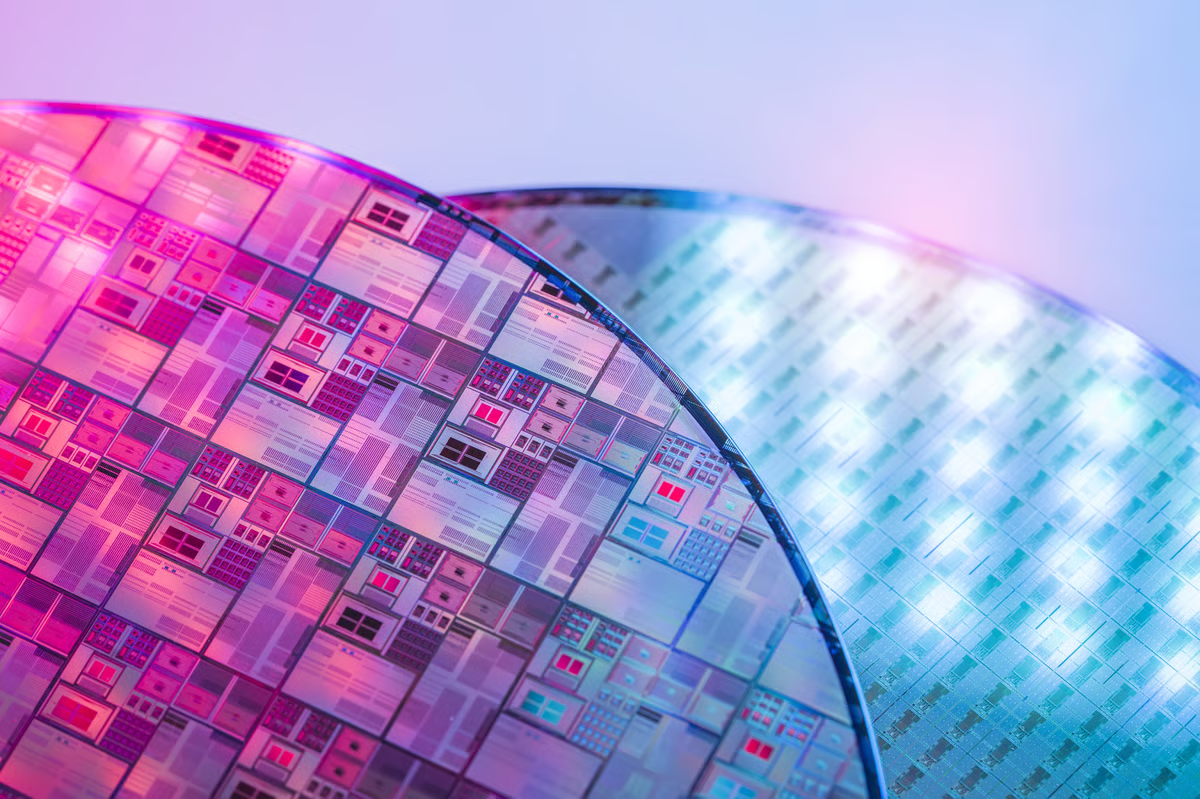
ASML Holding N.V. is a global supplier of semiconductor lithography systems, supplying the core equipment used to manufacture integrated circuits at advanced technology nodes. The company’s products enable the patterning of increasingly complex circuitry on silicon wafers, supporting the industry’s ongoing shift toward higher performance, smaller geometries, and greater transistor density. ASML’s platforms are typically sold as complete lithography systems configured for specific process requirements, with substantial value also tied to the software, optics, control systems, and qualification support required to run production-grade wafer fabrication.
ASML’s business model blends high-value capital equipment sales with a long-lived installed base that supports recurring revenues. Customers—primarily leading semiconductor manufacturers and foundries—purchase systems for capacity expansion, technology transitions, and process improvements. The installed base then becomes a source of service, upgrades, spare parts, and performance enhancements delivered over many years. This structure creates a strong linkage between the pace of technology transitions in semiconductor manufacturing and the durability of ASML’s revenue profile.
From an operational standpoint, ASML functions as a systems integrator of complex subsystems spanning precision optics, illumination optics, wafer stages, metrology and alignment systems, laser sources (often in collaboration with ecosystem partners), and advanced process control software. Delivering these systems requires deep expertise in engineering, supply chain execution, and stringent quality management given the nanometer-scale tolerances and the high uptime expectations of customer fabs.
💰 Revenue Streams & Monetisation Model
ASML monetises primarily through four related channels:
- Systems sales: Revenue from the delivery of lithography platforms and their configured options. These sales are the largest driver of cyclical revenue variation, influenced by capital expenditure cycles at major customers and the pace of technology transitions.
- Service and support: Ongoing service contracts for maintenance, software updates, and technical support. This component is typically more stable than new systems orders and is linked to the installed base uptime requirements.
- Installed-base upgrades: Performance improvements and configuration changes that extend the capability of installed tools as manufacturing needs evolve.
- Spare parts and consumables: Replacement parts and critical components supporting continued tool operation and minimizing downtime.
The monetisation model is strengthened by the fact that lithography tools are deeply embedded in production lines. Replacing equipment is costly and disruptive, while upgrading and service are generally more feasible to manage production continuity and yield improvement. As a result, service and upgrades can provide resilience through industry cycles, even when system deliveries fluctuate.
In addition, ASML benefits from long qualification cycles. Once a tool is installed and integrated into a customer’s process flow, customers tend to value continuity of performance, reliability, and support responsiveness. This dynamic contributes to a higher likelihood that the installed base remains a long-term commercial relationship rather than a single-transaction purchase.
🧠 Competitive Advantages & Market Positioning
ASML occupies a strategically critical position in semiconductor manufacturing: it provides the lithography equipment necessary for advanced patterning. The competitive landscape is shaped less by generic manufacturing capability and more by technical barriers, including:
- Optical and laser-system complexity: Advanced lithography depends on precision optics, high stability, and stringent tolerances that require specialized engineering and extensive validation.
- Process integration and software: Modern lithography systems incorporate sophisticated control software and process calibration routines that affect yield and throughput.
- Qualification and customer trust: Semiconductor fabs require extremely high uptime and predictable performance, making supplier reliability a key differentiator.
- Ecosystem and supply chain execution: Delivering cutting-edge systems requires coordination with upstream technology providers and materials suppliers.
The company’s market positioning is further reinforced by technological leadership in extreme ultraviolet (EUV) lithography. EUV has become a central enabler for continued scaling and for maintaining production viability at smaller feature sizes. While competitors may participate in adjacent lithography segments, ASML’s prominence stems from system-level execution and the ability to deliver tools that meet manufacturing-ready specifications at scale.
ASML also benefits from a de facto industry standardization effect. When major foundries and memory producers build process flows around a particular lithography ecosystem, the switching cost is high, and the supplier relationship becomes sticky. This effect enhances pricing power in service and upgrades and stabilizes the installed-base economics.
🚀 Multi-Year Growth Drivers
ASML’s multi-year growth outlook is anchored in structural drivers of semiconductor demand and in the manufacturing technology roadmap. Key growth drivers include:
- Continued technology scaling and node transitions: Advanced logic and memory manufacturing relies on lithography advances to maintain transistor density and performance improvements. EUV adoption supports these transitions and can expand opportunities for incremental system configurations and tool capability upgrades.
- Processing complexity and patterning density: Even when “node naming” becomes less straightforward, the industry continues to demand tighter patterning tolerances and more complex architectures, which sustain the need for leading-edge lithography solutions.
- Foundry and memory capacity cycles with elevated technology content: Semiconductor production build-outs, when they occur, tend to incorporate higher proportions of advanced tools, increasing the equipment content per wafer and supporting demand for sophisticated lithography systems.
- Ecosystem maturation around EUV: As EUV processes become more widely adopted, the system base grows and supports ongoing service revenue, while continuous improvements enhance throughput and yield—creating a pathway for additional upgrades and performance extensions.
- Geographic diversification and capital reallocation: The semiconductor industry’s supply chain strategy drives new fab investments across regions. When new sites come online, the installed base and demand for advanced tooling typically scale with the need to establish competitive process capabilities.
Importantly, ASML’s growth is not purely tied to “units shipped.” Many of the most economically meaningful cycles come from technology transition moments where customer requirements shift toward higher-performance lithography. These transitions can increase both systems revenue and the lifetime value of the installed base through upgrade paths and sustained service needs.
From a longer-term lens, ASML’s installed base strategy can support a compounding effect: more installed tools lead to greater service and upgrade opportunity, which can partially smooth revenue variability tied to new-build cycles. This dynamic is consistent with how customers operate their production fleets—tools are maintained, upgraded, and supported for many years as long as they remain cost-effective versus replacement.
⚠ Risk Factors to Monitor
ASML’s investment case carries several risks that can affect financial performance, execution, and valuation:
- Industry capex cyclicality: Semiconductor equipment demand is highly linked to customer capital expenditures. Downcycles can reduce order rates and delay technology transitions.
- Technology adoption pacing: While advanced nodes require leading-edge lithography, the pace of adoption can vary based on demand outlook, yield learning curves, and product mix. Slower migrations can compress incremental tool demand.
- Supply chain constraints and execution risk: Advanced lithography systems require highly specialized components and manufacturing processes. Bottlenecks, component qualification delays, or logistics disruptions can affect delivery schedules and margins.
- Customer concentration and pricing pressure: A limited number of large semiconductor manufacturers represent a substantial share of ordering activity. Competitive dynamics, procurement leverage, or negotiated pricing can impact profitability.
- Geopolitical and export controls: Semiconductor equipment is subject to export regulations and broader geopolitical risk, potentially affecting where systems can be delivered and to whom.
- Technical complexity and reliability: As systems become more advanced, higher performance targets increase the complexity of meeting uptime requirements and achieving stable production yield. Performance shortfalls could affect customer acceptance, service costs, and long-term reputation.
- Program and technology transition risk: Future lithography needs may evolve in ways that require additional engineering and substantial research. If technological progress or roadmap execution encounters setbacks, it could delay monetisation.
These risks are often mitigated by ASML’s entrenched supplier relationships, installed-base service economics, and technical leadership; however, they remain meaningful for assessing downside scenarios and the sustainability of margins through different points in the semiconductor cycle.
📊 Valuation & Market View
Valuation for ASML typically reflects a combination of factors: the durability of its competitive moat, the strategic importance of EUV/advanced lithography in semiconductor roadmaps, and the expectation that installed-base service and upgrades will provide resilience. In practice, market participants often price ASML with an emphasis on:
- Expected earnings power across cycles: Investors evaluate not only near-term order visibility but also longer-term capacity to generate cash flows from systems sales and service/upgrade economics.
- Technology leadership premium: The market frequently assigns higher multiples to suppliers that sit at the center of the most critical manufacturing steps for scaling.
- Gross margin structure and operating leverage: High complexity and scale can support strong margins, but execution quality and component costs can shift the margin profile.
- Installed-base economics: Recurring revenue opportunities can reduce volatility and enhance the quality of earnings compared with more purely transactional equipment peers.
A market view consistent with a high-quality compounder typically recognizes that semiconductors require continued process innovation and that ASML’s equipment becomes progressively more embedded in customers’ manufacturing architectures over time. At the same time, valuation can become sensitive to perceived shifts in capex intensity, adoption timelines, and policy constraints. As a result, long-term investors often focus on scenario-based analysis of demand and margins rather than on linear extrapolation of any single cycle.
Practical valuation frameworks for ASML commonly include discounted cash flow scenarios built on technology transition assumptions (including EUV adoption and upgrade intensity), service revenue persistence, and margin durability. Alternative valuation approaches include comparing implied multiples to the company’s expected normalized earnings and cash generation capacity over the cycle.
🔍 Investment Takeaway
ASML is positioned as a strategic infrastructure provider to the semiconductor industry, supplying the lithography systems required for advanced manufacturing. The company’s moat is driven by deep technical complexity, customer trust, and the installed-base effect that supports recurring service and upgrade monetisation. Over multi-year horizons, growth is supported by the ongoing need for smaller geometries, higher patterning density, and continued adoption of leading-edge lithography technologies.
The investment merits are balanced by cyclical demand dynamics in semiconductor capex, execution and supply chain risks inherent in high-precision equipment, and policy/export constraints that can influence delivery opportunities. A robust investment thesis typically combines recognition of ASML’s structural role in advanced chip production with disciplined scenario analysis around technology adoption pace and the durability of margins through varying equipment cycle conditions.
For long-term investors, ASML’s core proposition is the combination of technological leadership and installed-base recurrence: a model designed to translate industry transitions into sustained cash generation potential, even as the timing of new systems orders fluctuates with semiconductor investment cycles.
⚠ AI-generated — informational only. Validate using filings before investing.





 Growth Catalysts