Vertiv Holdings Co

Vertiv Holdings Co (VRT) Market Cap

Vertiv Holdings Co has a market capitalization of .

No quote data available.

CEO: Giordano Albertazzi

Sector: Industrials

Industry: Electrical Equipment & Parts

IPO Date: 2018-08-02

Website: https://www.vertiv.com

Vertiv Holdings Co (VRT) - Company Information

Market Cap: -|Sector: Industrials

Company Profile

Vertiv Holdings Co, together with its subsidiaries, designs, manufactures, and services critical digital infrastructure technologies and life cycle services for data centers, communication networks, and commercial and industrial environments. It offers AC and DC power management products, thermal management products, integrated rack systems, modular solutions, and management systems for monitoring and controlling digital infrastructure that are integral to the technologies used for various services, including e-commerce, online banking, file sharing, video on-demand, energy storage, wireless communications, Internet of Things, and online gaming. The company also provides lifecycle management services, predictive analytics, and professional services for deploying, maintaining, and optimizing its products and their related systems; and preventative maintenance, acceptance testing, engineering and consulting, performance assessments, remote monitoring, training, spare parts, and critical digital infrastructure software services. It offers its products primarily under the Liebert, NetSure, Geist, E&I, Powerbar, and Avocent brands. The company serves social media, financial services, healthcare, transportation, retail, education, and government industries through a network of direct sales professionals, independent sales representatives, channel partners, and original equipment manufacturers in the Americas, the Asia Pacific, Europe, the Middle East, and Africa. Vertiv Holdings Co is headquartered in Columbus, Ohio.

Analyst Sentiment

79%
Strong Buy

From 26 Active Polls

1Y Forecast: $371.67

▲ +0.0% Potential Upside

Consensus Target Metrics

Low Bound

$277

Median

$354

High Bound

$500

Average

$372

Price & Moving Averages

Loading chart...

🎯 Wall Street Analyst Intelligence Report

1-Year structural target targets, chart projections, and sentiment maps.

Average 1Y Target
$371.67
▲ +23.68% Upside
Low Target
$277.00
-8% Risk
Median Target
$354.00
18% Mid
High Target
$500.00
66% Max

Consensus Trend Projection

Trailing closures vs. 12-month metrics map.

Analyst Vote Distribution

Aggregate institutional coverage sentiment weights.

Sentiment volume allocation data unavailable.

Historical valuation matrix unavailable.

📘 Full Research Report

ℹ️

AI-Generated Research: This report is for informational purposes only.

📘 VERTIV HOLDINGS CLASS A (VRT) — Investment Overview

🧩 Business Model Overview

Vertiv designs, manufactures, and services critical infrastructure for data centers and other high-density computing environments. The value chain centers on (1) converting power reliably and efficiently (UPS systems, power distribution, batteries where applicable), (2) removing heat and controlling thermal profiles (air and liquid cooling solutions), and (3) enabling control/monitoring (management software, cabinets, and supporting infrastructure) through engineering, deployment, and lifecycle services.

Revenue is supported by both project-based equipment sales (data center builds and expansions) and a service-led model that extends the lifecycle of deployed assets. This combination tends to reduce revenue volatility versus a pure equipment vendor because service contracts and spares depend on an installed base rather than solely on new construction cycles.

💰 Revenue Streams & Monetisation Model

Vertiv monetizes through:

  • Project and equipment revenue: UPS, power distribution, cooling hardware (including rack-level and room-level solutions), and related infrastructure delivered to customers as part of build-outs.
  • Services revenue: maintenance, remote monitoring, upgrade/refurbishment services, spares, and lifecycle support across deployed systems.
  • Software/controls & monitoring enablement: software and integration tied to operational efficiency, reliability, and asset management workflows.

Margin structure is typically strongest where Vertiv combines hardware performance with service attachment. The key margin drivers are (1) product mix toward higher value systems and controls, (2) services penetration across an installed base, and (3) operational execution in procurement, manufacturing, and deployment—particularly as data center operators increasingly optimize for uptime and total cost of ownership rather than lowest upfront capex.

🧠 Competitive Advantages & Market Positioning

Vertiv’s moat is primarily switching costs and installed-base durability, supported by cost advantages in lifecycle support (global service coverage, parts availability, and standardized maintenance processes).

  • Switching costs (installed base + operational integration): Data centers standardize around equipment that meets reliability and efficiency specifications, integrates with monitoring/control stacks, and has established maintenance workflows. Replacing subsystems can require engineering re-qualification, downtime risk, and rework of thermal/power layouts.
  • Design-in and qualification barriers: Large customers typically evaluate vendors through technical qualification, performance validation, and references. Once designed into a platform or repeated deployment standard, the vendor earns repeat orders.
  • Service-led customer lock-in: Maintenance contracts, spares provisioning, and remote monitoring generate recurring revenue and strengthen customer dependence on Vertiv’s field and support capabilities.

Competitive benchmarking:

  • Schneider Electric and Eaton compete across broader electrical infrastructure portfolios, often bundling power management with wider electrical distribution and automation offerings.
  • ABB competes in power and industrial automation adjacent markets and participates in portions of data center power infrastructure.
  • Delta Electronics is another relevant competitor in power and cooling-related systems.

Vertiv’s positioning emphasizes IT infrastructure continuity—power + thermal + monitoring—with a services model designed to support the installed base over multiple equipment lifecycles. Competitors with broader electrical suites may win when customers prefer consolidated procurement, but Vertiv’s specialization and installed-base service depth help sustain share where uptime, performance, and lifecycle cost are central selection criteria.

🚀 Multi-Year Growth Drivers

Over a 5–10 year horizon, Vertiv’s opportunity is driven by structural demand for higher compute capacity and more stringent operational efficiency requirements:

  • Rising compute density and power/thermal constraints: AI and high-performance workloads increase heat flux and power density, raising the value of efficient cooling and reliable power architectures.
  • Data center expansion at the edge and in hyperscale: Growth extends beyond traditional colocation into distributed environments that require standardized, reliable infrastructure with lifecycle support.
  • Efficiency and uptime as procurement criteria: Customers increasingly prioritize total cost of ownership, redundancy, and energy efficiency—supporting demand for optimized power and thermal systems and related services.
  • Lifecycle services attach: As installed assets age, upgrades, refurbishment, monitoring enablement, and maintenance represent a durable revenue stream independent of new-build cycles.

TAM expansion is reinforced by the trend toward architectures that demand tighter integration between power, cooling, and monitoring—areas where Vertiv’s product and services integration can translate into sustained vendor selection.

⚠ Risk Factors to Monitor

  • Data center capex cyclicality: Equipment orders can track build activity and financing conditions; service demand may dampen volatility but does not eliminate cycle exposure.
  • Competitive intensity and pricing pressure: Large incumbents and well-capitalized electrical/power peers can bid aggressively, affecting margins.
  • Technology shifts in cooling architectures: Rapid adoption of new thermal approaches (e.g., evolving liquid cooling designs) can pressure product roadmaps and qualification timelines.
  • Supply chain and component availability: Power and thermal systems depend on semiconductor, electronics, and power components where shortages or logistics disruptions can impact delivery schedules.
  • Execution risk in services scale-up: Service growth requires workforce capacity, parts logistics, and disciplined contract economics; poor execution can impair profitability.

📊 Valuation & Market View

Equity valuation for companies in data center infrastructure is commonly anchored to earnings power and cash generation rather than accounting for purely hardware revenue. The market typically emphasizes:

  • EV/EBITDA and operating margin trajectory: Reflecting mix shift toward higher value systems and services.
  • Services contribution and durability: Recurring or contract-based revenue tends to be valued at a premium due to better visibility and resilience.
  • Order conversion and backlog quality: Delivery schedule discipline and project execution can influence earnings cadence.
  • Free cash flow conversion: Working capital management and disciplined capex/reinvestment affect valuation.

Key valuation “needle movers” include sustained services attachment, stable gross margins through product mix and procurement discipline, and continued execution in scaling support operations.

🔍 Investment Takeaway

Vertiv offers a specialized, lifecycle-oriented position in data center power, cooling, and monitoring infrastructure. The durable economic edge rests on switching costs from installed-base integration, design-in/qualification barriers, and service-led customer lock-in. With demand supported by compute-driven efficiency and uptime requirements, Vertiv’s long-term model is positioned to convert infrastructure growth into a mix shift toward more resilient, services-supported earnings—while maintaining exposure to structural secular trends that extend beyond equipment cycles.


⚠ AI-generated — informational only. Validate using filings before investing.

📊 AI Financial Analysis

Powered by StockMarketInfo
Earnings Data: Q Ending 2026-03-31

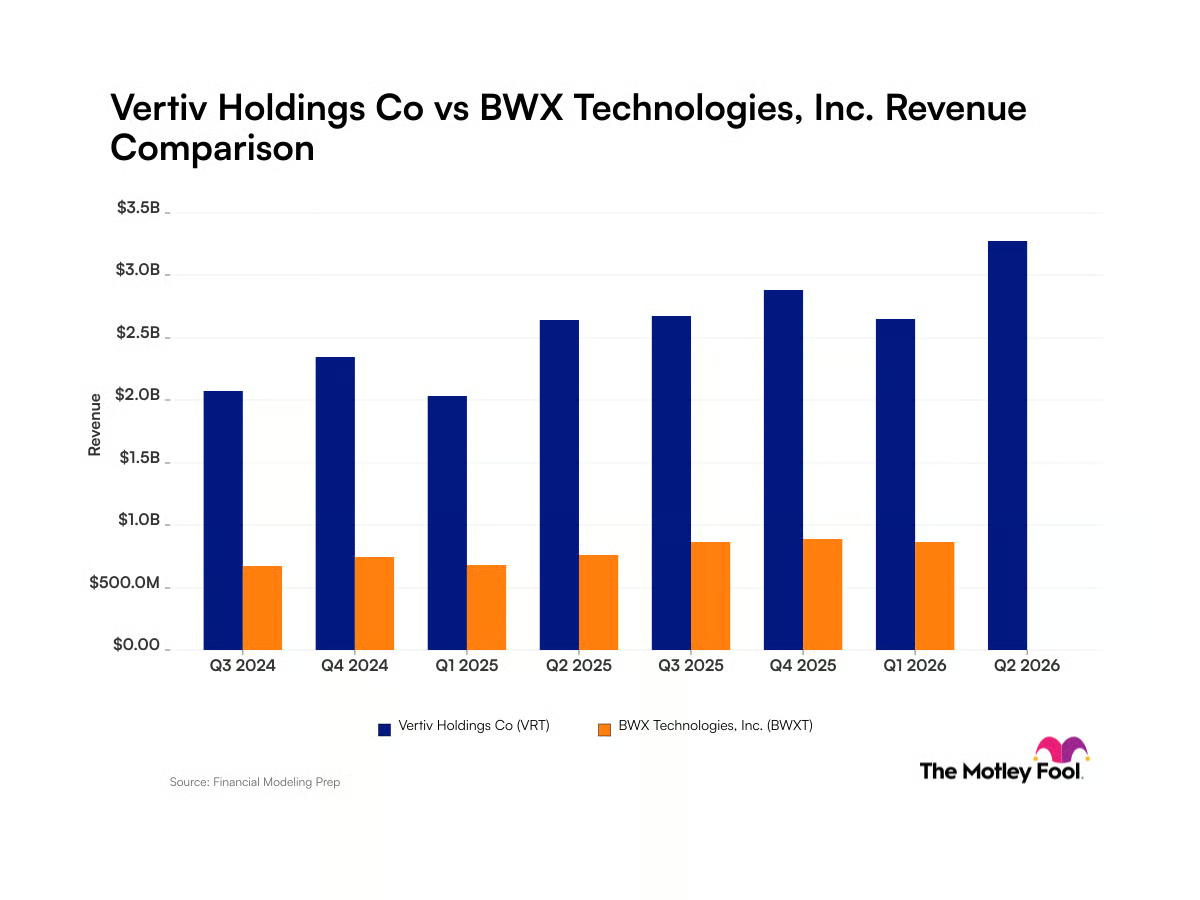
"VRT delivered Revenue of $2.65B and Net Income of $390.1M in the most recent quarter (EPS: $1.02). On a QoQ basis, Revenue fell from $2.88B to $2.65B (-8.1%) and Net Income declined from $445.6M to $390.1M (-12.5%). On a YoY basis, Revenue rose from $2.04B to $2.65B (+30.1%) while Net Income more than doubled from $164.5M to $390.1M (+137.1%), indicating meaningful operating leverage year-over-year. Profitability is mixed across the 4-quarter period: net margin was ~14.7% in the latest quarter versus ~15.5% QoQ (slight contraction), but it improved versus ~8.1% YoY (strong margin expansion). Cash flow specifics and buybacks are not provided; dividends are modest (latest quarterly dividend $0.063, payout ratio ~6.2%), so shareholder value is being driven primarily by capital appreciation. Balance sheet strength improved: Total Assets grew to $13.40B (+9.7% QoQ) and Total Equity increased to $4.24B (+7.6% QoQ), while Net Debt decreased to $1.04B (down ~37.8% QoQ). Shareholder returns are exceptional—price is up 328.95% over 1 year—far outweighing the low dividend yield."

Revenue Growth

Positive

Latest Revenue was $2.65B. QoQ: -8.1% (vs $2.88B). YoY: +30.1% (vs $2.04B), showing strong annual growth despite near-term deceleration.

Profitability

Good

EPS declined QoQ ($1.17 to $1.02, -12.8%) but surged YoY ($0.43 to $1.02, +136%). Net margin was ~14.7% latest vs ~15.5% QoQ (slight contraction) and vs ~8.1% YoY (clear expansion).

Cash Flow Quality

Neutral

Net Income improved sharply YoY (+137%) and Net Debt fell materially QoQ, but cash flow and buyback activity are not provided. Dividend is small (yield ~0.025%, payout ~6.2%), indicating limited shareholder-return support from dividends.

Leverage & Balance Sheet

Good

Total Assets and Equity both expanded QoQ ($13.40B and $4.24B, respectively). Net Debt decreased to $1.04B (from $1.68B), improving balance-sheet resilience.

Shareholder Returns

Excellent

Total return is dominated by capital appreciation: 1Y price change +328.95% (>20% momentum threshold). Dividend contribution is minimal but positive; buybacks are not disclosed.

Analyst Sentiment & Valuation

Caution

Valuation appears demanding: latest P/E ~61.5. Consensus target (~$282.67) is below the current price ($307.34), implying the stock trades ~9% above the consensus target.

Disclaimer:This analysis is AI-generated for informational purposes only. Accuracy is not guaranteed and this does not constitute financial advice.

Fundamentals Overview

Loading fundamentals overview...

Vertiv delivered a strong Q1 2026 start with adjusted diluted EPS of $1.17 (+83% YoY, $0.19 ahead of guidance) and net sales of $2.65B (+30% YoY; +23% organic). Profitability improved materially: adjusted operating margin was 20.8%, up 430 bps YoY and 180 bps above guidance, supported by volume leverage, productivity, and price/cost execution, partly offset by tariff headwinds. Management raised full-year guidance, projecting adjusted diluted EPS of $6.35 (+51% vs 2025) and adjusted operating margin of 23.3% (+290 bps), maintaining 2026 adjusted free cash flow at $2.2B midpoint. The operating plan centers on capacity expansion in manufacturing and services, backed by multi-sourcing resilience and tariff countermeasures (Sections 122 and 232). In Q&A, focus centered on EMEA’s spring-uncoiling into the back half, services scaling/margins (~30%–35% incremental proxy), and the 800-volt transition as a potential TAM expansion into higher-density power and thermal stacks beyond just liquid cooling.

AI IconGrowth Catalysts

  • Organic sales acceleration (+23% YoY) with broad-based Americas strength (+44% organic growth) and improving EMEA booking momentum into the back half
  • Data center demand growth supporting capacity expansion across manufacturing and services (power, thermal, infrastructure solutions, IT systems)
  • Systems-level opportunities driven by AI infrastructure complexity; competitive advantages compounding via integrated solutions and services scaling
  • Service growth momentum tied to increased installed base and lifecycle services capture (project services and life cycle services)

Business Development

  • Strategic acquisition: Thermal Key (closing anticipated in a few months) to expand thermal management with dry coolers/chillers for EMEA starting point
  • Strategic acquisition: B, market structures (Custom engineered structural fabrication capabilities) to accelerate manufactured/converged infrastructure at scale
  • Customer project: Ecodata Center in Sweden supporting demanding AI workloads with NVIDIA’s latest generation (Vertiv 1 core selected for full data center solution: power, thermal, IT white space and services)
  • Partnership: C Power Energy to enable U.S. data centers to convert on-site energy assets into grid resources (speed to power, resilience, cost reduction)
  • Partnerships referenced for bring-your-own-power ecosystem: Caterpillar and Oklo

AI IconFinancial Highlights

  • Adjusted operating margin: 20.8% in Q1, up 430 bps YoY and 180 bps above guidance
  • Adjusted diluted EPS: $1.17, up 83% YoY and $0.19 above Q1 guidance
  • Net sales: $2.65B, up 30% YoY; organic net sales up 23% (acquisitions +4%, FX +3%)
  • Adjusted operating profit: $551M, up 64% YoY
  • Adjusted free cash flow: $653M, up $147M YoY (working capital improvement; partially offset by higher cash tax and higher net CapEx)
  • Full-year raised guidance: adjusted diluted EPS midpoint $6.35 (+51% vs 2025); adjusted operating profit midpoint $3.2B (+53%); adjusted operating margin expected 23.3% (+290 bps from 2025)
  • Price/cost positive expected for 2026 inclusive of tariffs and countermeasures; Q2 adjusted operating margin midpoint 21.2% (+270 bps vs Q2 2025)

AI IconCapital Funding

  • No explicit buyback/debt/cash runway figures stated in the provided transcript
  • Exited Q1 with net leverage of 0.2x (strategic flexibility)
  • Higher net CapEx and ER&D investment levels driving sustained capacity build; free cash flow guidance maintained at $2.2B midpoint for 2026 (+17% vs prior year)

AI IconStrategy & Ops

  • Regional supply chain resilience via regionalized footprint and multi-sourcing; supplier diversification and proactive commodity/component management
  • Tariff mitigation efforts including countermeasures tied to Section 122 and 232 changes; stated confidence in materially offsetting tariff impacts
  • Capacity expansion characterized as broad-based (manufacturing and services) with VOS-driven productivity gains and ER&D scaling
  • Operational ramp headwind expectation: sequential margin dip from Q1 to Q2 attributed to bringing on capacity (noted as one of the biggest ramps in Q2)

AI IconMarket Outlook

  • Q2 2026 guidance (midpoint): adjusted diluted EPS $1.40 (+47% vs Q2 2025); net sales $3.35B (+27%); adjusted operating profit $710M (+45%); adjusted operating margin 21.2% (+270 bps vs Q2 2025); expectation to materially offset unfavorable tariff margin impact
  • Full-year 2026 guidance (midpoint): net sales $13.75B (+34%); adjusted diluted EPS $6.35 (+51%); adjusted operating profit $3.2B (+53%); adjusted operating margin 23.3% (+290 bps)
  • Investor conference: May 19-20 in Greenville, South Carolina (includes multi-year outlook and Q&A; technology session and Pelzer Infrastructure Solutions facility tour)

AI IconRisks & Headwinds

  • EMEA Q1 softness: EMEA net sales down 29% organically attributed to temporary reflection of softer orders in Q2 and Q3 2025
  • Tariff headwinds (ongoing) were partially offset by pricing/cost execution; margins still expected to experience a Q1→Q2 sequential dip while capacity ramps
  • Supply chain and labor constraints plus evolving trade dynamics and geopolitical complexity; management cites mitigations via multi-sourcing, countermeasures, and resilience actions
  • Capacity ramp execution risk acknowledged through sequential incremental margin compression in Q1→Q2 (due to capacity adds/work-through of tariff actions)

Q&A: Analyst Interest

  • EMEA back-half ramp drivers: Management tied higher confidence to improving EMEA market sentiment through Q1, confirmed by pleased Q4 and Q1 orders plus accelerating pipeline. They highlighted a “coiled spring” dynamic driven by data center and especially AI-capable capacity shortages and Vertiv’s strong Europe presence.
  • Services growth and margin complexion: Management described a local “territory” service structure alongside dedicated teams for large deployments. They emphasized investment in service population, training, and tools for engineers. For margin expectations, they pointed to overall incremental margins of ~30%–35% as a proxy for service pull-through.
  • 800-volt architecture and shipping timeline: Management stated they are on-time with programs and see wholesale 800-volt adoption as important into 2027+. They noted second-half 2026 portfolio launches (prototypes/validation feedback positive) but shipping is “a little bit further away.” They linked 800V to broader thermal/powertrain TAM, not only chip cooling.

Sentiment: POSITIVE

Note: This summary was synthesized by AI from the VRT Q1 2026 earnings transcript. Financial data is complex; please verify all metrics against official SEC filings before making investment decisions.

Loading financial data and tables...
© 2026 Stock Market Info — Vertiv Holdings Co (VRT) Financial Profile