Williams-Sonoma, Inc.

Williams-Sonoma, Inc. (WSM) Market Cap

Williams-Sonoma, Inc. has a market capitalization of $24.14B.

Price: $204.98

-3.11 (-1.49%)

Market Cap: 24.14B

NYSE · time unavailable

CEO: Laura J. Alber

Sector: Consumer Cyclical

Industry: Specialty Retail

IPO Date: 1983-07-07

Website: https://www.williams-sonomainc.com

Williams-Sonoma, Inc. (WSM) - Company Information

Market Cap: 24.14B|Sector: Consumer Cyclical

Company Profile

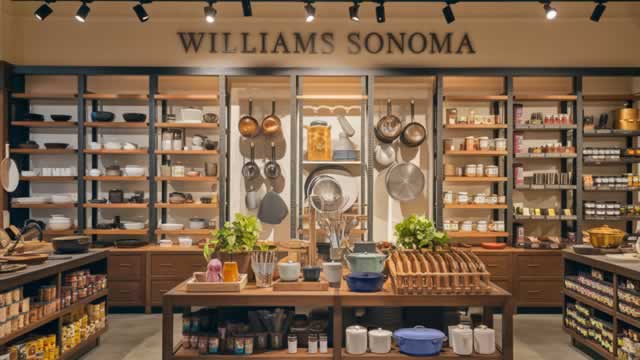
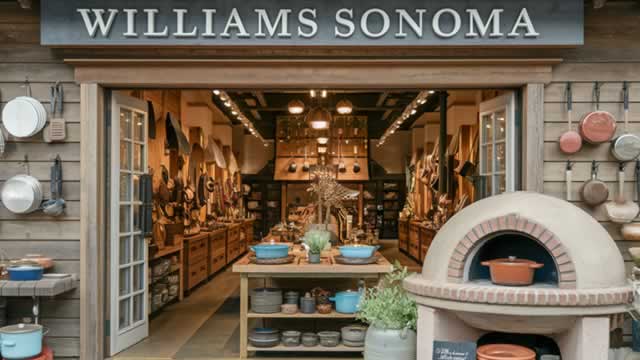
Williams-Sonoma, Inc. operates as an omni-channel specialty retailer of various products for home. It offers cooking, dining, and entertaining products, such as cookware, tools, electrics, cutlery, tabletop and bar, outdoor, furniture, and a library of cookbooks under the Williams Sonoma Home brand, as well as home furnishings and decorative accessories under the Williams Sonoma lifestyle brand; and furniture, bedding, lighting, rugs, table essentials, and decorative accessories under the Pottery Barn brand. The company also provides home decor products under the West Elm brand; kids accessories under the Pottery Barn Kids brand; and an organic bedding to multi-purpose furniture under the Pottery Barn Teen brand. In addition, it offers made-to-order lighting, hardware, furniture, and home decors inspired by history under the Rejuvenation brand; and women's and men's accessories, travel, entertaining and bar, home décor, and seasonal items under the Mark and Graham brand, as well as operates a 3-D imaging and augmented reality platform for the home furnishings and décor industry. The company markets its products through e-commerce websites, direct-mail catalogs, and retail stores. It operates 544 stores comprising 502 stores in 41states, Washington, D.C., and Puerto Rico; 20 stores in Canada; 19 stores in Australia; 3 stores in the United Kingdom; and 139 franchised stores, as well as e-commerce websites in various countries in the Middle East, the Philippines, Mexico, South Korea, and India. Williams-Sonoma, Inc. was founded in 1956 and is headquartered in San Francisco, California.

Analyst Sentiment

62%
Buy

From 22 Active Polls

1Y Forecast: $205.29

▲ +0.2% Potential Upside

Consensus Target Metrics

Low Bound

$190

Median

$200

High Bound

$230

Average

$205

Price & Moving Averages

Loading chart...

🎯 Wall Street Analyst Intelligence Report

1-Year structural target targets, chart projections, and sentiment maps.

Average 1Y Target
$205.29
▲ +0.15% Upside
Low Target
$190.00
-7% Risk
Median Target
$200.00
-2% Mid
High Target
$230.00
12% Max
Consensus
Hold
16 / 56 Buys

Consensus Trend Projection

Trailing closures vs. 12-month metrics map.

Analyst Vote Distribution

Aggregate institutional coverage sentiment weights.

📊 Historical Valuation Multiples

Real-time Trailing Twelve Month (TTM) momentum side-by-side with discrete quarterly metrics.

Fiscal QuarterTTMQ2 2026Q1 2026Q4 2025Q3 2025Q2 2025Q1 2025Q4 2024Q3 2024
Period EndingTrailing 12MMay 3, 2026Feb 1, 2026Nov 2, 2025Aug 3, 2025May 4, 2025Jan 31, 2025Oct 27, 2024Jul 28, 2024
Market Cap ($M)24,13620,79925,49623,39124,48819,49926,04116,60719,721
Enterprise Value ($M)24,97821,64125,93323,97224,89619,82126,17517,09519,770
Price to Earnings Ratio (P/E)22.2922.4717.3224.2024.7321.0816.9116.6821.84
Price/Earnings-to-Growth Ratio (PEG)0.699.654.010.4624.132.83
Price to Sales Ratio (P/S)3.0611.5210.8212.4213.3311.2710.589.2211.03
Price to Book Ratio (P/B)12.9811.1212.2411.3111.399.0212.158.718.76
Price to Free Cash Flow Ratio (P/FCF)22.03210.8649.3093.84106.15321.2445.9997.6691.70
Enterprise Value to Sales (EV/Sales)11.9911.0012.7313.5511.4610.639.4911.06
Enterprise Value to EBITDA (EV/EBITDA)16.7474.1954.2772.8863.2057.1047.2545.1057.11
Debt to Equity Ratio0.560.800.700.710.650.630.630.690.58

WSM Growth Runway Model

Standard long term linear growth fade

Multi-Stage Discounted Cash Flow Sandbox

Market Price$204.98
Intrinsic Value$167.34
Market Alignment
Overvalued by 18.4%relative to calculated intrinsic value
9.00%
Exp: 0%0%
i

Growth runway slowdown

This value provides a time window for the growth rate to decline beyond Stage 1 toward the terminal rate. Longer windows are most useful for companies with high growth starting conditions or strong competitive advantages. This option stretches out the growth rate slowdown across 5, 10, or 15-year steps. A high-growth starting condition (exceeding a 25% initial growth rate) automatically applies a curve decay to simulate realistic, rapid market saturation.
i

Terminal growth rate

With long-term inflation between 3-5%, revenue must grow by that baseline to maintain flat real-world market share. This value sets the permanent terminal growth rate to factor into the valuation beyond the growth slowdown runway toward maturity.

3-Stage Financial Runway Horizon

🧠 Perpetuity Horizon Engine (Stage 3: Post-2035)

Terminal FCF Base$1.25B
Perpetuity TV Value$23.45B
Discounted TV (PV)$9.91B
TV Weighting %57.6%
⚠️
Financial Model Disclaimer & Risk Disclosure: This interactive scenario simulator is an educational sandbox provided strictly for informational and analytical research purposes. Core historical financial statements and consensus estimates are sourced directly via Financial Modeling Prep (FMP). All downstream outputs are entirely deterministic, hypothetical projections generated by combining automated mathematical formulas (including linear interpolation and Gaussian bell-curve decay models) with user-selected variables and third-party financial data inputs. Users assume all liability for trading decisions executed based on these sandbox calculations.

📘 Full Research Report

ℹ️

AI-Generated Research: This report is for informational purposes only.

📘 WILLIAMS SONOMA INC (WSM) — Investment Overview

🧩 Business Model Overview

Williams-Sonoma Inc. operates a specialty home retail platform that spans owned brands and multi-channel execution (stores and digital). The company designs and curates assortments across key categories—furniture, bedding, kitchenware, decor, and seasonal items—then monetizes those products through branded storefronts, e-commerce, and fulfillment operations.

A central element of the model is merchandising discipline: WSM combines a portfolio of distinctive brands with category expertise and supply-chain scale. This enables consistent product availability, tailored assortment by brand, and efficient distribution that supports both store replenishment and direct-to-consumer delivery.

💰 Revenue Streams & Monetisation Model

WSM’s revenue is predominantly transactional, generated by sales of owned-brand products and, to a lesser extent, partner brands where applicable. The business is not “subscription-like,” but monetization is supported by repeat purchasing behavior driven by home life events (weddings/households, remodels, seasonal refresh cycles) and by a deep catalog of replenishment-oriented goods (kitchen staples, bedding, lighting, and decor).

Margin structure typically reflects:

  • Gross margin leverage driven by product mix (owned brands vs. third-party assortments), pricing power, sourcing terms, and freight efficiency.
  • Operating leverage from distribution scale, marketing efficiency, and store productivity (traffic converted into sales at acceptable inventory turns).
  • Working-capital discipline as inventory management directly affects markdown exposure and cash generation.

🧠 Competitive Advantages & Market Positioning

WSM’s moat is best characterized as scale/distribution leverage combined with private-label (owned brand) resistance. In specialty home retail, differentiation often appears through product design, breadth of curated assortments, and brand-level merchandising—areas where WSM has built capabilities and procurement economics that are difficult to replicate quickly at comparable scale.

  • Scale/Distribution leverage: Multi-brand operations and distribution infrastructure support efficient replenishment and fulfillment economics versus smaller specialty retailers.
  • Private-label resistance: Owned brands reduce reliance on commodity-like third-party inventories and provide greater control over quality, design cadence, and pricing architecture.
  • Brand-anchored assortment depth: The brand portfolio creates “category homes” across kitchen, living, and bedding needs, encouraging repeat purchases within households.

Competitive benchmarking (industry peers):

  • Wayfair (online home furnishings): Competes heavily on digital selection and fulfillment. WSM’s advantage centers on owned-brand merchandising and store+digital execution with category-specific curation.
  • RH (high-end specialty): Competes on design-led premium positioning. WSM’s broader mid-to-premium portfolio diversifies demand drivers and reduces dependence on a single price tier.
  • Target and Costco (mass/warehouse retail): Compete on value and assortment breadth. WSM’s private-label and design-driven assortment aims to maintain differentiation away from pure price competition.

🚀 Multi-Year Growth Drivers

  • Share shift toward digital and omnichannel convenience: Online shopping penetration in home categories supports direct-to-consumer growth, while store networks remain useful for sampling and service-led buying.
  • Owned-brand mix expansion: Increasing the share of products where WSM controls design, sourcing, and pricing typically improves margin resilience.
  • Category growth inside the home ecosystem: Long-lived categories (kitchenware, bedding, lighting) benefit from household replenishment and higher-than-average engagement around remodels and seasonal refresh.
  • International and cross-border e-commerce potential: Brand-led digital commerce can extend addressable market without the same lease-driven cost structure as physical expansion.
  • Operational improvement cycles: Better inventory productivity, more efficient fulfillment, and tighter merchandising feedback loops can extend operating leverage through the cycle.

⚠ Risk Factors to Monitor

  • Inventory and markdown risk: Home categories are sensitive to demand shifts; misaligned assortment or excess inventory can pressure gross margins.
  • Promotional intensity and price competition: Mass retailers and large e-commerce platforms can force promotional behavior that compresses margins.
  • Freight and input cost volatility: Home products are logistics-sensitive; changes in transportation and sourcing costs can affect gross margin.
  • Consumer discretionary demand elasticity: Furniture and décor spending can downshift during macro stress.
  • Real estate and execution risk: Store footprint and lease obligations introduce fixed-cost leverage and execution complexity.

📊 Valuation & Market View

The market typically values specialty retail on EV/EBITDA and P/S, with narrative emphasis on sustainable gross margin, inventory health, and operating leverage. For this business model, the “multiple” tends to expand or contract based on:

  • Gross margin durability (owned-brand mix, pricing discipline, freight and sourcing terms).
  • Inventory turns and markdown rate (working capital conversion quality).
  • Sales leverage from store productivity and digital conversion efficiency.
  • Expense discipline (fulfillment cost per order, controllable marketing spend efficiency).

Given the transactional nature of revenue, valuation often responds to evidence that merchandising and inventory management can sustain profitability through a full demand cycle.

🔍 Investment Takeaway

WSM offers a durable specialty retail thesis anchored in owned-brand merchandising and scale-driven distribution economics. The investment case rests on sustaining gross margin and inventory productivity while expanding the owned-brand and omnichannel mix—reducing exposure to pure price competition and supporting resilient operating leverage over a multi-year horizon.


⚠ AI-generated — informational only. Validate using filings before investing.

📰 Market News & Coverage

15 Stories Available

Real-time institutional reporting and market updates for WSM.

businesswire.com2026-06-03

GreenRow Launches New Collaboration With New York Botanical Garden

SAN FRANCISCO--(BUSINESS WIRE)-- #Fortune500--GreenRow Launches new Collaboration with New York Botanical Garden.

fool.com2026-06-01

Williams-Sonoma: A Strong Contender in Home Furnishings Investment

Explore the exciting world of Williams-Sonoma (WSM 0.70%) with our contributing expert analysts in this Motley Fool Scoreboard episode. Check out the video below to gain valuable insights into market trends and potential investment opportunities!

zacks.com2026-06-01

Lifetime Brands' Home Decor Expansion Supports Broader Revenue Growth

LCUT is turning home decor into a major growth engine, with strong channel demand and brand momentum helping expand its market reach.

zacks.com2026-05-29

Is Most-Watched Stock Williams-Sonoma, Inc. (WSM) Worth Betting on Now?

Zacks.com users have recently been watching Williams-Sonoma (WSM) quite a bit. Thus, it is worth knowing the facts that could determine the stock's prospects.

seekingalpha.com2026-05-28

Williams-Sonoma: Upgrading To Hold Due To Strong Sales Growth

Williams-Sonoma showed resilience and broad-based revenue growth in the most recent quarter. The macro landscape, however, remains challenging, with consumer confidence hitting record lows, the housing market remaining soft, and energy prices remaining elevated. Despite the growth, the firm's valuation metrics do not look appealing in absolute terms.

marketbeat.com2026-05-26

Powerhouse Williams-Sonoma Heading to Fresh Highs in 2026

Williams-Sonoma NYSE: WSM faces headwinds like any retailer this year, but it has several things going for it that most retailers don't. Williams-Sonoma's brand quality, growing portfolio, and consumer segment position it for strength across all cycles, particularly in its cash flow and capacity for capital returns.

zacks.com2026-05-26

Why Williams-Sonoma (WSM) is a Top Momentum Stock for the Long-Term

The Zacks Style Scores offers investors a way to easily find top-rated stocks based on their investing style. Here's why you should take advantage.

seekingalpha.com2026-05-25

Williams-Sonoma: Current Valuation Supports A 'Hold'

Williams-Sonoma (WSM) delivered Q1 FY26 revenue and EPS above analyst expectations, driving a 6.5% share price jump. WSM's growth was broad-based across all brands, with West Elm leading at 7.8% revenue growth and strong comparable sales. The company maintains a debt-free balance sheet, over $1B in cash, robust buybacks, and a 15% dividend increase.

zacks.com2026-05-21

Williams-Sonoma Q1 Earnings Beat Estimates, Revenues Meet, Both Up Y/Y

WSM beats first-quarter fiscal 2026 EPS estimates as West Elm and Pottery Barn brands drove revenue growth.

seekingalpha.com2026-05-21

Williams-Sonoma, Inc. (WSM) Q1 2027 Earnings Call Transcript

Williams-Sonoma, Inc. (WSM) Q1 2027 Earnings Call Transcript

marketbeat.com2026-05-21

Williams-Sonoma Q1 Earnings Call Highlights

Williams-Sonoma NYSE: WSM reported stronger first-quarter fiscal 2026 sales and earnings, with management pointing to broad-based gains across its brand portfolio, improving performance in both furniture and non-furniture categories and continued benefits from supply chain efficiencies.

zacks.com2026-05-21

Claims, Starts & Walmart: Busy Pre-Market

New jobless claims stay on the low side, Housing Starts up on multi-family and Walmart beats by a penny.

proactiveinvestors.com2026-05-21

Williams Sonoma Q1 revenue rises on strong West Elm performance

Williams Sonoma Inc (NYSE:WSM) posted first-quarter 2026 revenue of $1.81 billion, up 4.4% year over year and slightly ahead of analyst estimates of $1.80 billion, as comparable sales growth across all four major brands signaled broad demand for premium home furnishings. Net income was $231.4 million, flat compared to the prior-year period, while operating margin came in at 16.2%, down 60 basis points year over year due to higher selling, general and administrative costs.

zacks.com2026-05-21

Here's What Key Metrics Tell Us About Williams-Sonoma (WSM) Q1 Earnings

Although the revenue and EPS for Williams-Sonoma (WSM) give a sense of how its business performed in the quarter ended April 2026, it might be worth considering how some key metrics compare with Wall Street estimates and the year-ago numbers.

zacks.com2026-05-21

Williams-Sonoma (WSM) Tops Q1 Earnings and Revenue Estimates

Williams-Sonoma (WSM) came out with quarterly earnings of $1.93 per share, beating the Zacks Consensus Estimate of $1.8 per share. This compares to earnings of $1.85 per share a year ago.

📊 AI Financial Analysis

Powered by StockMarketInfo
Earnings Data: Q Ending 2026-05-03

"WSM reported Q1 2026 revenue of $1.805B and net income of $231M, with diluted EPS of $1.93. On a QoQ basis, revenue fell to $1.805B from $2.357B in Q4 2025 (-23.4%), while net income declined to $231M from $368M (-37.1%). YoY comparisons show revenue rose from $1.730B in Q1 2025 to $1.805B (+4.5%), and net income increased from $231M to $231M (+0.04%)—i.e., earnings were essentially flat despite top-line growth. Profitability was mixed: net margin weakened to 12.8% in Q1 2026 from 13.4% in Q1 2025 (down ~0.5pp) and also from 15.6% in Q4 2025 (down ~2.8pp). Cash flow remains solid: operating cash flow was $156M and free cash flow was $99M in the quarter, supported by operating cash conversion even as working capital was a headwind (change in working capital: -$145M). Shareholder returns are strong given market momentum—WSM’s 1-year price change is +44.4%—along with continued capital returns: the company paid $86M in dividends and repurchased $381M of common stock in the quarter. Balance sheet resilience is moderate: equity was $1.87B and net debt increased to ~$842M from ~$437M in Q4 2025, reflecting higher leverage."

Revenue Growth

Neutral

QoQ revenue decreased from $2.357B (Q4 2025) to $1.805B (Q1 2026) (-23.4%), reflecting seasonality. YoY revenue grew modestly from $1.730B (Q1 2025) to $1.805B (+4.5%).

Profitability

Fair

Net income was essentially flat YoY ($231.3M vs $231.3M, +0.04%), while net margin contracted to 12.8% from 13.4% in Q1 2025 (down ~0.5pp) and from 15.6% in Q4 2025 (down ~2.8pp).

Cash Flow Quality

Positive

Q1 2026 operating cash flow was $156M and free cash flow $99M. Working capital was a drag (-$145M change in working capital), but cash generation remained positive; dividends and buybacks were funded without a cash-flow collapse.

Leverage & Balance Sheet

Neutral

Equity was $1.87B. Net debt rose to ~$842M from ~$437M QoQ, indicating increasing leverage versus last quarter, though liquidity (cash $652M) remains meaningful.

Shareholder Returns

Strong

Total shareholder return is bolstered by strong momentum: 1y_change +44.4% (>20%). Capital returns also active in the quarter (dividends paid $86M; buybacks $381M).

Analyst Sentiment & Valuation

Positive

With price at $198.69 and consensus target $199, valuation appears roughly in line with consensus. (High recent momentum supports sentiment, but valuation upside looks limited near term.)

Disclaimer:This analysis is AI-generated for informational purposes only. Accuracy is not guaranteed and this does not constitute financial advice.

Fundamentals Overview

Loading fundamentals overview...

WSM delivered a strong Q1 2026 with +4.8% comp growth and EPS of $1.93, while operating margin reached 16.2% and beat expectations despite tariffs and higher fuel costs. The margin story was a mix of ~-30 bps gross margin and ~-100 bps merchandise-margin pressure from tariff-driven COGS, partially offset by ~+50 bps supply-chain efficiency (lower shrink accrual) and ~+20 bps occupancy leverage. SG&A rose ~30 bps as employment deleveraged, though advertising leveraged. Guidance was reiterated rather than raised: FY26 comps +2% to +6% (midpoint ~4%) and operating margin 17.5% to 18.1% (midpoint ~17.8%). Management emphasized a front-half-weighted tariff impact that moderates later, with no tariff-refund benefit assumed. Investor focus in Q&A centered on consumer behavior, whether demand is promotionally/artificial, and supply chain KPIs supporting service-led execution.

AI IconGrowth Catalysts

  • Broad-based positive comps: companywide comp +4.8% with every brand positive
  • West Elm comp +8.5% driven by newness, better in-stock availability, and product/channel improvements
  • Williams Sonoma comp +5.0% driven by kitchen acceleration and proprietary/market-exclusive design products
  • Pottery Barn comp +1.0% improvement tied to heritage aesthetic in marketing/product and improved value
  • Pottery Barn Kids comp +4.5% supported by collaborations/licensing (Love Shack Fancy, Christopher Loves Julia) and registry/dorm momentum
  • B2B record quarter +13.7% with trade +9% and contract +22%
  • Supply chain efficiency initiatives reducing returns/replacements and improving timely delivery to support net revenue momentum

Business Development

  • Partnership/collaboration: Love Shack Fancy (Pottery Barn Kids); Christopher Loves Julia (Pottery Barn Kids)
  • Collaboration: Emma Chamberlain collection (West Elm)
  • Spokesperson/partnership: Kelly Wearstler for Williams Sonoma exclusive rental offering
  • Product collaboration: Stanley Tucci pizza oven with Green Pan (Williams Sonoma)
  • Food collaboration: Oakville Grocery (Napa Valley) with Williams Sonoma
  • B2B marquee projects/customers: Delano Miami; Bernardus Resort and Spa; AMLI; Greystar
  • B2B sports/entertainment: Capital One Arena Live Nation Philadelphia; upcoming work with the US Open
  • Industry recognition: Hospitality Design Expo “best in show” award (for B2B) to start Q2
  • New brand launch: Dormify launched as the 10th brand for Pottery Barn Kids

AI IconFinancial Highlights

  • Net revenues: $1.81B with +4.8% comp growth
  • Operating margin: 16.2%, ahead of expectations
  • EPS: $1.93 vs $1.85 prior year (+~4%)
  • Gross margin: 44.0%, down ~30 bps YoY; merchandise margins down ~100 bps
  • Tariffs: higher weighted-average COGS from tariffs pressured merchandise margins (~100 bps decline)
  • Offsetting bps benefits: supply chain efficiencies (lower shrink accrual) delivered ~+50 bps gross margin benefit; occupancy cost leverage ~+20 bps
  • SG&A: 27.8% of revenues, up ~30 bps YoY; employment expense deleveraged ~30 bps; advertising leveraged ~10 bps; general expenses deleveraged ~10 bps (timing)
  • Inventory: $1.46B (+9% YoY) including ~$60M embedded incremental tariff costs; ex-tariff would be in line with top-line growth
  • Guidance includes: no benefit from tariff refunds (uncertain timing); tariffs assumed to remain in effect for FY26 with impact front-half weighted

AI IconCapital Funding

  • Returned to investors: $373M in Q1 via share repurchases and dividends
  • Share repurchases: $288M, ~1.4% of shares outstanding
  • Dividends: $85M, +15% YoY; quarterly dividend $0.76/share (15% increase YoY) maintained
  • Q1 capex: $58M
  • Full-year capex guidance: ~$275M; ~95% allocated to ecommerce, retail, and supply chain
  • Remaining buyback authorization: ~$1.1B under current authorizations
  • Balance sheet / runway referenced indirectly via “fortress balance sheet” (no new debt figures provided)

AI IconStrategy & Ops

  • Extended AI further into the customer journey; scaled personalization and optimized shopping/checkout experience
  • Automation investment to improve customer care and strengthen product discovery; advanced design tools
  • Supply chain focus: timely delivery, low returns/replacements, and continued shrink reduction to offset tariffs/fuel
  • Customer care differentiation targets: “perfect order on time, damage free every time” with explicit KPIs
  • Retail footprint: year-end store count expected essentially flat in FY26; FY27 onward expected 1% to 3% annual store count growth
  • West Elm store expansion plan: 5 West Elm openings planned in 2026

AI IconMarket Outlook

  • FY26 guidance reiterated (not raised): net revenue comps +2% to +6% (midpoint ~4%); total net revenue growth +2.7% to +6.7%
  • FY26 operating margin guidance: 17.5% to 18.1% (midpoint ~17.8%)
  • Interest income (full year): ~$25M
  • Effective tax rate (full year): ~25.5%
  • Tariff modeling: impact assumed front-half weighted and moderating in back half; tariffs assumed all currently in place remain for balance of FY26; Section 122 assumed replaced around July at similar rate

AI IconRisks & Headwinds

  • Tariffs: merchandise margin pressure (MM decline ~100 bps YoY) and continued uncertainty; management does not plan for tariff refunds benefit
  • Fuel/oil: higher fuel and transportation costs (ocean freight pressure and domestic shipping cost pressure) though partially mitigated by scale and supply chain efficiencies
  • External uncertainty: geopolitics/war, trade policy/tariffs, and interest rates; management explicitly not building a meaningful housing recovery into guidance
  • Tariff policy changes could require guidance updates (timing and ultimate tariff levels uncertain)

Q&A: Analyst Interest

  • Topic: Consumer demand and potential price actions under persistent inflation—Management’s detailed response: Management said they cannot speak for other reports but believe the consumer is responding to products and strategies across channels/brands, evidenced by broad-based furniture-to-small-items strength and non-promotionally driven events. For persistent inflation, they said it is too early to comment on price increases, emphasizing differentiation beyond price and continued investment in “best value.”
  • Topic: Tariff cadence, merchandise margin trough/peak timing, and guidance assumptions—Management’s detailed response: Management stated Q1 merchandise-margin declined about 100 bps but was a little better than Q4 and slightly better than expected. They reiterated that tariffs are heavily front-weighted and then moderate across the back half due to weighted-average cost accounting flow. They also said Q2 lacks the easier timing comparisons present in Q1, making Q2 likely the peak impact period.
  • Topic: Underlying demand curve, West Elm/Pottery Barn drivers, and supply chain KPI visibility—Management’s detailed response: On underlying demand, management pushed back on a tax-refund-only view, citing broad-based, non-promotionally led strength, “very, very strong Easter,” and confidence from improved stock/newness. They described West Elm positioning as sustainable and Pottery Barn improvements as early-stage. On supply chain, management highlighted KPIs: perfect order on time and damage-free, plus customer satisfaction validation via post-delivery signoff and photo capture.

Sentiment: POSITIVE

Note: This summary was synthesized by AI from the WSM Q1 2026 earnings transcript. Financial data is complex; please verify all metrics against official SEC filings before making investment decisions.

📋 Official Regulatory 10-K / 10-Q SEC Filings

Direct authenticated documentation links to audited SEC database reports for WSM.

SEC EDGAR Live Feed
Loading financial data and tables...
📁

SEC Filings (WSM)

© 2026 Stock Market Info — Williams-Sonoma, Inc. (WSM) Financial Profile