📘 BKV CORP (BKV) — Investment Overview
🧩 Business Model Overview
BKV is a focused upstream oil & gas producer with core operations in the Bakken/Three Forks resource play in North Dakota. The value chain centers on (1) securing and holding dense oil-bearing acreage, (2) drilling and completing wells using standardized, repeatable development patterns, (3) producing and processing crude through operated gathering/processing and water handling systems, and (4) selling crude to regional buyers with pricing tied to commodity benchmarks and local differentials.
The economic engine is the conversion of drilling and completion capital into long-lived, stacked well performance—then recycling operating cash flow into continued development while managing decline rates and per-unit costs.
💰 Revenue Streams & Monetisation Model
BKV’s monetisation is primarily commodity-driven:
- Crude oil sales (dominant revenue driver), priced against regional benchmark pricing with quality and location basis impacts.
- Natural gas and NGL sales, typically smaller and more variable, often influenced by takeaway constraints and field-specific gas handling economics.
- Ancillary revenue may arise from gas processing arrangements or other field services, but the business remains fundamentally upstream and volume/benchmark dependent.
Margin structure is driven less by contractual pricing power and more by controllable operating levers: lease operating expenses, gathering/transport costs, water management costs, well productivity (initial rate and decline profile), and realized differentials. Capital efficiency (finding/harvesting hydrocarbons per dollar) is the key link between drilling activity and long-run free cash flow generation.
🧠 Competitive Advantages & Market Positioning
BKV’s competitiveness is best characterized by geographic cost advantage and logistical infrastructure, anchored in dense Bakken acreage and field-level systems.
- Geographic Cost Advantage (Bakken concentration): Dense development enables tighter well spacing, shorter trucking/transport paths for inputs, and operational standardization. That typically supports lower per-unit costs than more geographically dispersed producers.
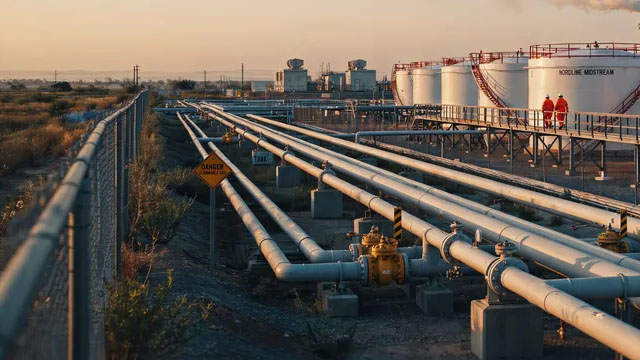
- Logistical Infrastructure: Operated gathering, processing, and water handling reduce reliance on third-party transportation for core volumes, improving controllability of downtime and unit costs.
- Learning Curve & Technical Execution: Repetition across a concentrated resource base supports improved completion designs, drilling performance, and decline optimization, which translates into better cash economics through the cycle.
Competitive benchmarking: The Bakken is populated by large operators with meaningful scale and resource footprints, including Continental Resources, Marathon Oil, and EOG Resources. Compared with these broader portfolios, BKV’s positioning emphasizes a more concentrated upstream focus in the Bakken—seeking per-BOE operational discipline and logistics control in a defined geographic basin rather than diversifying across multiple plays.
🚀 Multi-Year Growth Drivers
Over a 5–10 year horizon, growth is primarily a function of reserve replacement, production sustainability, and unit cost improvement rather than a shift to new revenue models. Key drivers include:
- Development scalability within the core basin: Dense acreage and repeatable well execution support continued incremental production from a defined resource base.
- Well productivity and decline-rate management: Targeting stronger initial productivity and flatter decline profiles increases the lifetime value of each well and improves capital returns.
- Operational efficiency initiatives: Improvements in drilling/completion execution, supply-chain contracting, and field operations can reduce lifting and infrastructure-related costs.
- Midstream and field logistics optimization: Continued focus on gathering/processing reliability and water logistics reduces bottlenecks that can otherwise constrain production.
- Cycle-agnostic capital discipline: In upstream, the path to durable free cash flow is heavily influenced by maintaining development pace aligned with balance sheet capacity and cash flow generation through price volatility.
⚠ Risk Factors to Monitor
- Commodity price and differential risk: Realized prices depend on benchmark oil prices and local differentials, which can swing materially with regional supply-demand dynamics.
- Regulatory and permitting risk: North Dakota and federal oversight can affect drilling approvals, environmental compliance, flaring rules, and water management obligations.
- Operational execution risk: The value of a Bakken-centric model depends on maintaining well performance; variability in reservoir quality or execution can impair returns.
- Capital intensity and balance sheet sensitivity: Upstream development requires sustained capital. Poor capital discipline can pressure liquidity during lower-price periods.
- Infrastructure and takeaway constraints: Even with logistical assets, broader regional constraints (processing capacity, gathering expansions, water handling) can limit production growth or increase costs.
📊 Valuation & Market View
The market typically values upstream producers through asset-based and cash-flow frameworks rather than balance-sheet multiples. Common approaches include:
- EV/EBITDAX-style multiples reflecting operating earnings power and margin durability through the commodity cycle.
- Net asset value (NAV) and reserve-based valuation tying discounted future cash flows to proved reserves, decline assumptions, and capital requirements.
- DCF sensitivity to commodity price, realized differentials, and operating cost curves, which often dominate valuation movement.
Key valuation “needle movers” are production sustainability (decline rate), per-unit cost competitiveness, realized pricing and differentials, and the credibility of capital allocation to achieve reserve replacement and maintain balance sheet resilience.
🔍 Investment Takeaway
BKV’s long-term thesis rests on a Bakken-focused cost-and-logistics advantage supported by dense acreage development, field-level execution repeatability, and controllable gathering/processing and water handling economics. The investment case is strongest when disciplined capital allocation preserves unit-cost competitiveness and supports sustainable production through commodity cycles.
⚠ AI-generated — informational only. Validate using filings before investing.











 Growth Catalysts