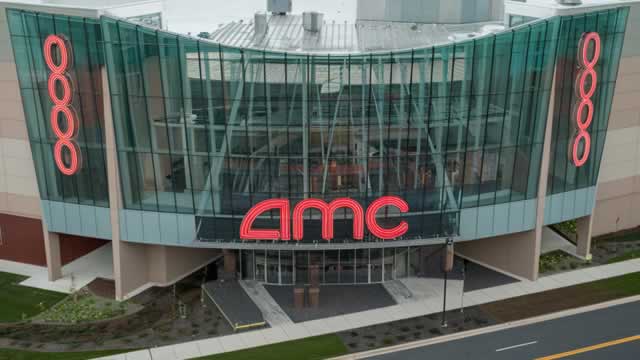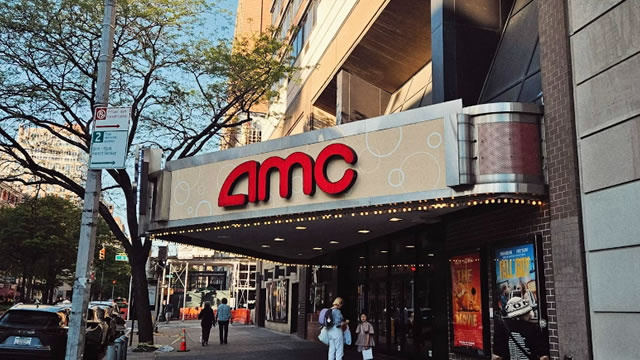
AMC Entertainment Holdings, Inc.

AMC Entertainment Holdings, Inc. (AMC) Market Cap

AMC Entertainment Holdings, Inc. has a market capitalization of $996.6M.

Financials based on reported quarter end 2025-12-31

Price: $1.71

0.04 (2.40%)

Market Cap: 996.58M

NYSE · time unavailable

CEO: Adam Aron

Sector: Communication Services

Industry: Entertainment

IPO Date: 2013-12-18

Website: https://www.amctheatres.com

AMC Entertainment Holdings, Inc. (AMC) - Company Information

Market Cap: 996.58M · Sector: Communication Services

AMC Entertainment Holdings, Inc., through its subsidiaries, engages in the theatrical exhibition business. The company owns, operates, or has interests in theatres in the United States and Europe. As of March 1, 2022, it operated approximately 950 theatres and 10,600 screens. The company was founded in 1920 and is headquartered in Leawood, Kansas.

Analyst Sentiment

52%
Hold

Based on 28 ratings

Analyst 1Y Forecast: $0.00

Average target (based on 3 sources)

Consensus Price Target

Low

$3

Median

$4

High

$8

Average

$4

Potential Upside: 156.7%

Price & Moving Averages

Loading chart...

📘 Full Research Report

ℹ️

AI-Generated Research: This report is for informational purposes only.

📘 AMC ENTERTAINMENT HOLDINGS INC CLA (AMC) — Investment Overview

🧩 Business Model Overview

AMC Entertainment Holdings Inc. (“AMC”) operates as one of the leading theatrical exhibition companies globally, primarily through physical movie theaters. The company’s core business revolves around owning, leasing, and operating multiplex cinemas in key domestic and international markets. AMC targets a wide customer spectrum, catering to moviegoers seeking both blockbuster releases and premium theatrical experiences. Throughout its footprint, AMC’s operations are focused on cinema exhibition, food and beverage concessions, private screenings, and various ancillary entertainment offerings. Strategic initiatives also include investments in premium large-format screens, luxury seating, and evolving technology to elevate visitor experience and drive customer retention.

💰 Revenue Streams & Monetisation Model

AMC’s revenues originate from several key channels: - **Box Office Sales:** The primary revenue driver is ticket sales, including standard, premium, and event-based showings. Partnerships with major film studios help secure early access to blockbuster films, maximising attendance. - **Concession Sales:** Food and beverage offerings — from classic popcorn and soft drinks to gourmet snacks, alcoholic beverages, and branded merchandise — represent a high-margin revenue stream critical to overall profitability. - **Premium Experiences:** Upselling luxury seating, IMAX and Dolby options, private screenings, and loyalty programs attract discerning audiences willing to pay a premium. - **Screen Advertising and On-Screen Promotions:** AMC leverages its audience to generate advertising revenue from studios, local businesses, and national brands. - **Other Ancillaries:** Additional income stems from digital initiatives, on-demand content partnerships, real estate rentals, and event hosting.

🧠 Competitive Advantages & Market Positioning

AMC is distinguished by its scale, brand recognition, and geographic diversity. As one of the world’s largest cinema chains, AMC benefits from the following competitive advantages: - **Scale and Theatre Portfolio:** Strong bargaining power with studios and suppliers, unique ability to secure exclusive releases, and flexibility in geographic targeting. - **Brand Equity:** The AMC name is synonymous with theatrical exhibition, fostering customer loyalty and top-of-mind awareness for consumers considering entertainment options. - **Technological Investments:** Continuous upgrades to projection and sound technology, experiential seating, and digital ticketing platforms improve the guest experience and operational efficiency. - **Loyalty and Subscription Programs:** Initiatives like “AMC Stubs” foster customer retention and provide valuable data for targeted marketing and offer personalisation. - **Exclusive Partnerships:** AMC frequently secures exclusive promotional agreements with studios, ancillary services, and concession suppliers.

🚀 Multi-Year Growth Drivers

Several structural and strategic trends have potential to serve as catalysts for AMC’s long-term growth: - **Premiumization of the Movie-Going Experience:** Consumer willingness to pay for enhanced experiences, including luxury recliners, gourmet concessions, and immersive formats, supports ticket and concession price growth. - **Alternative Content & Events:** Expansion into live sports broadcasts, opera, concerts, gaming tournaments, and private rentals diversifies revenue beyond traditional Hollywood releases. - **Recovery and Growth of the Film Slate:** As studios return to theatrical-dedicated releases and invest in blockbuster content, foot traffic and box office revenue can benefit from a more robust and varied slate. - **Loyalty and Subscription Innovation:** Membership and subscription-driven models encourage visitation frequency and customer stickiness while facilitating upsell opportunities. - **Digital Upsell and Data Utilisation:** Enhanced mobile applications, online ticketing, and personalised CRM marketing can deepen engagement and create incremental revenue streams. - **Geographic Expansion & Consolidation:** Opportunities exist to expand into untapped regions or acquire competing chains to further cement market leadership.

⚠ Risk Factors to Monitor

Investors should remain vigilant of several risks that could impact AMC’s operating performance or valuation: - **Competition from Streaming and Home Entertainment:** Increased investment in direct-to-consumer streaming by studios threatens traditional theatrical windowing and box office receipts. - **Shifts in Consumer Preferences:** Demands for at-home entertainment, changing media consumption habits, or health/safety concerns can suppress theater attendance. - **Operational and Financial Leverage:** Substantial fixed operating costs, high debt load, and lease obligations may pressure margins and cash flow, particularly during periods of revenue disruption. - **Content Supply Volatility:** Delays, disruptions, or evolving release strategies by major studios can compress the number or quality of theatrical releases. - **Regulatory and Economic Cycles:** Changing labor laws, wage pressures, inflation, or macroeconomic downturns may impact cost structures and consumer discretionary spending.

📊 Valuation & Market View

AMC’s valuation has historically reflected a combination of its physical asset base, brand strength, and perceived recovery/turnaround potential, as well as its exposure to high operating leverage and volatility in box office trends. Market perception is often influenced by expectations for industry-wide box office recovery, the quality of studio film slates, and management’s ability to adapt to evolving consumer behaviors. Fundamental equity valuation for cinema operators such as AMC typically includes multiples of earnings, enterprise value to EBITDA, and cash flow analyses, adjusted for leverage and real estate assets. Given the company’s variable profitability and notable debt levels, AMC’s valuation tends to be more volatile than industry peers with steadier free cash flow. Additionally, sentiment-driven retail investor activity can periodically introduce a disconnect between fundamental value and market capitalization.

🔍 Investment Takeaway

AMC Entertainment Holdings Inc. represents a pure-play exposure to the structural evolution and recovery potential of theatrical exhibition. The company’s scale, brand recognition, and ongoing investment in premium guest experiences offer meaningful competitive advantages within a challenged sector. However, AMC also faces formidable headwinds, including intensifying competition from streaming, high fixed costs, and evolving content distribution strategies by studios. The balance between premiumization-driven growth opportunities and persistent structural risks forms the core of the AMC investment thesis. Investors should carefully assess AMC’s ability to manage its capital structure, adapt its business model, and maintain relevance with changing consumer entertainment preferences.

⚠ AI-generated — informational only. Validate using filings before investing.

Fundamentals Overview

Loading fundamentals overview...

📊 AI Financial Analysis

Powered by StockMarketInfo
Earnings Data: Q Ending 2025-12-31

"AMC reported Q4’25 revenue of $1.288B (EPS -$0.25) and a net loss of $127.4M. On a QoQ basis, revenue fell slightly from $1.300B in Q3’25 (-0.9%), while net loss improved meaningfully (loss narrowed from -$298.2M to -$127.4M; ~+57%). On a YoY basis, revenue was roughly flat/down marginally ($1.288B vs. $1.306B, -1.4%), and net loss improved modestly (-$127.4M vs. -$135.6M, ~+6%). Profitability (net margin) improved versus Q3’25: net margin went from about -22.9% (Q3’25) to about -9.9% (Q4’25), though the company remains unprofitable. Over the past four quarters, earnings have swung materially (a near-breakeven quarter in Q2’25 vs. larger losses in Q1’25 and Q3’25), indicating volatility rather than sustained recovery. Balance-sheet resilience is weak: equity remains negative (about -$1.89B in Q4’25) and leverage stays elevated (net debt ~$7.71B). Shareholder returns are currently poor—stock performance shows -33.6% over the last year, and there are no dividends (dividend yield 0%). Despite a low current price versus consensus targets, the total return setup is constrained by continued losses and balance-sheet risk."

Revenue Growth

Caution

Revenue was -0.9% QoQ ($1.300B to $1.288B) and -1.4% YoY ($1.306B to $1.288B), indicating a largely flat trend with no clear growth acceleration across the 4-quarter period.

Profitability

Neutral

Net loss improved QoQ (-$298.2M to -$127.4M; ~+57%) and slightly improved YoY (-$135.6M to -$127.4M; ~+6%). Net margin improved from ~-22.9% (Q3’25) to ~-9.9% (Q4’25), but the company remains consistently loss-making with quarter-to-quarter swings.

Cash Flow Quality

Neutral

No cash-flow line items were provided. With persistent net losses, cash generation quality is uncertain, and there are no dividends/buyback data to offset earnings pressure.

Leverage & Balance Sheet

Neutral

Equity is negative in Q4’25 (~-$1.89B). Net debt remains high (~$7.71B) and total liabilities exceed assets, limiting balance-sheet resilience despite a QoQ decrease in net debt from Q3’25.

Shareholder Returns

Neutral

Total shareholder return is weak: 1-year price change is -33.6%, with dividend yield at 0% and no buyback information provided to compensate.

Analyst Sentiment & Valuation

Fair

Consensus target ($4.39) vs. current price ($1.86) implies substantial upside on paper, but given ongoing losses and negative equity, sentiment may be discounting a turnaround that has not yet stabilized.

Disclaimer:This analysis is AI-generated for informational purposes only. Accuracy is not guaranteed and this does not constitute financial advice.

AMC’s Q4 2025 results show resilience despite a softer backdrop: $1.29B revenue, $134M adjusted EBITDA, and $127M cash from operating activities, alongside 140 bps of North American industry outperformance. Management’s tone is confident and offense-oriented—emphasizing operating leverage (2/3 of incremental revenue flowing to adjusted EBITDA) and a 2026 box office step-up outlook ($500M to >$1B North America upside), plus capital-light theater optimization and premium-format/loyalty monetization. However, the Q&A pressure points in the excerpt are about “real world” operational risks—union negotiations/possible strike timing and film distribution “windows”—yet the provided text does not include specific answers or mitigation details. International remains a quantitative drag (attendance -5.5%, constant-currency adjusted EBITDA -10%), which tempers the headline progress. Net-net: bullish 2026 demand assumptions vs. unresolved labor/distribution risk visibility in the Q&A excerpt.

AI IconGrowth Catalysts

  • 140 bps industry outperformance in North America during Q4 2025
  • Premium formats and loyalty platforms driving per-patron records
  • Expansion of XL (extra large-format) screenings: ~170 global XL screens with expectation to double by end of 2026
  • Food & beverage menu experimentation (e.g., freshly baked chocolate chip cookies; improved dine-in pizza)
  • AMC Stubs loyalty tier migration (AMC Premiere GO) reaching ~39M households; ~51% of U.S. attendance using points

Business Development

  • Netflix: brought K-Pop Demon Hunters to AMC theaters; delivered ~35% of Netflix’s total attendance for the Halloween weekend window
  • Netflix: hosted Stranger Things series finale in ~231 AMC theaters over New Year’s Eve/Day; ~105,000 seats initially on sale, then ~753,000 fans ultimately; AMC collected ~ $15 million in cash from Netflix fans
  • Example of spot acquisition impact: Los Angeles theater taken over as a spot acquisition, improved from #28 to #5 in U.S. annual box office receipts
  • Apple studios win: F1 partnership cited as successful for both AMC and Apple

AI IconFinancial Highlights

  • Q4 2025: ~$1.29B total revenue, $134M adjusted EBITDA, and $127M cash from operating activities
  • 2025 consolidated: revenue >$4.8B (+4.6% YoY), adjusted EBITDA ~$388M (~+13% YoY)
  • North America Q4: box office declined ~4.4% YoY while AMC still delivered outperformance
  • U.S. segment: admissions revenue +3.9% and 240 bps in excess of overall industry growth; nearly +15% adjusted EBITDA
  • International: attendance -5.5% YoY; revenue +4.6% (flat in constant currency); adjusted EBITDA -2.1% (-10% constant currency)
  • Per-patron records (2025): admissions $12.09 (+5.9%); food & beverage $7.62 (+5.1%); total revenue per patron $22.10 (+6.8%); contribution margin per patron $14.80 (+7.2%)
  • Contribution margin per patron: +51% vs pre-pandemic 2019 (and domestic contribution margin per patron +56% vs 2019)

AI IconCapital Funding

  • Cash at year-end (excluding restricted cash): $428M
  • FY 2025 free cash flow (use of cash): -$366M; explicitly attributed to Q1 2025 seasonality/working capital
  • 9 months ending Dec 31, 2025: +$51M free cash flow
  • Equity capital markets: at-the-market equity offering gross proceeds received as of last Friday: $26.2M
  • Debt actions: since 2020 reduced total debt by ~$1.8B (incl. ~$1.4B principal reduction + ~$420M repayment of COVID-related lease deferrals)
  • July 2025: received >$240M cash from new debt issuance and equitized $183M of debt with potential to equitize up to ~$337M; addressed all 2026 debt maturities by pushing them out to 2029
  • Recent refinancing launched: targets ~ $2.4B of debt; if successful extends maturities from 2027/2029 to 2031

AI IconStrategy & Ops

  • Portfolio reshaping: 2025 closed 21 locations and opened 3; since 2020 net reduction of 148 theaters (~-15% of portfolio)
  • Lease optimization: ~10% of leases come up for renewal each year (~85 leases), used to improve theater economics
  • CapEx discipline: 2025 CapEx net of lease incentives totaled $200M (midpoint of $175M-$225M range); 2026 CapEx net of lease incentives guided $175M-$225M
  • New build vs spot acquisitions: management reiterated capital-light strategy; only a small number of new theaters expected in 2026; most growth via spot acquisitions/upgrades (example LA theater added AMC ‘secret sauce’ leading to major ranking improvement)
  • Automation/technology specifics not quantified in transcript; examples centered on projection/format upgrades (laser projection in fully half of U.S. circuit)

AI IconMarket Outlook

  • 2026 North American box office outlook: could increase by ~$500M to as much as >$1B vs 2025
  • January 2026 start: North American box office up ~16% YoY
  • International outlook: Europe recovering faster than U.S. from 2025; weaker dollar implies overseas revenues/EBITDA returning in U.S. dollars at stronger levels; Europe expected to be stronger than the U.S. (possibly Europe’s best year of the last 6)
  • CapEx: 2026 net of lease incentives expected in $175M-$225M range

AI IconRisks & Headwinds

  • Industry recovery pacing: management characterized it as “more measured” than expected; Q4 2025 North American box office still declined ~4.4% YoY despite AMC outperformance
  • International headwind: attendance -5.5% YoY; adjusted EBITDA -2.1% (-10% constant currency) despite revenue stability
  • Q&A risk prompt (not answered with specifics in provided text): union negotiations and potential for a strike later this year; also an analyst asked for a “windows” update (no concrete window/strike timing or quantified impact provided in transcript excerpt)

Sentiment: MIXED

Note: This summary was synthesized by AI from the AMC Q4 2025 earnings transcript. Financial data is complex; please verify all metrics against official SEC filings before making investment decisions.

Loading financial data and tables...
📁

SEC Filings (AMC)

© 2026 Stock Market Info — AMC Entertainment Holdings, Inc. (AMC) Financial Profile