📘 NORDSON CORP (NDSN) — Investment Overview
🧩 Business Model Overview
Nordson engineers and manufactures precision equipment used to dispense, apply, and control fluids in industrial manufacturing processes. The core workflow is value creation through application know-how: systems deliver engineered dosing/dispensing performance (often with repeatable process control), customers integrate equipment into production lines, and Nordson supports performance over the lifecycle via parts, service, and process optimization.
A substantial portion of Nordson’s stickiness comes from the way these systems fit into customer production qualification. Equipment selection is not a simple “swap”; it typically requires process validation for specific materials (e.g., adhesives, coatings, potting/encapsulation fluids) and product requirements, leading to long-term installed-base dynamics.
💰 Revenue Streams & Monetisation Model
Nordson monetizes through a blend of engineered systems and recurring lifecycle revenue:
- Systems and solutions: one-time revenue from dispensing/coating/automation equipment tailored to customer applications.
- Service and support: maintenance, calibration, troubleshooting, and field support that extend system uptime and performance.
- Spare parts and consumables: replacement components and application-critical parts that scale with installed units and production volumes.
Margin is typically supported by a mix shift toward service/aftermarket content and by the fact that precision components and application-critical parts are harder to substitute once a manufacturing process is qualified. Engineered solutions can carry higher gross margins than commodity parts, while service strengthens earnings quality through more stable demand patterns.
🧠 Competitive Advantages & Market Positioning
Nordson’s primary moat is high switching costs created by process qualification and application-specific integration. Competitors can sell hardware, but displacing an installed process usually requires revalidation of yield, defects, and performance across the product lifecycle. Nordson’s technical application support, system repeatability, and global service footprint further reinforce installed-base retention.
Competitive benchmarking:
- ITW (including EFD): broad presence in dispensing/industrial application equipment. ITW competes across adjacent applications, often with a wider product portfolio; Nordson’s positioning emphasizes precision dispensing and application expertise tied to higher-control manufacturing needs.
- Graco: strong in industrial fluid handling and motion/dispensing. Graco’s end-market coverage can be broader and more generalized; Nordson tends to focus more on precision application performance and manufacturing integration.
- Dürr: prominent in industrial coating systems, especially in automotive/large-scale coating environments. Dürr’s emphasis can skew toward coating processes at larger industrial scales; Nordson’s competitive edge is more tightly linked to controlled dispensing/application and process repeatability across multiple electronics and industrial manufacturing segments.
In addition to switching costs, Nordson benefits from cost advantages from scale and support density (service availability, parts logistics, and accumulated application knowledge). The combination of installed-base support and application engineering functions as an intangible asset: expertise that reduces customer performance risk when scaling or changing materials.
🚀 Multi-Year Growth Drivers
Over a 5–10 year horizon, Nordson is positioned to benefit from structural drivers that favor precision application, automation, and yield optimization:
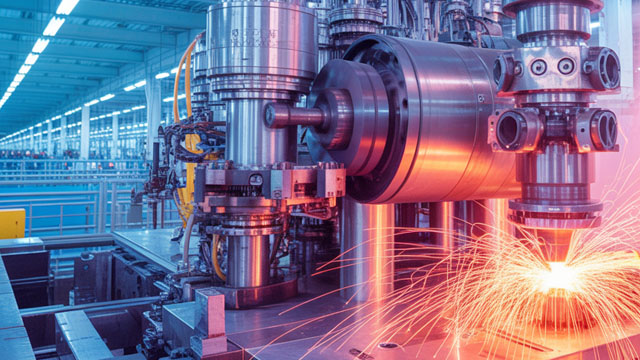
- Smaller, more complex products: electronics manufacturing, advanced packaging, and medical device production demand tighter deposition control, repeatability, and defect reduction.
- Process automation and traceable quality: customers move from manual or semi-automated workflows toward equipment that improves consistency, monitoring, and throughput.
- Higher-value material usage: adhesives, coatings, encapsulants, and specialty fluids require controlled application to protect performance and reduce waste.
- Lifecycle spend: an installed base generates follow-on demand for parts, service, and upgrades, supporting durability versus pure “new build” equipment models.
Collectively, these trends support a TAM expansion in applications requiring controlled fluid deposition and ongoing reliability, while reinforcing Nordson’s advantage through installed-base conversion and service attachment.
⚠ Risk Factors to Monitor
- End-market cyclicality: electronics production cycles and industrial capex cycles can pressure system orders even if service remains supportive.
- Technology and application substitution: shifts in manufacturing approaches (attachment methods, dispense architectures, or material systems) can change equipment requirements and lengthen evaluation cycles.
- Customer qualification risk: qualification timelines and cost/defect tolerance vary by customer and product; project delays can impact conversion timing.
- Execution and supply chain: precision manufacturing depends on stable sourcing and quality controls for key components; disruptions can raise costs or reduce deliveries.
- Regulatory and environmental constraints: coating and dispensing-related compliance requirements can increase customer and manufacturer costs (process changes, material restrictions, and emissions standards).
📊 Valuation & Market View
The market typically values Nordson-like industrial technology companies using EV/EBITDA and P/S, with emphasis on earnings quality and the sustainability of margins. Valuation sensitivity often increases when investors perceive:
- Aftermarket/service mix strength (greater earnings stability)
- Evidence of durable installed-base demand (service/parts growth)
- Margin resilience through pricing discipline, product mix, and service attach
- Reliable end-market exposure and manageable cyclicality
Because Nordson’s moat is rooted in process qualification and installed systems, investors generally reward consistent service attachment and reduced volatility in demand for parts and support.
🔍 Investment Takeaway
Nordson is best viewed as an installed-base and application-engineering platform in precision dispensing and related industrial application systems. Its durable advantage stems from high switching costs driven by customer process qualification and the technical integration required to achieve yield and performance targets. Over time, structural demand for automated, higher-precision manufacturing and the shift toward lifecycle support can sustain a resilient earnings profile—making Nordson suitable for investors seeking quality within industrial automation and precision application equipment.
⚠ AI-generated — informational only. Validate using filings before investing.







 Growth Catalysts