PaySign, Inc.

PaySign, Inc. (PAYS) Market Cap

PaySign, Inc. has a market capitalization of $379.6M.

Price: $6.79

-0.18 (-2.58%)

Market Cap: 379.60M

NASDAQ · time unavailable

CEO: Mark R. Newcomer

Sector: Technology

Industry: Software - Infrastructure

IPO Date: 2007-10-10

Website: https://www.paysign.com

PaySign, Inc. (PAYS) - Company Information

Market Cap: 379.60M|Sector: Technology

Company Profile

PaySign, Inc. provides prepaid card products and processing services under the PaySign brand for corporate, consumer, and government applications. It offers various services, such as transaction processing, cardholder enrollment, value loading, cardholder account management, reporting, and customer service through PaySign, a proprietary card-processing platform. The company also develops prepaid card programs for corporate incentive and rewards, including consumer rebates, donor compensation, clinical trials, healthcare reimbursement payments, and pharmaceutical payment assistance; and payroll or general purpose reloadable cards, as well as gift or incentive cards. In addition, it offers and Per Diem/Corporate Expense Payments that allows businesses, and non–profits and government agencies the ability to control employee spending while reducing administration costs by eliminating the need for traditional expense reports. Further, the company provides payment claims processing and other administrative services; pharmacy-based voucher and copay, and medical claims and debit-based affordability programs; PaySign Premier, a demand deposit account debit card; and payment solution for source plasma collection centers, as well as customer service center and PaySign Communications Suite services. Its principal target markets for processing services comprise prepaid card issuers, retail and private-label issuers, small third-party processors, and small and mid-size financial institutions in the United States and Mexico. The company was formerly known as 3PEA International, Inc. and changed its name to PaySign, Inc. in April 2019. PaySign, Inc. was incorporated in 1995 and is based in Henderson, Nevada.

Analyst Sentiment

92%
Strong Buy

From 5 Active Polls

1Y Forecast: $9.00

▲ +32.5% Potential Upside

Consensus Target Metrics

Low Bound

$9

Median

$9

High Bound

$9

Average

$9

Price & Moving Averages

Loading chart...

🎯 Wall Street Analyst Intelligence Report

1-Year structural target targets, chart projections, and sentiment maps.

Average 1Y Target
$9.00
▲ +32.55% Upside
Low Target
$9.00
33% Risk
Median Target
$9.00
33% Mid
High Target
$9.00
33% Max
Consensus
Buy
5 / 8 Buys

Consensus Trend Projection

Trailing closures vs. 12-month metrics map.

Analyst Vote Distribution

Aggregate institutional coverage sentiment weights.

📊 Historical Valuation Multiples

Real-time Trailing Twelve Month (TTM) momentum side-by-side with discrete quarterly metrics.

Fiscal QuarterTTMQ1 2026Q4 2025Q3 2025Q2 2025Q1 2025Q4 2024Q3 2024Q2 2024
Period EndingTrailing 12MMar 31, 2026Dec 31, 2025Sep 30, 2025Jun 30, 2025Mar 31, 2025Dec 31, 2024Sep 30, 2024Jun 30, 2024
Market Cap ($M)380325284345390114161196209
Enterprise Value ($M)365311277343381110153189181
Price to Earnings Ratio (P/E)36.0014.9652.0538.9070.3410.9829.2634.1375.09
Price/Earnings-to-Growth Ratio (PEG)0.649.702.9527.240.5712.755.298.68
Price to Sales Ratio (P/S)4.1511.6112.4715.9620.476.1110.3012.8614.61
Price to Book Ratio (P/B)6.815.925.857.539.252.895.286.887.80
Price to Free Cash Flow Ratio (P/FCF)5.4319.026.1175.43213.21-13.4013.49-8.6811.51
Enterprise Value to Sales (EV/Sales)11.0912.1615.8919.995.899.7912.3812.64
Enterprise Value to EBITDA (EV/EBITDA)17.1433.4168.1178.62107.2125.5470.5183.75115.77
Debt to Equity Ratio-0.690.110.290.130.060.070.100.110.12
⚠️

Valuation Model Suspended

API Payload Error: Inverted or negative baseline Free Cash Flow margin detected (-3.1%).

Troubleshooting Notice: The upstream financial data supplier has uploaded corrupted or inverted baseline metrics for PAYS. The server sandbox cannot calculate an intrinsic value path from negative cash generation baselines.

📘 Full Research Report

ℹ️

AI-Generated Research: This report is for informational purposes only.

📘 PAYSIGN INC (PAYS) — Investment Overview

🧩 Business Model Overview

PAYSIGN is a B2B2C payments provider centered on prepaid and related card-based payment programs. The operating model typically follows a platform-and-partners structure: PAYSIGN enables issuance and processing of prepaid products (cards and digital variants), supports KYC/AML program operations, manages transaction processing and settlement workflows, and earns consideration through transaction-linked economics and program/processing services.

Customer “stickiness” comes from the integration layer (corporate or institutional program onboarding, compliance tooling, payout/disbursement workflows) and the ongoing operational workflow (reloads, card lifecycle management, dispute/chargeback handling, and reconciliation).

💰 Revenue Streams & Monetisation Model

  • Transaction-linked income: fees and consideration tied to card usage (processing, interchange-like economics depending on arrangement, and other transaction fees).
  • FX/foreign spend economics: where cross-border or multi-currency prepaid products exist, profitability is driven by spreads and operational FX management (net of hedging/settlement frictions).
  • Program and service fees: B2B revenue from managing prepaid programs for corporates/partners (often more recurring than pure transaction volume).
  • Ancillary card economics: potential income from activation, replacement, and other card lifecycle events (materiality varies by program mix and geography).

Margin drivers are primarily (1) the take rate on transactions (fees net of partner costs), (2) FX spread durability where applicable, and (3) operating leverage as transaction volumes scale against fixed compliance and technology costs.

🧠 Competitive Advantages & Market Positioning

PAYSIGN’s moat is best described as switching costs plus regulatory/compliance embeddedness rather than classic consumer network effects.

  • Switching costs (program integration & operational lock-in): corporate/partner onboarding for prepaid programs involves KYC/KYB workflows, settlement and reconciliation processes, card lifecycle operations, and dispute management. Replacement vendors typically require re-integration and re-certification of operational processes.
  • Regulatory and compliance track record: prepaid issuance and related processing require robust AML/KYC controls and monitoring. This raises the bar for new entrants and increases the compliance cost of switching.
  • Economies of processing scale: as volumes increase, unit processing costs and risk/compliance overhead can decline, supporting better contribution margins.

Competitive benchmarking (focus and differentiation):

  • Euronet Worldwide: broad payments platform footprint (including card processing and other payment services). PAYSIGN’s emphasis is more concentrated on prepaid and partner-enabled program models rather than a more diversified processing-led mix.
  • Nium (formerly InstaReM/linked remittance offerings): stronger focus on cross-border payments and money transfer rails. PAYSIGN’s positioning centers on card-based prepaid mechanisms and program-based distribution.
  • Cashfree / Razorpay (India payments ecosystem peers): oriented toward merchant acquiring and platform-enabled payment acceptance. PAYSIGN is less centered on merchant acquiring and more on prepaid program issuance and transaction processing through partner channels.

In short, while competitors may compete across payment categories, PAYSIGN’s defensibility is strongest where prepaid program integration, compliance operations, and ongoing partner management are central.

🚀 Multi-Year Growth Drivers

  • Shift toward cashless and card-based payment instruments: prepaid products provide a pragmatic route for underbanked/limited-bankability user segments and controlled-spend use cases.
  • Corporate payouts and employee benefit disbursements: prepaid rails can support structured spending programs, reimbursements, and controlled budgets—creating repeatable B2B demand.
  • Cross-border commerce and travel spend: growth in international e-commerce and travel sustains demand for multi-currency prepaid solutions and partner distribution.
  • Partner channel expansion: PAYSIGN can scale through additional issuance/processing relationships with banks, fintech partners, and distribution networks without proportionate fixed-cost increases.
  • Digital product migration: transition from physical to digital card experiences and embedded prepaid/virtual card use can enhance transaction frequency and engagement.

⚠ Risk Factors to Monitor

  • Regulatory risk: prepaid card frameworks, KYC/AML expectations, and operational requirements can change across jurisdictions, affecting product economics and compliance costs.
  • Partner/bank concentration risk: reliance on issuing/settlement partners can shift economics if partner terms or routing controls change.
  • Competitive pricing pressure: payments platforms can face take-rate compression as competitors scale and bid for partner programs.
  • Fraud, chargebacks, and risk management: prepaid programs can face elevated fraud attempts relative to some payment types; loss rates directly impact profitability.
  • FX and settlement volatility: where multi-currency products are material, FX spreads, hedging effectiveness, and settlement timing can affect margins.
  • Technology and operational resilience: payments processing requires continuous uptime, strong cybersecurity controls, and disciplined reconciliation to avoid revenue leakage.

📊 Valuation & Market View

Markets typically value payments and transaction platforms using a blend of Revenue multiple (P/S) and cash flow/earnings metrics (EV/EBITDA), with higher multiples when businesses demonstrate durable unit economics and scalable infrastructure.

Key valuation drivers that influence the multiple include: (1) transaction growth with stable or expanding take rate, (2) demonstrable operating leverage, (3) controllable credit/fraud loss dynamics, and (4) evidence that regulatory capital/compliance overhead is not structurally rising faster than contribution margins.

🔍 Investment Takeaway

PAYSIGN’s long-term thesis rests on switching costs created by prepaid program integration and compliance operations, supported by processing-scale efficiencies and recurring elements of partner program management. The investment case is strongest when the company maintains competitive take rates, improves operating leverage, and sustains disciplined risk and compliance execution—while managing regulatory, partner, and pricing pressures typical to prepaid/payment ecosystems.


⚠ AI-generated — informational only. Validate using filings before investing.

📰 Market News & Coverage

15 Stories Available

Real-time institutional reporting and market updates for PAYS.

gurufocus.com2026-06-02

Paysign, Inc. to Present at the Planet MicroCap Las Vegas 2026

Paysign, Inc. (NASDAQ: [url="]PAYS[/url]), a leading provider of patient affordability programs, donor compensation solutions, engagement and management platfo

businesswire.com2026-06-02

Paysign, Inc. to Present at the Planet MicroCap Las Vegas 2026

HENDERSON, Nev.--(BUSINESS WIRE)--Paysign, Inc. to Present at the Planet MicroCap Las Vegas 2026.

gurufocus.com2026-05-27

Paysign, Inc. to Present at the Barrington Research Virtual Spring Investment Conference

Paysign, Inc. (NASDAQ: [url="]PAYS[/url]), a leading provider of patient affordability programs, donor compensation solutions, engagement and management platfo

businesswire.com2026-05-27

Paysign, Inc. to Present at the Barrington Research Virtual Spring Investment Conference

HENDERSON, Nev.--(BUSINESS WIRE)--Paysign, Inc. to Present at the Barrington Research Virtual Spring Investment Conference.

seekingalpha.com2026-05-13

Paysign, Inc. (PAYS) Q1 2026 Earnings Call Transcript

Paysign, Inc. (PAYS) Q1 2026 Earnings Call Transcript

fool.com2026-05-13

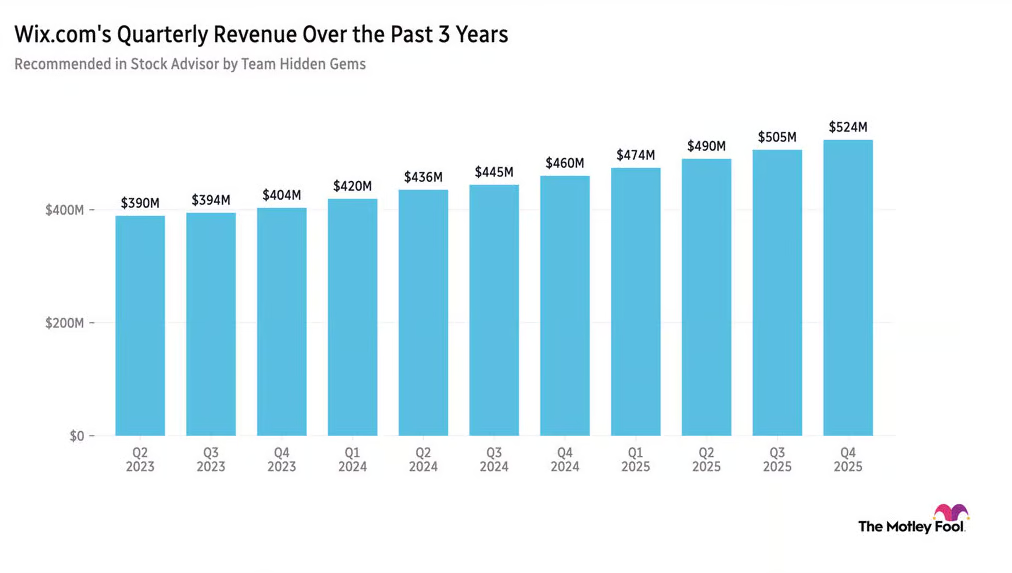
Breakfast News: Wix.com Pins Hopes on AI Tools

Wix.com revenue growth continues, PaySign beats Q1 management guidance, and more

marketbeat.com2026-05-12

Paysign Q1 Earnings Call Highlights

Paysign NASDAQ: PAYS reported what executives described as the strongest start to a year in the company's history, with first-quarter 2026 revenue rising 50.8% year over year to $28 million and profitability expanding sharply as its patient affordability business became its largest revenue contributor.

businesswire.com2026-05-12

Paysign's Patient Affordability Drives 51% Revenue Growth and Significant Margin Expansion for First Quarter 2026

HENDERSON, Nev.--(BUSINESS WIRE)--Paysign's Patient Affordability Drives 51% Revenue Growth and Significant Margin Expansion for First Quarter 2026.

businesswire.com2026-04-15

Paysign to Host First Quarter 2026 Earnings Call

HENDERSON, Nev.--(BUSINESS WIRE)--Paysign to Host First Quarter 2026 Earnings Call.

seekingalpha.com2026-04-09

Paysign: The Market Is Finally Repricing A Pharma Margin Story

Paysign is evolving beyond a niche prepaid card processor, with patient affordability now driving higher-margin growth. 2025 results highlight a 40.5% revenue increase to $82M, with pharma revenue surging to $33.9M and gross margin expanding to 59.4%. PAYS trades above peer sales multiples, reflecting its shift to a high-value workflow business, while price-to-cash flow remains attractive if cash conversion holds.

seekingalpha.com2026-03-31

Paysign Is On A Roll

Paysign remains a buy, supported by strong performance in both Plasma Centers and hypergrowth in Patient Affordability. PAYS's Plasma Center segment holds a 50% market share, adding 115 new centers in FY25, despite revenue per center declining due to plasma surplus. That surplus can disappear, and the Plasma segment can benefit from the BECS, generating high-margin SaaS subscription revenue.

defenseworld.net2026-03-26

Paysign Q4 Earnings Call Highlights

Paysign (NASDAQ: PAYS) reported fourth-quarter and full-year 2025 results that management said showed "continued strength and exceptional growth" across key metrics, driven primarily by rapid expansion in its patient affordability platform and improving operating leverage. Full-year 2025 results and margin improvement For full-year 2025, the company said revenue increased 40.5% to $82.0 million. Net income rose

fool.com2026-03-25

Why Paysign Stock Is Skyrocketing Today

Paysign posted Q4 earnings that were in line with Wall Street's target and sales that beat expectations. The company's forward guidance is spurring huge gains for the stock.

seekingalpha.com2026-03-25

Paysign, Inc. (PAYS) Q4 2025 Earnings Call Transcript

Paysign, Inc. (PAYS) Q4 2025 Earnings Call Transcript

businesswire.com2026-03-24

Paysign, Inc. Reports Fourth Quarter and Full-Year 2025 Financial Results; Patient Affordability Drives 40% Revenue Growth and Significant Margin Expansion

HENDERSON, Nev.--(BUSINESS WIRE)--Paysign, Inc. Reports Fourth Quarter and Full-Year 2025 Financial Results.

📊 AI Financial Analysis

Powered by StockMarketInfo
Earnings Data: Q Ending 2026-03-31

"Q1’26 Revenue was $28.0M and Net Income was $5.4M (EPS: $0.09 diluted). YoY, Revenue rose +50.6% (from $18.6M in Q1’25) and Net Income rose +110.2% (from $2.6M). QoQ, Revenue increased +23.1% (from $22.8M in Q4’25) while Net Income jumped +299.6% (from $1.4M). Profitability improved versus both recent quarters, with gross margin expanding from 47.9% (Q4’25) to 64.98% (Q1’26) and net margin expanding to 19.40% (up from 5.99% in Q4’25 and above Q1’25’s 13.91%). Cash flow data appear inconsistent across quarters (e.g., operating cash flow is shown as 0 in Q1’26, and balance-sheet cash jumps due to FX effects), so operating cash flow quality for the quarter is hard to validate from the provided fields. Balance sheet resilience looks strong: total assets grew to $312.7M from $276.3M in Q4’25, while equity increased to $55.0M from $48.5M, with net debt remaining negative (net cash position). There were no dividends, and no buybacks are shown; shareholder returns therefore likely rely on price momentum. PAYS is up +200.96% over 1 year, which should materially support total shareholder returns. Analyst sentiment/valuation: consensus price target is $9 versus the latest price of $6.29 (upside implied ~43%)."

Revenue Growth

Strong

Q1’26 Revenue of $28.0M grew +50.6% YoY (vs $18.6M in Q1’25) and +23.1% QoQ (vs $22.8M in Q4’25), with a clear accelerating run-rate across the last four quarters.

Profitability

Good

Margins expanded meaningfully: gross margin rose to 64.98% in Q1’26 from 47.96% (Q4’25) and net margin to 19.40% from 5.99% (Q4’25). Operating income margin improved to 23.78%.

Cash Flow Quality

Fair

Net Income increased sharply, but operating cash flow is reported as 0 in Q1’26 and free cash flow is 0, while cash changes show large FX effects. Based on provided fields, cash conversion for the quarter is uncertain.

Leverage & Balance Sheet

Good

Strong balance sheet: equity increased to $55.0M (from $48.5M in Q4’25) and net debt remains negative (net cash position). Total assets grew to $312.7M.

Shareholder Returns

Strong

Price momentum is very strong: +200.96% 1Y. No dividends or buybacks are shown in the cash flow, so total return is likely driven primarily by capital appreciation.

Analyst Sentiment & Valuation

Positive

Consensus price target is $9 vs $6.29 last price, implying ~43% upside. Valuation multiples appear elevated, but the recent earnings/margin acceleration provides some support.

Disclaimer:This analysis is AI-generated for informational purposes only. Accuracy is not guaranteed and this does not constitute financial advice.

Fundamentals Overview

Loading fundamentals overview...

PAYS delivered a strong Q1 2026 performance with operating leverage driving a step-change in profitability. Revenue rose 50.8% YoY to $28.0M, while operating margin expanded to 23.8% from 13.4%, an increase of ~1,040 bps, reflecting faster profit growth than revenue growth. Pharma scaled materially: patient affordability revenue grew 82% YoY to $15.7M and claim volume was ~49% higher, supported by dynamic business rules value delivery, $540M+ in patient assistance, and 4 new programs to 135 active. Plasma contributed $11.7M (+25%), with improving per-center economics, though center count was impacted by churn and consolidation (573 centers; expecting 555–560 by Q2 after 19 closures). Guidance exceeded Q1 targets and management maintained 2026 ranges, emphasizing continued mix-driven margin dynamics. Key watch items are FDA approval timing for the SaaS/app, ongoing customer center volatility, and Q1’s higher effective tax rate driven by discrete items.

AI IconGrowth Catalysts

  • Patient affordability: +82% YoY revenue to $15.7M, nearly as much revenue as H1 2025 in the quarter
  • More benefit deployment: $540M+ patient financial assistance in Q1 2026 vs ~$320M in Q1 2025
  • New pharma program launches: 4 new programs in Q1 bringing total active programs to 135; continued pipeline to exceed 55 net program additions
  • Claim/usage growth: claim volume ~49% higher than Q1 2025 driven by new programs, organic growth, and ramp of largest pharmaceutical clients
  • Dynamic business rules technology economic value for co-pay maximizer/accumulator navigation
  • Plasma: +25% YoY revenue to $11.7M and improving per-center economics (avg monthly revenue per center $6,671 vs $6,517)
  • Plasma SaaS expansion progress, including discussions for direct integration with plasmapheresis device manufacturers to reduce manual steps/errors

Business Development

  • Attended ASX 26 (Assembia Specialty Pharmacy Summit, Las Vegas): 50+ meetings over 3 days and closed new business onsite
  • Plasma operations: customer closed 19 underperforming plasma centers in early May; related impacts expected to be neutral as cardholders transition nearby
  • Plasma center loss: exited quarter with 573 centers (below guidance 589) due to one customer selling all centers to a competing provider
  • International Plasma Protein Congress sponsorship (late April, Milan): discussions with plasma collection companies across US/Europe/Asia and with plasmapheresis device manufacturers on direct software integration
  • FDA discussions underway regarding SaaS/app (no monetization yet)

AI IconFinancial Highlights

  • Revenue: $28.0M, +50.8% YoY; exceeded high end of March guidance ($27.0M–$27.5M)
  • Operating margin: 23.8% vs 13.4% prior-year; expanded by ~1,040 basis points (10.4% YoY operating leverage)
  • Gross profit margin: 65.0% vs 62.9% Q1 2025, reflecting higher Pharma mix vs plasma
  • Net income: $5.4M, +110% YoY; $0.09 per diluted share vs $0.05 prior-year period
  • Adjusted EBITDA: $10.6M, +113.4% YoY; adjusted EBITDA margin 37.8% vs 26.7% prior-year
  • Tax: effective tax rate 27.2% vs 20.5%, driven by discrete items including stock-price-related benefit compression for stock-based compensation
  • Q1 operating conversion: converted ~$9.4M incremental revenue into ~$4.2M operating income (as stated by management)

AI IconCapital Funding

  • Unrestricted cash: $20.5M at quarter end; restricted cash +$15M to $159M (customer program deposits for Plasma and Pharma customers; funds on card)
  • Bank debt: 0
  • Share repurchases: none in the quarter
  • Gamma-related obligations: ~$6M remaining to founders, paid annually on next 3 anniversary dates in March

AI IconStrategy & Ops

  • Patient affordability platform scaling: exited quarter with 135 active programs; guidance to 147–150 active programs by end of Q2
  • Operational constraint acknowledgment: Q1 most operationally constrained due to plan year transitions, formulary changes, deductible resets
  • Plasma center optimization: continued consolidation due to capacity gains from plasmapheresis hardware advancements; closed/sold lower-performing centers with expected minimal financial impact
  • Plasma network: exited quarter with 573 centers; management expects 555–560 centers after May 19-center closure, offset by some new center openings
  • SaaS/app integration direction: pursuing reduced-friction workflows via direct integration between software and plasmapheresis devices; reduces manual steps and human error

AI IconMarket Outlook

  • 2026 full-year revenue guidance maintained: $106.5M to $110.5M (30%–35% YoY); gross profit margin 60%–62%
  • 2026 net income guidance: $13M to $16M ($0.21–$0.26 diluted EPS)
  • 2026 adjusted EBITDA guidance: $30M to $33M ($0.49–$0.53 per diluted share)
  • Active patient affordability programs: as of today 141 active; exit Q1 with 135; expect exit Q2 with 147–150 active programs
  • Plasma center count: guidance decline to 555–560 centers by end of Q2 after 19 underperforming center closures in May
  • Management confidence: increasingly confident to achieve upper end of 2026 guidance ranges

AI IconRisks & Headwinds

  • Tax rate elevated in Q1: 27.2% effective tax rate vs 20.5% due to discrete items related to stock price and stock-based compensation benefit
  • Plasma center churn risk: exit center count below guidance (573 vs 589) due to a customer selling centers to a competing provider; potential volatility in center counts
  • FDA/approval execution risk: SaaS/app currently not generating revenues; discussions continue and FDA status may delay monetization
  • Margin trajectory sensitivity: guidance implies adjusted EBITDA margin conversion shifts over the year due to mix (patient affordability moderating while plasma grows)

Q&A: Analyst Interest

  • Pipeline confidence drivers: Management explained that net program additions beyond 55 are supported by a 50-50 mix of entirely new clients and growth within existing clients. They said there is no single inflection event, emphasizing the larger client base plus continuous selling and hiring for account support.
  • Plasma revenue outlook with center declines: Analysts questioned whether expected plasma center declines imply a back-half ramp. Management responded that plasma revenue should increase sequentially through the rest of the year, attributing the center declines to underperforming “garbage centers” and nearby consolidation that shifts cardholders without materially hurting revenue.
  • SaaS/app monetization and FDA status: Management clarified the plasma SaaS/app is not yet generating revenues and is still in discussion with the FDA. They said additional non-pharmaceutical payment initiatives have targets but are “premature” to quantify, indicating timing uncertainty for future monetization expansion.

Sentiment: MIXED

Note: This summary was synthesized by AI from the PAYS Q1 2026 earnings transcript. Financial data is complex; please verify all metrics against official SEC filings before making investment decisions.

📋 Official Regulatory 10-K / 10-Q SEC Filings

Direct authenticated documentation links to audited SEC database reports for PAYS.

SEC EDGAR Live Feed
Loading financial data and tables...
📁

SEC Filings (PAYS)

© 2026 Stock Market Info — PaySign, Inc. (PAYS) Financial Profile