
📘 SERVE ROBOTICS INC (SERV) — Investment Overview
🧩 Business Model Overview
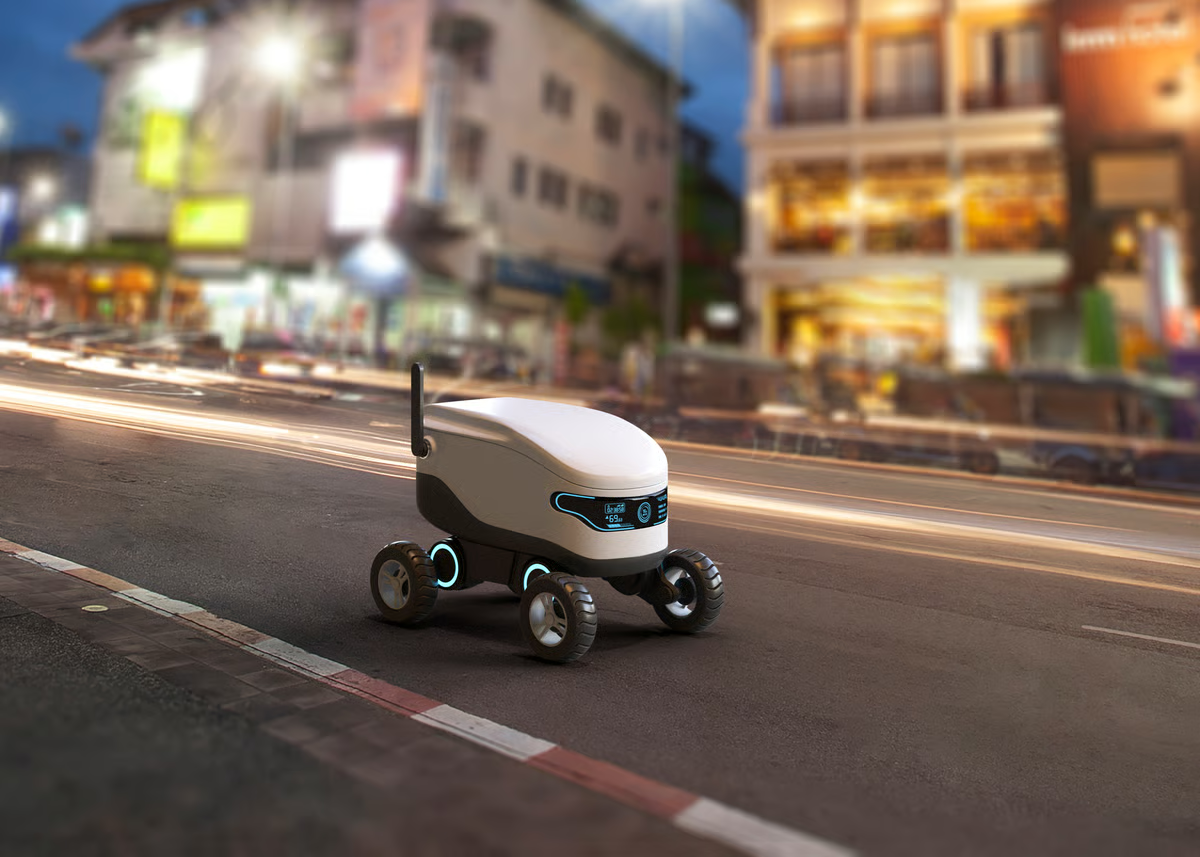
SERVE ROBOTICS develops and operates autonomous delivery robots used for last-mile logistics in urban and campus settings. The value chain is centered on (1) autonomous navigation and delivery execution software, (2) deployed robot fleet hardware, and (3) operational integration with partners that place orders and manage fulfillment workflows. In practice, Serve’s offering is used to move goods from a designated pick-up point to a delivery destination with minimal human intervention, supported by remote monitoring and fleet operations.
Customer stickiness tends to increase as operations mature: delivery partners must integrate routing, geofencing/service areas, pickup workflows, and customer access/receiving procedures with Serve’s system. That operational embedding makes renewals and expansions more likely than one-off pilots.
💰 Revenue Streams & Monetisation Model
SERV typically monetizes through a mix of usage-based delivery activity and service/operations arrangements with partners (e.g., fulfillment operators, food delivery networks, and enterprise sites). Monetisation is usually structured to tie revenue to active deployments and service levels rather than purely one-time robot sales.
- Transactional/usage component: revenue linked to deliveries performed and/or active robot utilization.
- Operational & software-service component: ongoing support, remote monitoring, maintenance coordination, and software enablement that supports continuity and safety requirements.
- Potential enterprise expansion component: scaling within a site/campus or expanding coverage zones after performance targets are met.
Key margin drivers are fleet utilization, delivery success rate (directly tied to autonomy performance), and total cost per delivery (robot depreciation, charging/battery logistics, field servicing, and support). Sustained improvements in autonomy efficiency and maintenance effectiveness typically improve gross margin potential as volume scales.
🧠 Competitive Advantages & Market Positioning
The competitive landscape for sidewalk delivery robots is crowded, but structural advantages can emerge when autonomy performance, deployment density, and operational integration reinforce one another.
Primary moat: Switching costs via operational integration + data gravity
- Operational switching costs: partners embed with Serve’s routing/service-area configuration, pickup/delivery workflows, receiving procedures, and operational escalation processes. Changing vendors requires re-integration and re-validation of safety and service-level performance.
- Data gravity for autonomy: repeated deployments generate operational data (routes attempted, failure modes, obstacle handling, geofencing edge cases). Over time, improved models can reduce delivery failures and improve unit economics, raising the cost of switching for customers that already optimized operations on Serve’s stack.
Competitive benchmarking (industry peers)
- Starship Technologies: similar end-market (autonomous sidewalk delivery) with a focus on fleet deployments and partner integrations. Serve’s differentiation tends to come from specific partnership execution and deployment workflow fit rather than a fundamentally different business model.
- Marble (Marble Technologies): also targets autonomous ground delivery with a fleet-oriented approach. Marble competes for “time-to-scale” and partnerships in dense last-mile environments, pressuring pricing and deployment economics.
- Nuro: autonomous delivery with a different platform emphasis (vehicle-based deliveries) and different regulatory/safety footprint implications. While not a direct apples-to-apples competitor for sidewalk robots, Nuro competes for investor and partner attention in autonomy-enabled logistics.
Across these peers, the competitive battleground is commercialization velocity and unit economics—how quickly deployments translate into repeatable, low-cost delivery operations. Serve’s industry focus is on operating autonomous robots within partner ecosystems where integration and utilization drive value, rather than selling standalone robot units without a service footprint.
🚀 Multi-Year Growth Drivers
- Labor cost pressure & reliability requirements: expanding utilization of automation to reduce labor dependency and improve delivery consistency.
- Urban density and constrained logistics capacity: in dense areas, point-to-point delivery can be inefficient for human-driven models, increasing the appeal of autonomous “last-mile legs.”
- Operational learning loops: iterative improvements to autonomy and remote operations can compound as deployments scale, supporting better success rates and lower cost per delivery.
- Expansion from pilots to rollouts: once safety, service-level, and workflow integration pass thresholds, sites/cities can add coverage zones and additional robots.
- TAM expansion through adjacent use cases: beyond food delivery, robots can support broader enterprise and campus delivery needs (packets, small parcels, replenishment), broadening addressable routes and partner categories.
Over a 5–10 year horizon, value creation likely depends on translating early deployments into scalable economics: higher delivery density per geographic footprint, improved autonomy success, and repeatable partner onboarding.
⚠ Risk Factors to Monitor
- Regulatory and permitting risk: autonomous delivery operations require municipal permissions, safety frameworks, and local compliance. Restrictions can limit where robots can operate or increase operating constraints.
- Safety, incident, and liability risk: collision events or navigation failures can lead to operational suspensions, partner churn, or increased insurance/compliance costs.
- Technology performance risk: autonomy robustness in edge cases (weather, construction, dense pedestrian traffic, complex curb/obstacle environments) determines delivery success and unit economics.
- Capital intensity and cash burn: maintaining and scaling a robot fleet, spares, servicing, and charging logistics can be cash intensive before unit economics fully stabilize.
- Partner concentration risk: reliance on a limited number of delivery or enterprise partners can increase revenue volatility if contracts are paused or reprioritized.
- Competitive pressure on pricing and deployment terms: peers can bid aggressively for pilots or scale partnerships, compressing near-term margins.
📊 Valuation & Market View
Robotics and autonomy companies are typically valued through a blend of growth expectations and margin trajectory rather than mature earnings power. In this sector, valuation frameworks often emphasize:
- Revenue scale vs. cost-to-serve: progression toward favorable gross margin as delivery success rates rise and maintenance/servicing costs stabilize.
- Utilization and retention: higher deployments per geographic footprint and partner renewals signal operating leverage.
- Capital efficiency: how quickly incremental deployments generate cash flow or reduce incremental cost per delivery.
- Optionality: market assesses whether autonomy capabilities can expand across use cases and geographies.
Given the hardware-and-software hybrid nature of autonomy delivery, investors often look for a path from pilot revenue to repeatable deployments, and from experimental economics to sustainable unit economics. Metrics that move the needle tend to include delivery success rates, coverage expansion, service-level performance, and trends in cost per delivery rather than accounting profits alone.
🔍 Investment Takeaway
SERVE ROBOTICS offers exposure to autonomous last-mile logistics where long-term value hinges on operational integration and autonomy-driven cost reductions. The core investment thesis rests on the emergence of switching costs through partner workflow embedding and the compounding effect of fleet data on autonomy performance. Upside depends on scaling deployments into repeatable, capital-efficient delivery operations, while key downside risks center on regulatory constraints, safety outcomes, and the time required to achieve sustainable unit economics in a competitive robotics field.
⚠ AI-generated — informational only. Validate using filings before investing.

















 Growth Catalysts