Talen Energy Corporation

Talen Energy Corporation (TLN) Market Cap

Talen Energy Corporation has a market capitalization of $15.17B.

Price: $334.10

1.56 (0.47%)

Market Cap: 15.17B

NASDAQ · time unavailable

CEO: Mark Allen McFarland

Sector: Utilities

Industry: Independent Power Producers

IPO Date: 2023-06-02

Website: https://www.talenenergy.com

Talen Energy Corporation (TLN) - Company Information

Market Cap: 15.17B|Sector: Utilities

Company Profile

Talen Energy Corporation functions as an independent power producer and infrastructure enterprise, providing electricity, capacity, and essential ancillary services to wholesale energy markets across the United States. The company's diverse generation assets include nuclear, fossil fuel, solar, and coal-powered facilities. Additionally, it is currently engaged in the development of battery energy storage projects. Overall, Talen Energy owns and manages an extensive portfolio of power infrastructure, amounting to approximately 10.7 gigawatts. The firm's headquarters are situated in Houston, Texas.

Analyst Sentiment

92%
Strong Buy

From 17 Active Polls

1Y Forecast: $464.14

▲ +38.9% Potential Upside

Consensus Target Metrics

Low Bound

$411

Median

$470

High Bound

$508

Average

$464

Price & Moving Averages

Loading chart...

🎯 Wall Street Analyst Intelligence Report

1-Year structural target targets, chart projections, and sentiment maps.

Average 1Y Target
$464.14
▲ +38.92% Upside
Low Target
$411.00
23% Risk
Median Target
$470.00
41% Mid
High Target
$508.00
52% Max
Consensus
Buy
11 / 13 Buys

Consensus Trend Projection

Trailing closures vs. 12-month metrics map.

Analyst Vote Distribution

Aggregate institutional coverage sentiment weights.

📊 Historical Valuation Multiples

Real-time Trailing Twelve Month (TTM) momentum side-by-side with discrete quarterly metrics.

Fiscal QuarterTTMQ1 2026Q4 2025Q3 2025Q2 2025Q1 2025Q4 2024Q3 2024Q2 2024
Period EndingTrailing 12MMar 31, 2026Dec 31, 2025Sep 30, 2025Jun 30, 2025Mar 31, 2025Dec 31, 2024Sep 30, 2024Jun 30, 2024
Market Cap ($M)15,16614,56117,12619,43313,2469,1559,2609,0776,662
Enterprise Value ($M)20,94620,34123,19521,92216,18311,85211,93611,0548,656
Price to Earnings Ratio (P/E)-726.3057.83-11.7923.4846.01-16.9828.3013.503.67
Price/Earnings-to-Growth Ratio (PEG)0.95-90.760.34-0.580.39
Price to Sales Ratio (P/S)4.6911.7322.2125.2429.1814.5118.9816.3516.13
Price to Book Ratio (P/B)14.2013.5715.6713.2310.637.766.683.802.65
Price to Free Cash Flow Ratio (P/FCF)18.1637.1471.3645.83-59.94166.45-289.37238.86-144.83
Enterprise Value to Sales (EV/Sales)16.3930.0828.4735.6418.7824.4619.9220.96
Enterprise Value to EBITDA (EV/EBITDA)25.6470.14-126.0647.1465.78-790.1196.2631.8611.86
Debt to Equity Ratio7.076.346.242.032.462.542.171.101.05

📘 Full Research Report

ℹ️

AI-Generated Research: This report is for informational purposes only.

📘 TALEN ENERGY CORP (TLN) — Investment Overview

🧩 Business Model Overview

TALEN Energy Corp is a U.S. power generator whose value is created by operating dispatchable generation assets and selling electricity and related services into regional electricity markets. The operating footprint concentrates on high-demand grid regions where capacity and reliability are remunerated through market mechanisms.

In practice, TALEN monetizes electricity through (1) energy sales when plants run and (2) market-based reliability revenues that compensate generators for being available during peak demand or system constraints. Nuclear and gas assets are central to this model: nuclear provides steady, low-carbon baseload output, while gas-fired generation helps address operating flexibility needs.

💰 Revenue Streams & Monetisation Model

Revenue is primarily driven by three complementary components:

  • Energy-market sales (MWh): Spot and contract-linked power prices determine the economics of generation when plants dispatch.
  • Capacity-market compensation: Availability payments reward credible capacity commitments, reducing revenue volatility versus a pure merchant model.
  • Ancillary and related services: Generators earn for supporting grid reliability (e.g., reserves), where market rules define eligibility and performance.

Margin drivers flow from (a) plant availability and operational performance, (b) the relative cost of production (fuel and variable O&M for gas; maintenance and compliance costs for nuclear), and (c) the structure of regional market pricing, especially capacity and scarcity components. The business generally benefits when generation adequacy tightens and when rules favor reliable, low-carbon resources.

🧠 Competitive Advantages & Market Positioning

TALEN’s core moat is not “brand” or proprietary technology; it is rooted in asset location and credibility of supply in constrained power markets, supported by low-cost feedstock access and long-lived generation infrastructure.

Key structural advantages:

  • Geographic cost advantage via fuel and grid access: In U.S. electricity markets, natural gas economics are a major determinant of marginal generation cost. TALEN’s gas exposure benefits from proximity to the natural gas supply chain and its ability to procure fuel efficiently relative to less advantaged generators.
  • Logistical infrastructure / constrained-region positioning: Power plants located in reliability-critical load pockets can command stronger pricing through capacity and scarcity dynamics. Physical transmission constraints and permitting constraints limit how quickly competitors can add dispatchable capacity where it is most valuable.
  • Regulatory and market-rule moat (capacity/ancillary frameworks): U.S. regional market mechanisms reward availability and performance through capacity and reliability products. These frameworks are difficult for new entrants to replicate without existing assets, interconnection rights, and a demonstrated operating record.

Competitive benchmarking:

  • Exelon (nuclear-focused): Exelon competes directly in nuclear baseload and reliability revenue streams. Compared with Exelon’s broader portfolio and regulated-utility exposure, TALEN’s positioning emphasizes asset concentration in markets where reliability products materially influence earnings.
  • Constellation Energy (nuclear-focused): Constellation’s scale and nuclear operating base create similar competitive pressures. TALEN differentiates through its specific regional asset footprint and the mix of nuclear plus dispatchable gas to balance production and merchant/capacity economics.
  • Vistra (merchant power + flexible generation): Vistra’s larger merchant footprint relies heavily on short-cycle optimization and fuel/dispatch flexibility. TALEN’s model is more anchored to reliability-based compensation that can dampen pure energy-price exposure.

🚀 Multi-Year Growth Drivers

  • Generation adequacy and capacity market support: Aging thermal fleets, retirement timelines, and long lead times to develop new dispatchable capacity tend to increase the value of existing, qualified generators.
  • Power demand growth from electrification: Data centers, industrial electrification, and broader electrification increase peak demand needs, tightening supply-demand balance in constrained regions.
  • Nuclear and long-duration reliability value: Nuclear plants provide dependable output during periods when variable resources may not fully cover system needs. Long-term operating certainty and performance translate into durable revenue potential.
  • Operational performance and availability as compounding drivers: In power generation, incremental improvements in outage duration, fuel efficiency, and maintenance execution can have outsized earnings impact because revenues are linked to availability and dispatch.
  • Market design evolution favoring reliability and low-carbon capacity: Where policy and market rules increasingly reward carbon-free and firm capacity, existing qualified generation can benefit disproportionately.

⚠ Risk Factors to Monitor

  • Power price and capacity rule volatility: Changes to regional market rules, qualification thresholds, or capacity supply-demand balance can affect pricing and revenue durability.
  • Fuel price volatility (for gas exposure): Gas-fired economics remain sensitive to natural gas price spreads and heat rates, which can pressure margins during unfavorable fuel-price environments.
  • Nuclear execution and regulatory risk: Nuclear operations face stringent compliance requirements, outage and inspection uncertainties, and potential cost overruns associated with refueling and major maintenance cycles.
  • Capital intensity and maintenance capex: Sustaining generation reliability requires continuous investment. Under-spending can increase outage risk; over-spending can reduce returns.
  • Interest rate and credit conditions: Financing costs and access to capital influence the risk-adjusted returns of maintenance and capital programs.
  • Environmental and permitting constraints: Emissions regulations, cooling water requirements, and permitting for both maintenance and potential upgrades can create cost and schedule risk.

📊 Valuation & Market View

Market valuation for dispatchable power generators typically reflects asset availability, contract/market revenue durability, and fuel-cost sensitivity rather than growth in the conventional consumer or tech sense. Common valuation frameworks include:

  • EV/EBITDA and EV/EBITDA-to-fuel-price sensitivity: EBITDA quality hinges on plant performance and the share of reliability-linked revenues.
  • Cash flow yield (FCF/Sales or FCF margin): Working capital swings, capex intensity, and maintenance schedules influence the conversion of earnings into free cash flow.
  • Scenario-based valuation: Investors often underwrite power and capacity price assumptions, outage schedules, and regulatory outcomes.

Key drivers that move valuation include scarcity pricing and capacity market outcomes, nuclear operating performance and maintenance costs, and the effective cost of gas generation versus competitors in the same regional markets.

🔍 Investment Takeaway

TALEN’s long-term investment case is built on the economic value of firm generation in constrained U.S. power markets, with a differentiated ability to monetize reliability through capacity and energy mechanisms. Its structural advantages derive from generation asset location, credibility of availability, and dispatchable cost positioning tied to natural gas, which together can support earnings resilience across market cycles—provided nuclear execution, maintenance discipline, and regional market rules remain favorable.


⚠ AI-generated — informational only. Validate using filings before investing.

📰 Market News & Coverage

15 Stories Available

Real-time institutional reporting and market updates for TLN.

zacks.com2026-07-30

All You Need to Know About Talen Energy Corporation (TLN) Rating Upgrade to Strong Buy

Talen Energy Corporation (TLN) has been upgraded to a Zacks Rank #1 (Strong Buy), reflecting growing optimism about the company's earnings prospects. This might drive the stock higher in the near term.

zacks.com2026-07-29

3 Alternative Energy Stocks Riding the Next Wave of Clean Energy Growth

BE, TLN and MNTK are well positioned to benefit from the long-term growth of renewable energy, supported by expanding wind power, rising EV adoption and improving clean energy demand.

zacks.com2026-07-27

Why Talen Energy Corporation (TLN) is Poised to Beat Earnings Estimates Again

Talen Energy Corporation (TLN) has an impressive earnings surprise history and currently possesses the right combination of the two key ingredients for a likely beat in its next quarterly report.

defenseworld.net2026-07-27

Entropy Technologies LP Purchases 1,474 Shares of Talen Energy Corporation $TLN

Entropy Technologies LP grew its holdings in Talen Energy Corporation (NASDAQ: TLN) by 20.7% during the undefined quarter, according to the company in its most recent disclosure with the SEC. The fund owned 8,591 shares of the utilities provider's stock after purchasing an additional 1,474 shares during the quarter. Entropy Technologies LP's holdings

247wallst.com2026-07-24

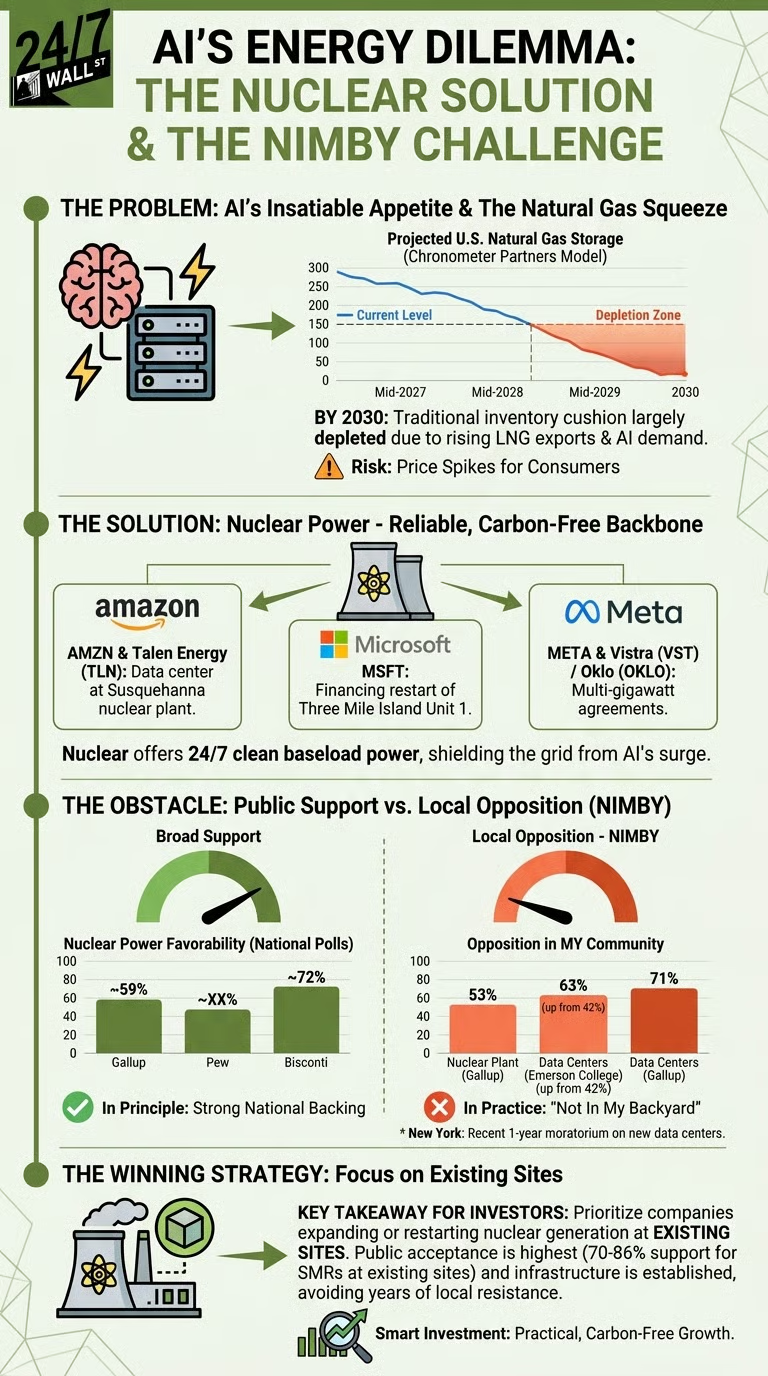
Nuclear Could Solve America’s Looming Natural Gas Crisis — Except For This 1 Thing

Artificial intelligence is creating a problem few investors were talking about just a year ago: the U.S. may not have enough reliable electricity to support the next wave of data centers without driving up energy costs for everyone else. That challenge increasingly points to one solution. Nuclear power can provide around-the-clock electricity without the carbon... Nuclear Could Solve America's Looming Natural Gas Crisis - Except For This 1 Thing

defenseworld.net2026-07-24

Atika Capital Management LLC Cuts Holdings in Talen Energy Corporation $TLN

Atika Capital Management LLC lowered its stake in shares of Talen Energy Corporation (NASDAQ: TLN) by 56.1% in the first quarter, according to the company in its most recent Form 13F filing with the Securities and Exchange Commission. The firm owned 18,490 shares of the utilities provider's stock after selling 23,610 shares during

defenseworld.net2026-07-24

Arrow Capital Management LLC Buys 4,296 Shares of Talen Energy Corporation $TLN

Arrow Capital Management LLC increased its stake in shares of Talen Energy Corporation (NASDAQ: TLN) by 15.3% in the first quarter, according to its most recent 13F filing with the SEC. The firm owned 32,340 shares of the utilities provider's stock after purchasing an additional 4,296 shares during the period. Talen Energy makes

etftrends.com2026-07-20

The Consortium Fueling the Nuclear Renaissance

The U.S. Department of Energy (DOE) published the approved voluntary agreement that formally establishes the Nuclear Fuel Cycle Consortium under the Defense Production Act (DPA). While the name centers on fuel production, the framework and its broad list of participants reach across the entire nuclear value chain.

globenewswire.com2026-07-20

Standard BioTools Announces Filing of Registration Statement in Connection with Treeline Biosciences Transaction

Highlights combined company's strong financial position with over $900 million expected at closing, Treeline's deep clinical-stage pipeline, planned 2027 data updates for TLN-121 and TLN-372, and expected new program clinical starts

defenseworld.net2026-07-18

Allspring Global Investments Holdings LLC Decreases Stock Holdings in Talen Energy Corporation $TLN

Allspring Global Investments Holdings LLC lessened its stake in Talen Energy Corporation (NASDAQ: TLN) by 9.8% in the first quarter, according to the company in its most recent 13F filing with the Securities and Exchange Commission. The firm owned 257,438 shares of the utilities provider's stock after selling 27,972 shares during the period.

globenewswire.com2026-07-15

Talen Energy to Report Second Quarter 2026 Financial Results on August 5, 2026

HOUSTON, July 15, 2026 (GLOBE NEWSWIRE) -- Talen Energy Corporation ("Talen") (NASDAQ: TLN) plans to release its second quarter 2026 financial results on Wednesday, August 5, 2026, after market close. Chief Executive Officer Mac McFarland, President Terry Nutt, and Chief Financial Officer Cole Muller will discuss the financial and operating results during an earnings call at 4:30 p.m. ET (3:30 p.m. CT) on August 5, 2026.

seekingalpha.com2026-07-10

Talen Energy: A Good Bet On Direct Data Centers Energy

Talen Energy is rated Buy, driven by transformative contracts, accretive acquisitions, and a robust free cash flow growth outlook. TLN's 17-year, $1.4B annual PPA with Amazon anchors long-term cash flows, with $8+ after-tax cash flow per share projected by 2030-2032. The recent $3.5B acquisition of gas plants expands TLN's PJM capacity to 13.1GW, is immediately accretive, and is supported by intelligent refinancing.

seekingalpha.com2026-07-07

Vistra Vs. Talen: I Prefer The Higher-Risk AI Power Trade

Talen Energy offers sharper forward growth and a more attractive valuation for aggressive investors, despite higher concentration risk versus Vistra. Vistra is larger, more diversified, and more profitable, with major catalysts from Meta, Helix, and a robust buyback program, making it the safer AI power trade. TLN's near-term catalysts include the Cornerstone acquisition, Amazon-linked demand, and significant free cash flow per share ramp through 2028.

247wallst.com2026-07-06

Record Heat Dome Drove the Grid to All-Time Peak Demand Friday: Here's 4 Stocks To Buy As Things Heat Up

A once-in-a-decade heat dome baked the eastern United States this Fourth of July weekend.

investors.com2026-06-29

Talen Energy, Stock Of The Day, Delivers For Amazon, AI Data Centers

Talen Energy has a deal to supply Amazon Web Services with nuclear-powered electricity. The Stock Of The Day is near highs and a buy point.

📊 AI Financial Analysis

Powered by StockMarketInfo
Earnings Data: Q Ending 2026-03-31

"TLN reported Q1 2026 revenue of $1.129B and net income of $63.0M, with EPS of $1.38 (diluted $1.33). Versus Q1 2025, revenue rose +79.1% YoY (from $631M) and net income swung from -$135M to +$63M (+146.7M improvement). QoQ, revenue increased +68.6% (from $670M in Q4 2025) and net income increased sharply from -$363M to +$63M. Profitability improved meaningfully. Net margin increased to 5.6% in Q1 2026 from -54.2% in Q4 2025 and -21.4% in Q1 2025, while operating income turned positive ($210M) after large losses in Q4. The company also generated strong operating cash flow of $461M and delivered positive free cash flow of $461M, though cash flow dynamics appear volatile quarter to quarter. Balance sheet resilience improved: cash and cash equivalents rose to $1.027B from $752M in Q4, while total assets were roughly flat ($10.99B vs. $10.91B). Leverage remains high with long-term debt of $6.78B and net debt of $5.78B, and equity is $1.07B. Shareholder returns appear strong given the +79.8% 1-year price change (capital appreciation only; no dividends paid and no buybacks reported in the quarter)."

Revenue Growth

Strong

Revenue accelerated to $1.129B in Q1 2026 (+79.1% YoY from $631M; +68.6% QoQ from $670M). Strong rebound from Q4.

Profitability

Good

Net income improved to +$63.0M in Q1 2026 from -$135M YoY and -$363M QoQ. Net margin improved to 5.6% from -21.4% (Q1'25) and -54.2% (Q4'25).

Cash Flow Quality

Positive

Operating cash flow was $461M and free cash flow was $461M in Q1 2026. However, prior quarters show significant volatility (e.g., OCF $220M in Q4 2025 vs. -$184M in Q2 2025). No dividends; buybacks not reported this quarter.

Leverage & Balance Sheet

Neutral

Cash increased to $1.027B and total assets were stable (~$11.0B). Nonetheless, leverage remains elevated (long-term debt $6.78B; net debt $5.78B; debt-to-equity ~6.34).

Shareholder Returns

Strong

Total shareholder return proxy is strong: +79.8% 1-year price appreciation. Dividend yield is 0 and no buybacks were reported in the most recent quarter.

Analyst Sentiment & Valuation

Fair

Valuation looks demanding: price-to-sales ~12.9 and price-to-earnings ~57.8 (based on the quarter’s earnings). Analyst consensus target ($475.8) is above the provided price ($365.35), implying upside, but valuation risk remains.

Disclaimer:This analysis is AI-generated for informational purposes only. Accuracy is not guaranteed and this does not constitute financial advice.

Fundamentals Overview

Loading fundamentals overview...

Talen delivered strong Q1 2026 financial momentum: adjusted EBITDA of $473m and adjusted free cash flow of $350m, with EBITDA more than doubling and FCF quadrupling year over year. Management attributes the acceleration to higher prices/spark spreads, capacity and ROR revenue improvements, and the ramp of the AWS PPA, alongside reduced cash taxes from Freedom and Guernsey. Operationally, winter cold events did not derail performance; recordable incident rate was 0.37 and Susquehanna Unit 1 outage work synced back to the grid “slightly exceeding” planned duration. The key swing factor is Cornerstone: the company signed the transaction, secured financing, and expects regulatory approvals and a close “this summer,” but reaffirmed 2026 guidance that excludes Cornerstone contributions. Outlook confidence is reinforced via preliminary 2027–2028 FCF per share targets (~$34/$36 base case, ~ $41 in 2028 with repurchases) and cited ~11% FCF yield. Core risks are timing/close execution and ongoing PJM basis volatility driven by transmission work.

AI IconGrowth Catalysts

  • Cornerstone transaction signed; expected to close “as soon as this summer,” expanding load-contracting opportunities and diversification
  • Higher prices and spark spreads in Q1, plus improved capacity and ROR revenues (ROR starting June 2025) and ongoing AWS PPA ramp
  • PJM market tightening: ~3% weather-adjusted incremental deliveries in PJM vs. Q1 2025, validating higher dispatch of flexible fleet
  • Demand-driven volatility driving higher summer spark spreads; term sparks appreciation through 2026–2028

Business Development

  • Cornerstone transaction (pending; assets included in 2027–2028 preliminary outlooks, not included in 2026 guidance range)
  • Freedom and Guernsey acquisitions (closed Q4 2025; discussed as accretive to EBITDA/FCF and safety onboarding)

AI IconFinancial Highlights

  • Q1 2026 adjusted EBITDA: $473m; adjusted free cash flow: $350m (EBITDA more than doubled; FCF quadrupled YoY)
  • 2026 guidance reaffirmed: adjusted EBITDA $1.75b–$2.05b; adjusted free cash flow $980m–$1.18b (excludes Cornerstone contribution); update after close
  • Capital structure/interest: raised $4.0b senior unsecured notes (blended rate just above 6.25%) and took out $1.2b senior secured notes (~8.58% coupon), delivering >$40m/year interest expense reduction; “nearly $1” to free cash flow per share
  • Leverage: forecasted 2026 net leverage ratio 3.1x as of March 31 (excludes Cornerstone debt); expects ability to stay below 3.5x by year-end 2026 after close
  • Safety/reliability KPI: recordable incident rate 0.37 (below industry average)

AI IconCapital Funding

  • Cornerstone acquisition financing secured: $4b senior unsecured notes in private placement (5- and 7-year tranches)
  • Redeemed/removed $1.2b senior secured notes with ~8.58% coupon; cited >$40m annual interest savings
  • Liquidity enhancements to activate on Cornerstone close: revolver upsize to $1.35b; stand-alone letter of credit facility to $1.5b; LCF maturity extended through Dec 2029
  • Share repurchase program: 2027–2028 outlook assumes use of 70% of available free cash flow (explicit cash runway noted as additional ~$1.0b across 2027–2028 beyond modeled repurchases)

AI IconStrategy & Ops

  • Outage season execution: Susquehanna Unit 1 refueling progressed well; unit synced back to grid “yesterday”; outage duration slightly exceeding plan
  • Spring outage season underway; operational efficiency improved vs. last year due to learnings
  • Hybrid development concept: existing generation contracted for speed to market; supplemented by new generation later years
  • Development pipeline: land up to ~3,000 acres supporting ~3–4 GW data center capacity; zoning varies from fully zoned to in-process (e.g., Montour)
  • Generation mix for data center reliability needs: advancing gas and storage projects totaling >2 GW; initial stages described as capital-light with no material spend
  • Interconnection progress: submitted multiple projects in PJM’s Cycle 1 interconnection study cluster (CTs, batteries, CCGTs); early generation development intended to be tied to long-term offtake agreements or PJM RBP with “financial discipline”

AI IconMarket Outlook

  • 2026 guidance reaffirmed (Cornerstone excluded) with update planned after summer close
  • Preliminary 2027–2028 outlook includes Cornerstone assets and assumes flywheel upside levers plus share repurchases
  • Base case (flat share count): free cash flow per share ~ $34 in 2027 and ~ $36 in 2028 (cited as 15% above January estimates)
  • With share repurchase program (70% of free cash flow): projected ~ $41 per share in 2028 (cited as 30% increase vs. January)
  • Free cash flow yield cited at about ~11% (at projected levels, assuming 70% of FCF deployed to repurchases)

AI IconRisks & Headwinds

  • PJM zonal basis volatility (West Hub vs. PPL zone) attributed to transmission work; management expects reversion but acknowledged mark timing/illiquidity effects from the auction process
  • Cornerstone approval/close execution risk: guidance update contingent on regulatory approvals; management expects FERC approval by this summer and Indiana unopposed final order submitted (approval by this summer) but close timing drives guidance changes
  • Interconnection/queue reforms complexity: ability to add resources depends on queue clearing/prioritization and timing of new capacity

Q&A: Analyst Interest

  • RBP contracting and required “new build” quantum: Management rejected a strict 1:1 additionality requirement, framing the issue as a “50-hour problem.” They emphasized a mix of batteries, CTs, and longer-run CCGTs, plus other ways to increase reserve margin during tight periods rather than solving every hour.
  • PPL vs West Hub basis correction catalyst: Management said the widened basis reflects ongoing transmission work and temporal congestion feeding into term marks, not a permanent fundamental shift. They pointed to load evolution in PPL pockets as the reversion mechanism and noted auction timing/illiquidity can distort near-term marks.
  • Data center development while PJM/FERC rules finalize: Management said there are no specific thresholds that halt progress. They emphasized continuing customer interest in taking power quickly off existing generation while hyperscalers plan new generation in 5+ years; ongoing regulatory dialogue (colocation docket, RBP, PJM related proceedings) is acknowledged.

Sentiment: POSITIVE

Note: This summary was synthesized by AI from the TLN Q1 2026 earnings transcript. Financial data is complex; please verify all metrics against official SEC filings before making investment decisions.

📋 Official Regulatory 10-K / 10-Q SEC Filings

Direct authenticated documentation links to audited SEC database reports for TLN.

SEC EDGAR Live Feed
Loading financial data and tables...
📁

SEC Filings (TLN)

© 2026 Stock Market Info — Talen Energy Corporation (TLN) Financial Profile